Houseplant · Asteraceae
String of Pearls
Curio rowleyanus
Get the watering right and this drought-adapted trailing succulent drapes a curtain of green pearls past the pot.
Bright indirect
50–81°F · 10–27°C
USDA 9–12
1–3 ft · 0.3–0.9 m
Overview
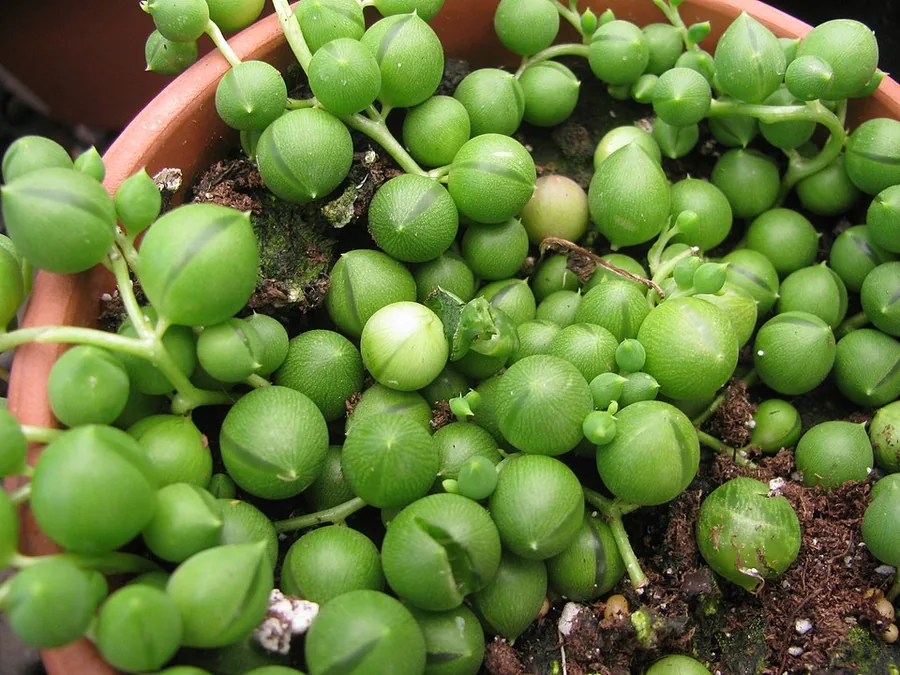
String of pearls is a trailing succulent native to the dry regions of South Africa, where its bead-shaped leaves act as water reservoirs that carry it through long dry spells. Each spherical pearl bears a thin translucent stripe, a small window that channels light to the tissue inside while the plump bead keeps water loss low. In cultivation it is grown almost exclusively as a hanging specimen so the strands can spill over the rim of the basket.
The species sits in the aster family, Asteraceae, the group that includes the daisy, and in summer a mature plant may produce small white flowers with a faint cinnamon scent, though flowering is uncommon indoors. Long cataloged as Senecio rowleyanus, and still sold under that label, it has since been transferred to the genus Curio, and the two names denote one and the same taxon.
Culture turns almost entirely on water management. Turgid pearls signal a well-hydrated plant and shriveled ones signal drought, but the more frequent cause of death is a medium held too wet. Provide bright light and sharp drainage, allow a complete dry-down between irrigations, and the plant will persist for years.
Care
The short version: bright indirect light, a gritty fast-draining medium in a shallow pot, and a full dry-down between thorough irrigations, reduced in winter, with a light spring feeding during active growth.
Light
Site it in bright indirect light, the exposure it receives near a window without direct sun on the beads. It will accept some direct sun once acclimated, but unfiltered midday radiation scorches the pearls, and insufficient light causes the strands to etiolate into thin, bare growth.
Water
Water is the decisive factor. Saturate the medium until it drains, then withhold water until it has dried out completely, applying more in summer and less in winter. The beads deflate under drought, but a medium that stays saturated drives the root rot responsible for most losses of this plant.
Soil
Use a gritty, fast-draining cactus or succulent medium so water does not linger at the roots, the condition that precedes rot. A pH between 6.0 to 8.0 is suitable, and a shallow clay pot aids aeration and speeds drying between waterings.
Temperature
Standard room temperatures suit it, roughly 50°F to 81°F (10°C to 27°C). A cooler rest near the lower end over winter is beneficial, and because the plant has no frost tolerance, keep it indoors once night temperatures fall.
Humidity
Low ambient humidity is what this succulent requires, so misting and pebble trays are unnecessary and counterproductive. Dry air suppresses rot around the stems and beads, which matters more than any added moisture.
Feeding
Nutrient demand is minimal. Apply a dilute balanced or cactus fertilizer lightly in spring during active growth, and withhold feeding entirely through the winter rest.
Pruning
Cut back leggy or bare strands to stimulate denser growth, and pinch overlong stems to maintain form. Because the removed tips root readily, the prunings can be returned to production as new plants.
Repotting
Repot only every one to two years, stepping up to a shallow container rather than a deep one, which the shallow root system favors. Roots crowding the pot, or a medium that dries almost immediately after watering, indicate the plant is ready.
Size & spacing
The strands extend roughly 1 to 3 feet (30 to 91 cm), with the plant spreading to a comparable width. Grown in a hanging basket, the beaded stems trail well below the container.
Troubleshooting
Nearly every disorder in string of pearls originates at irrigation or exposure. The pearls serve as a reliable gauge, softening under drought and going mushy under excess moisture. Read the symptom below and correct the underlying cause before a soft stem progresses to established rot.
Soft, mushy stems with dropping or translucent pearls
Softening, blackening stems and beads that drop or turn translucent are diagnostic of root and stem rot, the leading cause of death in this species, driven by a medium that remains saturated. Cease watering at once, excise the affected tissue, and re-establish healthy stem tips in fresh gritty medium rather than attempting to salvage the parent. Repot the remainder into fast-draining mix in a shallow container.
Fix:
- Stop watering and remove affected mushy sections
- Take healthy unaffected stem cuttings and restart in fresh gritty mix
- Repot into fast-draining cactus mix in a shallow, well-drained container
Wrinkled, soft, deflated pearls
Beads that wrinkle and soften indicate underwatering, and the sign appears once the medium has dried well below the surface and turgor is lost. Irrigate thoroughly until water exits the drainage hole, then allow a full dry-down before the next application. Time watering to the onset of shriveling rather than to a fixed calendar.
Fix:
- Water thoroughly until it drains, then let the mix dry completely before watering again
- Resume a regular dry-down cycle, watering more in summer than winter
Pale, brown, or crispy pearls on the exposed side
Bleached or browned beads on the side facing the window result from sun scorch, the effect of harsh, unfiltered light on unacclimated tissue. The plant wants bright light but not direct midday sun on beads that have not hardened to it, so return it to bright indirect light. When increasing exposure, do so over a week or two to allow gradual acclimation.
Fix:
- Move to bright indirect light
- Acclimate gradually before increasing sun exposure
Toxicity
This is a toxic species and should be sited accordingly. The leaves and sap contain pyrrolizidine alkaloids, so ingestion of the pearls can induce vomiting and lethargy in cats and dogs, while the milky sap irritates skin and the digestive tract. Position it out of reach of pets and children, and wear gloves during pruning.
Toxic to
Cats · Dogs · Horses · Rabbits · Livestock · Birds · People
Cats Toxic
In cats, ingestion of the pearls typically provokes vomiting followed by quiet lethargy. Drooling and loose stools may accompany it, and contact with the sap can leave the mouth sore.
Dogs Toxic
Dogs present much the same picture, with vomiting and reduced energy the predominant signs. A proportion also develop diarrhea after chewing the strands.
Horses Caution
The pyrrolizidine alkaloids characteristic of this genus are hepatotoxic in horses, so the trailing stems should be kept beyond reach. Consumption of the leaves can produce gastrointestinal upset and a dull, off-feed demeanor.
Rabbits Caution
Regard the plant as unsuitable for rabbits. The same alkaloids that affect other species render the leaves a poor and hazardous forage, so prevent any rabbit from grazing the pendant pearls.
Livestock Caution
Cattle, sheep, and goats are susceptible to Senecio-type alkaloids, which accumulate and injure the liver over time. A houseplant rarely reaches livestock, but it should be kept well away from any grazing animal.
Birds Caution
Data on avian sensitivity are sparse, so the prudent course is to keep pet birds away from the strands and restrict foraging to greens of known safety.
People Caution
No part of the plant is edible, and ingestion of the leaves can cause gastric upset. The milky sap also irritates broken skin, so wear gloves when pruning and keep young children from placing the pearls in their mouths.
Wear gloves when handling or pruning, as the sap can irritate skin and cause a rash in sensitive individuals.
Helpline numbers

United States
ASPCA Animal Poison Control: (888) 426-4435 (fee applies)
Poison Control: (800) 222-1222



Canada
Poison Centres: 1-844-764-7669
Varieties
The plain green species dominates cultivation, but a single named selection appears in the trade from time to time.
'Variegata' (variegated string of pearls)
Its spherical beads are marbled in green and creamy white, giving the trailing strands a distinctly paler appearance than the straight species.
How to propagate
String of pearls propagates readily, and routine pruning tends to leave you with surplus strands to root.
Stem cuttingsEasy
Active growth, spring through summer · Roots typically develop at the nodes within a couple of weeks
Stem cuttings are the rapid, dependable means of increase, best taken during active growth from spring through summer. Remove 3 to 4 inch stem tips, strip the lower beads, and lay the exposed nodes on moist gritty medium or bury them shallowly. Adventitious roots form at each buried node within a couple of weeks.
SeedModerate
Not commonly used in cultivation · Slow and uncommon in cultivation; less reliable than cuttings
Seed propagation is feasible but seldom justified in domestic cultivation. The wind-dispersed seeds bear a cottony pappus and are difficult to source in the trade, and they germinate slowly and far less reliably than cuttings, so most growers forgo them.
Myths
Senecio rowleyanus is the botanically correct name for this plant.
That binomial persists on most labels and retail listings, but the species has been reclassified. Kew's Plants of the World Online now accepts Curio rowleyanus, retaining Senecio rowleyanus as a synonym, so the two names refer to a single species.
As a succulent, it thrives on neglect and rarely needs watering.
The reputation understates its requirements. The pearls shrivel under drought, yet the plant rots and collapses quickly in a medium that stays wet, so the requirement is a complete dry-down between thorough waterings, neither sustained drought nor constant moisture.