Houseplant · Asteraceae
String of Bananas
Curio radicans
Supply bright light, a gritty free-draining mix, and dry intervals between waterings, and Curio radicans trails freely over the pot.
Bright indirect
50–77°F · 10–25°C
USDA 10–11
12–35 in · 30–90 cm
Overview
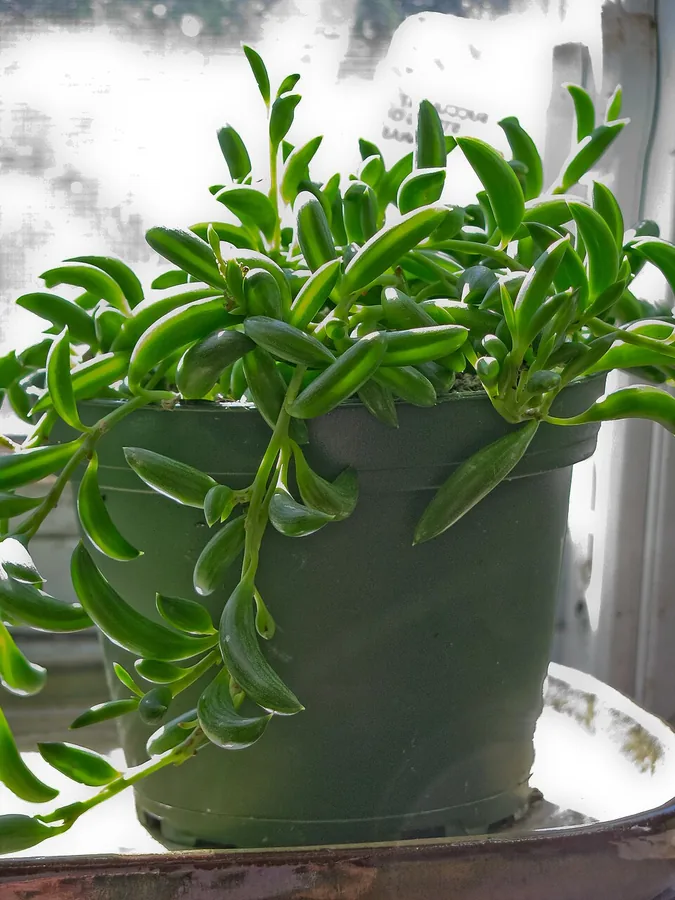
String of bananas, correctly Curio radicans, is a trailing succulent in the daisy family Asteraceae, native to southern Africa. Its common name marks the plump, banana-shaped leaves strung along pendent stems. Grown indoors it establishes fast and tolerates a wide margin of error, which accounts for its popularity.
Each falcate leaf functions as a water-storage organ, and the pale longitudinal stripe is a translucent leaf window that admits light to the photosynthetic tissue within. This internal reserve is the mechanism behind its drought tolerance, and it is also why saturated media are the primary hazard: with water on tap inside the tissue, the plant needs little at the roots and resents standing moisture.
Positioned in a bright window or on an elevated shelf, the stems extend several feet as they mature. The pendent habit is functional as well as ornamental, since it holds the foliage above easy reach, a relevant point because every part is toxic to pets and people on ingestion.
Care
The short version: bright indirect light, a gritty cactus medium that sheds water quickly, and irrigation withheld until the top half of the soil has dried. Reduce watering sharply in winter, and never allow the pot to stand in collected water.
Light
Provide bright, indirect light, the quality found a short distance in from a sunny window. It accepts some direct morning sun and a degree of shade, but intense afternoon radiation exceeds what the leaf surface can dissipate and scorches the tissue brown.
Water
Irrigate only once the top half of the soil has dried, then water thoroughly and let the surplus drain. Because this drought-adapted succulent is highly susceptible to rot in persistently wet media, cut back almost entirely in winter and apply only enough to keep the leaves from shriveling.
Soil
Grow it in a gritty, fast-draining cactus or succulent mix, whose open structure lets water pass before the roots sit wet. It is indifferent to acidity across pH 6.0 to 8.0, but a dense, water-retentive medium around the roots is poorly tolerated and predisposes it to rot.
Temperature
Ordinary interior temperatures suit it, with an optimum of 50°F to 77°F (10°C to 25°C). Keep it above freezing and clear of cold drafts, as the tissue has no frost tolerance.
Humidity
This is a low-humidity species adapted to dry indoor air, so misting and humidity management are unnecessary. Damp, poorly ventilated conditions are counterproductive and favor rot rather than growth.
Feeding
Fertilize sparingly through spring and summer during active growth, at roughly monthly intervals, using a diluted balanced or cactus formulation. Withhold feed over winter, when metabolic activity and growth decline.
Pruning
Cut back leggy or bare stems to redirect growth into a fuller habit, and pinch the tips to shape the plant. Retain the removed material, since each segment is a viable cutting that will root readily.
Repotting
Repot infrequently, every 2 to 3 years or once genuinely congested, because a slightly restricted root run favors both flowering and steady growth. Indications that the interval has elapsed include roots emerging at the drainage holes and a substrate that dries almost immediately after irrigation.
Size & spacing
Mature trailing stems reach 12 to 35 inches (30 to 90 cm) and spread to a comparable width beyond the container. Allow the strands to hang unobstructed from a shelf or basket so they neither tangle nor mat against a surface.
Troubleshooting
The great majority of disorders in this species are moisture-related, from deficit at one extreme to excess at the other, and the turgor of the leaves reports the imbalance quickly. Learn to interpret that signal. Identify the presentation below and correct it before a reversible wrinkle progresses to rot.
Mushy, blackened stems collapsing at the base
Softening and basal blackening signal root rot, the disorder most likely to prove fatal, and it develops where excess water lingers around the roots. Suspend irrigation, allow the medium to dry completely, then lift the plant and excise all brown, softened tissue. Secure several firm stem cuttings and re-establish them in fresh gritty mix before the rot advances further.
Fix:
- Stop watering and let the mix dry out
- Unpot and cut away rotted roots and stems
- Take healthy stem cuttings and restart in fresh gritty mix
- Repot into fast-draining cactus medium in a pot with drainage
Shriveled, wrinkled leaves with lost turgor
Loss of turgor and wrinkling indicates simple water deficit. The leaves serve as reservoirs, so once the substrate dries completely they collapse inward and deflate. Irrigate thoroughly until water exits the base, and turgor typically returns within a day or two.
Fix:
- Water thoroughly until it drains from the bottom
- Resume watering whenever the top half of the soil is dry
- Ensure the pot has drainage and the mix is not hydrophobic
Brown or reddish scorch on sun-exposed leaves
Brown to reddish discoloration on the exposed face is sunburn from excessive irradiance. Beads oriented toward the glass scorch first under intense or afternoon sun, which overwhelms the leaf. Relocate to bright indirect light, screen it from the strongest midday exposure, then re-acclimate to higher light in stages.
Fix:
- Move to bright indirect light
- Shade from intense afternoon summer sun
- Acclimate gradually before increasing light
Toxicity
Site this plant beyond the reach of animals and children. The whole plant contains pyrrolizidine alkaloids together with an irritant milky latex, so it is toxic to cats and dogs and hazardous to other animals and to people if ingested. Suspend it high, and wash your hands after any pruning to avoid contact dermatitis.
Toxic to
Cats · Dogs · Horses · Rabbits · Livestock · Birds · People
Cats Toxic
A cat that ingests the stems commonly presents with hypersalivation, vomiting, and inappetence. Diarrhea and lethargy tend to follow, and a large quantity places measurable strain on the liver.
Dogs Toxic
Dogs exhibit an equivalent response. Expect vomiting, loose stools, drooling, and marked lethargy in an animal that has been browsing the trailing stems.
Horses Toxic
The same pyrrolizidine alkaloids occur throughout the genus, so a grazing horse develops gastrointestinal upset, and repeated ingestion carries a substantiated risk of cumulative liver damage.
Rabbits Caution
No rabbit-specific data are recorded, but the alkaloids act across mammalian species, so the plant should be regarded as unsafe. A rabbit that samples it may develop gastrointestinal upset and reduced activity.
Livestock Toxic
Cattle and comparable grazers are listed among susceptible animals. The alkaloids accumulate with sustained browsing and can produce hepatic scarring, in addition to the nausea and dullness of a single feeding.
Birds Caution
Birds have not been assessed for this species, so exclusion is the prudent course. The irritant latex and alkaloid content give no basis to expect tolerance of ingestion.
People Caution
No part of the plant is edible. Ingestion may cause nausea and gastric upset, and the milky latex can redden or irritate skin, so wash your hands following any pruning.
Wear gloves or wash hands after handling, as the irritant sap can cause contact dermatitis.
Helpline numbers

United States
ASPCA Animal Poison Control: (888) 426-4435 (fee applies)
Poison Control: (800) 222-1222



Canada
Poison Centres: 1-844-764-7669
Varieties
Named selections are few in this species, though one appears in cultivation often enough to warrant identification.
Curio radicans 'Fish Hooks'
Selected for its markedly recurved, hook-shaped leaves, this cultivar is the source of the vernacular name string of fishhooks.
How to propagate
Propagation is straightforward, and the very material removed during routine trimming supplies ready cuttings for new plants.
Stem cuttingsEasy
Spring through summer during active growth · About 2 to 4 weeks to root
Stem cuttings are the standard and most reliable method. During active growth in spring or summer, sever stems, allow the cut surfaces to dry and callus for a day to limit rot, then lay or insert them on a gritty, fast-draining medium. Held lightly moist, they typically root in 2 to 4 weeks.
SeedModerate
Spring · Several weeks to months
Seed is viable but slow and seldom justified against cuttings. Sow in spring on a fast-draining medium and maintain warmth to promote germination, allowing several weeks to months before seedlings reach a size worth potting on.
Myths
Senecio radicans is the botanically correct name.
Under current taxonomy, Kew's Plants of the World Online accepts Curio radicans and relegates Senecio radicans to synonymy. Commercial labeling has not caught up and the Senecio name persists in trade, but Curio radicans is the accepted name.