Houseplant · Asteraceae
String of Dolphins
Curio × peregrinus
A trailing Curio succulent that reads its own thirst: give it bright, indirect light, water sparingly, and the dolphin leaves spill down the pot.
Bright indirect
50–77°F · 10–25°C
USDA 9–12
12–35 in · 30–90 cm
Overview
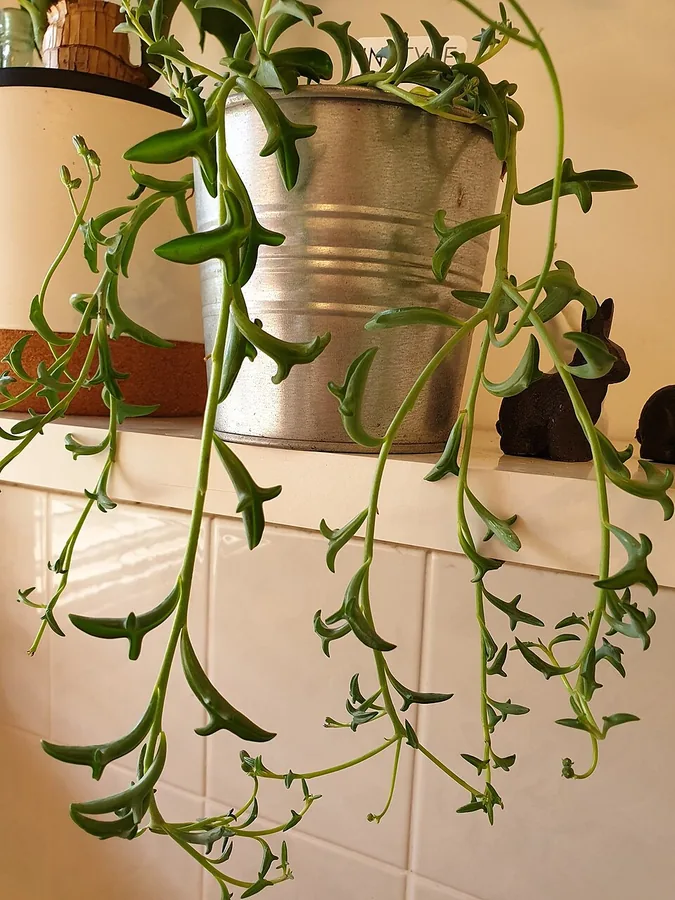
String of dolphins is a trailing succulent grown for its leaves, which curl into the profile of a leaping dolphin. It belongs to the Asteraceae, the daisy family, and it is a cultivated hybrid rather than a wild species: a cross between string of pearls and candle plant. The trailing stems reach 12 to 35 inches (30 to 90 cm), draping over the rim of a pot.
Its reputation as an easy plant follows from its succulent habit. Water stored in the leaves lets it ride out dry spells that would finish a thinner-leaved houseplant, so bright, indirect light and a fast-draining gritty mix meet most of its needs. The exception is standing moisture, which the plant cannot tolerate, because a wet mix around the base is precisely what triggers stem rot.
Growing it high, in a hanging basket or on an elevated shelf, suits both the plant and the household. The pendent stems display best when they can fall freely, and the height also keeps the mildly toxic foliage clear of pets and children that might chew it.
Care
The short version: bright, indirect light, a gritty cactus mix in a container that drains, and watering held back until the leaves begin to look slightly shriveled.
Light
Provide bright, indirect light for most of the day, near a window but screened from direct midday sun, which is strong enough to scorch the leaves. A little morning sun is tolerated. In low light the plant etiolates, the stems stretching thin and pale as they reach for the source, and the dolphin form blurs.
Water
Water lightly during active growth and then let the gritty mix dry completely, since the roots need air between drinks. The plant signals thirst by degrees, its leaves beginning to look slightly shriveled as stored water is spent. In winter, when growth stalls, water barely if at all, because cold combined with a wet mix is the classic setup for rot.
Soil
Use a gritty, fast-draining cactus or succulent mix so water passes through rather than lingering at the roots. The plant is indifferent to pH across 6.0 to 8.0, which means drainage, not soil chemistry, is the variable that determines whether it thrives.
Temperature
Ordinary indoor warmth of 50°F to 77°F (10°C to 25°C) suits it throughout the year, which is why most homes hold it without adjustment. It carries no frost hardiness, so bring it well indoors before temperatures fall.
Humidity
Humidity is a non-issue. The plant is adapted to dry air and prefers the low end, so there is no target reading to meet and no reason to mist, a practice that would only raise the moisture that encourages rot.
Feeding
Feed once a month across the growing season, from spring into early autumn, with a half-strength general-purpose liquid fertilizer; the dilution matches a succulent's modest appetite. Withhold feed in winter, when growth slows and the plant is not using it.
Pruning
Trim the trailing stems with scissors to hold the shape or drive bushier growth, and the plant recovers quickly from cutting. Because the cut sap can irritate skin, wear gloves while you work.
Repotting
Repot every 1 to 2 years, or sooner if roots crowd the surface or emerge from the drainage holes. Increase the pot by a single size and insist on drainage, since an oversized container holds a reservoir of moisture the roots do not want and rot readily in.
Size & spacing
The stems trail 12 to 35 inches (30 to 90 cm) and spread to a comparable width. A single specimen in its own hanging pot lets the dolphin-shaped leaves cascade without crowding or tangling into neighboring plants.
Troubleshooting
Almost every problem here traces to water, and it runs in two directions. Too little leaves the succulent depleted and shriveled, while too much saturates the mix and rots the stems. Identifying which way the plant is failing is the whole diagnosis, so read the symptom before adjusting the watering.
Soft, blackened stems collapsing at the base
The cause is rot, driven by a mix that stays wetter than a succulent can handle. The stems soften at the soil line, the base blackens, and a sour odor typically accompanies the collapse. Stop watering, excise every soft stem and root, and restart from clean cuttings in a gritty mix, moving the plant to a clay pot whose porous walls speed evaporation.
Fix:
- Stop watering and let the mix dry out
- Remove and discard rotted stems and roots
- Take healthy stem cuttings to propagate and start fresh in a gritty, fast-draining mix
- Repot into a clay pot with drainage to improve evaporation
Shriveled or etiolated leaves losing the dolphin form
One appearance, two mechanisms. When the mix runs bone-dry, the leaves spend their stored water and pucker; when light is too weak, the stems etiolate, drawing out thin and pale until the leaf shape is lost. Water thoroughly at the first shriveling, relocate to brighter, indirect light, and cut back the elongated growth so compact shoots replace it.
Fix:
- Water thoroughly when leaves begin to shrivel, then let the mix dry completely again
- Move to a brighter spot with bright, indirect light
- Trim leggy, distorted stems to encourage compact new growth
Toxicity
Handle this plant as toxic. Its tissues carry pyrrolizidine alkaloids along with an irritant sap, a profile inferred from its Curio parentage, which makes it hazardous to cats and dogs and unsuitable around other pets, livestock, and young children. No part is edible, and the sap can inflame skin on contact, so wear gloves during any pruning.
Toxic to
Cats · Dogs · Horses · Rabbits · Livestock · Birds · People
Cats Toxic
A cat that chews the stems typically vomits, develops diarrhea, drools, and grows lethargic. The response reflects the pyrrolizidine alkaloids in the tissue, so position the plant beyond jumping height.
Dogs Toxic
In dogs the same pyrrolizidine alkaloids produce vomiting, loose stools, and lethargy, and the bitter, irritant sap can leave the mouth sore. Keep the trailing stems out of reach.
Horses Toxic
Horses are listed among the susceptible species. Beyond acute digestive upset, the pyrrolizidine alkaloids in these Curio succulents are hepatotoxic, accumulating in the liver over repeated grazing.
Rabbits Toxic
A rabbit's digestive tract responds to the same alkaloids that affect cats and dogs, so the plant is not a safe browse. Keep the strands out of the hutch and off the floor.
Livestock Toxic
Grazing livestock are at risk because pyrrolizidine alkaloids accumulate in the liver with repeated intake. Fence the plant away and remove any fallen trimmings.
Birds Caution
The toxic constituents in the foliage make the plant a poor choice around pet birds, which should be treated as unable to eat it. Suspend it where beaks cannot reach.
People Caution
No part of the plant is edible, and ingestion can upset the stomach. The sap is a skin irritant, so prune with gloves and keep young children from handling the strands.
Wear gloves when pruning or handling cut stems, as the milky/irritant sap can irritate skin.
Helpline numbers

United States
ASPCA Animal Poison Control: (888) 426-4435 (fee applies)
Poison Control: (800) 222-1222



Canada
Poison Centres: 1-844-764-7669
Varieties
There is a single form to know. String of dolphins is propagated and sold as one hybrid, not a range of named cultivars, so the entry below covers it.
Curio × peregrinus (typical String of dolphins)
This is the type hybrid, distinguished by curved, branched leaves that arch like a pod of leaping dolphins, resembling string of pearls except for the forked leaf form inherited from the cross.
How to propagate
Propagation is straightforward because the stems root from their nodes. Two node-based methods work, and each needs only scissors and a gritty rooting mix.
Stem cuttingsEasy
Spring to summer during active growth · Roots in about a month
Take stem cuttings 3 to 4 inches (8 to 10 cm) long in spring or summer during active growth, strip the lower leaves to expose the nodes, and set those bare nodes in contact with a moist, gritty mix. Roots emerge readily from the nodes, and a cutting establishes within about a month.
LayeringEasy
Spring to summer · About a month to root
Layering exploits the same node-rooting response without detaching the stem. Pin a trailing stem against the compost so its nodes meet the surface, leave it fed by the parent while roots form over roughly a month, then sever it once it has anchored.
Myths
String of dolphins occurs as a wild species in nature.
No wild population exists. It is a cultivated hybrid, Curio x peregrinus, produced by crossing string of pearls (Curio rowleyanus) with candle plant (Curio articulatus), and that parentage accounts for the leaping-dolphin curvature of its leaves.