Houseplant · Crassulaceae
String of Buttons
Crassula perforata
Bright light and a fast-draining gritty mix are what let this Crassula stack its leaves into neat, upright towers.
Bright indirect
50–77°F · 10–25°C
USDA 9–11
8–18 in · 20–45 cm
Overview
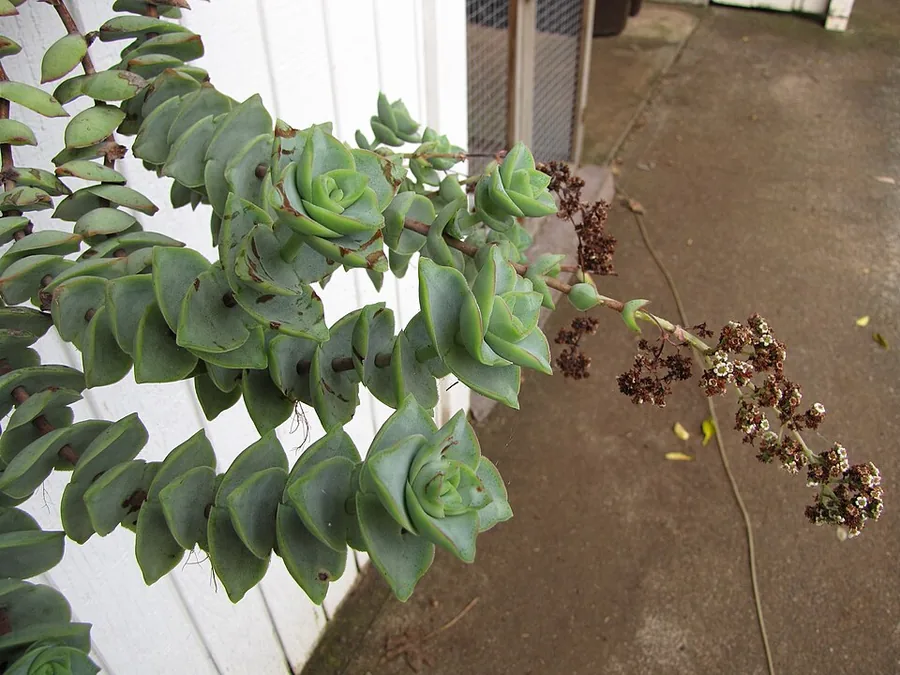
String of buttons, botanically Crassula perforata, is a trailing succulent whose triangular leaves are threaded along the stem in stacked pairs, the trait behind its common name. It belongs to the Crassulaceae, the family of jade and stonecrop, and holds a modest 8 to 18 inches (20 to 45 cm) indoors. Adequate light preserves the tight internode spacing that gives the plant its geometric form.
The species rates as an easy succulent because its needs are few: strong light and disciplined watering. Its leaves function as water-storage organs, which is why the growing medium must dry completely before the next irrigation. In spring it produces small star-shaped flowers in pale yellow to white, a modest floral display above the foliage.
Under good culture the stems branch and trail, spreading to roughly 12 to 24 inches (30 to 60 cm) and cascading over the rim of a pot or basket. Reduce the light and the internodes elongate, the stems lean toward the source, and the stacked habit gives way to a loose, leggy form. Light, more than any other factor, governs whether the plant stays compact.
Care
The short version: supply bright light, a gritty fast-draining medium, and water only after the soil has dried through. Hold it warm, curb watering in winter dormancy, and the plant is largely self-sufficient.
Light
Provide bright light, ideally bright indirect exposure supplemented by a few hours of direct sun. Fully hardened plants tolerate full sun, but under low light the internodes elongate and the stacked architecture degrades. Light drives the compact habit, so err toward more of it.
Water
Allow the medium to dry out completely between waterings, since the leaves already hold a stored reserve. Reduce watering through winter dormancy, when growth slows and uptake falls. The species is highly rot-prone in saturated soil, so withholding water is the safer error.
Soil
Use a gritty cactus or succulent mix that sheds water in seconds rather than minutes. A slightly acidic pH of 6.0 to 6.5 suits it, and the coarse grit prevents the roots from remaining wet, the principal cause of rot.
Temperature
Hold the plant within 50°F to 77°F (10°C to 25°C), its comfortable range. It is not frost-hardy, so relocate it to warmth before temperatures fall, since cold damages the succulent tissue.
Humidity
Low ambient humidity suits this succulent, so no target figure applies. Dry air and good airflow limit the surface moisture that would otherwise invite rot.
Feeding
Fertilize only in spring and summer, the active growth period, with a diluted balanced or low-nitrogen succulent feed. A light seasonal application meets its needs; excess nitrogen produces soft, weak growth prone to collapse.
Pruning
Pinch or trim leggy, stretched stems to stimulate branching and a denser, stacked habit. The removed segments root readily, so pruning doubles as a source of propagation material.
Repotting
Repot every 2 to 3 years, or once the plant is crowded, in spring at the start of active growth. Indications include roots emerging from the drainage holes, unusually rapid drying of the medium, and a top-heavy plant straining at the pot edges.
Size & spacing
Indoors the plant reaches about 8 to 18 inches (20 to 45 cm) tall and trails to roughly 12 to 24 inches (30 to 60 cm) wide. Allow space for the stems to cascade, or site it in a hanging container so the stacked growth can drape.
Troubleshooting
Most disorders in string of buttons resolve to a single variable, light or water. Deficient light drives etiolation and stem elongation, excess water in slow-draining soil promotes root rot, and an abrupt increase in sun scorches unacclimated foliage. Identify the pattern below, since the correction is usually a modest change in culture.
Yellow, mushy leaves and a soft base
Translucent, softened leaves and a dark, collapsing stem base indicate root rot, the result of excess water held in poorly draining soil. Cease watering and allow the system to dry. Where the base is already compromised, unpot the plant, excise the brown, slimy roots, and repot the firm tissue in fresh gritty mix, or take cuttings from any tissue that remains sound.
Fix:
- Stop watering and let soil dry fully
- Unpot, cut away rotted roots and stems, and repot healthy portions in fresh gritty mix
- Take cuttings from firm growth if the base is lost
Stems stretching out and losing their stacked shape
This is etiolation, the physiological stretch response to inadequate light. New growth emerges pale and elongated as internodes lengthen, and the stem angles toward the brightest source. Relocate the plant to substantially brighter light, then prune the drawn stems and root the cuttings to regenerate compact, stacked growth.
Fix:
- Move to a brighter spot with several hours of direct or very bright indirect light
- Prune stretched stems and root the cuttings to restart compact growth
Brown or reddish scorch marks on the leaves
These lesions are sunburn, which develops when unacclimated tissue meets strong direct sun. The damage concentrates on the surfaces exposed to the light, typically following a move outdoors or to a hot window. Return the plant to bright indirect light, remove the worst leaves, and reintroduce direct sun gradually over a week or two.
Fix:
- Move to bright indirect light and remove badly damaged leaves
- Reintroduce direct sun gradually over one to two weeks
Toxicity
For pet-owning households the assessment is favorable: string of buttons is generally regarded as non-toxic and safe. A cat, dog, or rabbit that samples a leaf should experience no ill effect. The foliage remains an ornamental succulent rather than food, so tasting warrants no encouragement, but the species requires no special containment.
Safe for
People · Cats · Dogs · Horses · Rabbits · Livestock · Birds
Cats None
String of buttons is classed as non-toxic to cats, so an exploratory bite presents no expected hazard.
Dogs None
The species carries no recognized toxicity for dogs, and a chewed leaf should produce no clinical signs.
Horses None
No toxic effect is documented in horses for this plant.
Rabbits None
Rabbits are unaffected, since the foliage contains no compounds known to be toxic to them.
Livestock None
Grazing stock such as goats and sheep incur no known toxicity from this succulent.
Birds None
The plant presents no recognized risk to companion birds.
People None
For humans the tissue is non-toxic, though it is an ornamental succulent and not intended for consumption.
Helpline numbers

United States
ASPCA Animal Poison Control: (888) 426-4435 (fee applies)

United Kingdom
Animal PoisonLine: 01202 509000 (fee applies)

Australia
Animal Poisons Helpline: 1300 869 738
Varieties
Commerce offers mostly the plain green species, yet one named cultivar merits attention.
Crassula perforata 'Variegata'
Under bright light its foliage develops creamy-yellow to pinkish variegation with a pink flush along the leaf margins.
How to propagate
String of buttons propagates readily, and a single specimen yields ample cutting material to establish additional pots or to distribute.
Stem cuttingsEasy
Spring through summer during active growth · 2 to 4 weeks to root
Stem cuttings are the most efficient method. Sever a stem segment during spring or summer, allow the cut surface to callus over for a day or two to seal against rot, then place it on or in gritty mix. Rooting follows in roughly 2 to 4 weeks.
Leaf cuttingsModerate
Spring through summer · 4 to 8 weeks to root and sprout
A single leaf can also serve as propagation material, though the method is slower and less certain. Detach an intact, healthy leaf, let it callus, and rest it on dry succulent mix in spring or summer. Expect 4 to 8 weeks to root and sprout, at a lower success rate than stem cuttings.
Myths
String of buttons must be poisonous because it looks like other toxic succulents.
Crassula perforata is generally classified as non-toxic and safe around cats and dogs. Many succulents do contain toxic compounds, so the family's cautious reputation has a basis, yet this species falls outside that group. The leaves are best regarded as ornament rather than food, though an incidental nibble carries no real risk.