Ornamental · Asteraceae
Strawflower
Xerochrysum bracteatum
Site it in full sun with sharp drainage, and the strawflower yields papery bracts that persist well past the growing season.
Full sun
75–90 days
USDA 8–10
1–5 ft · 0.3–1.5 m
Overview
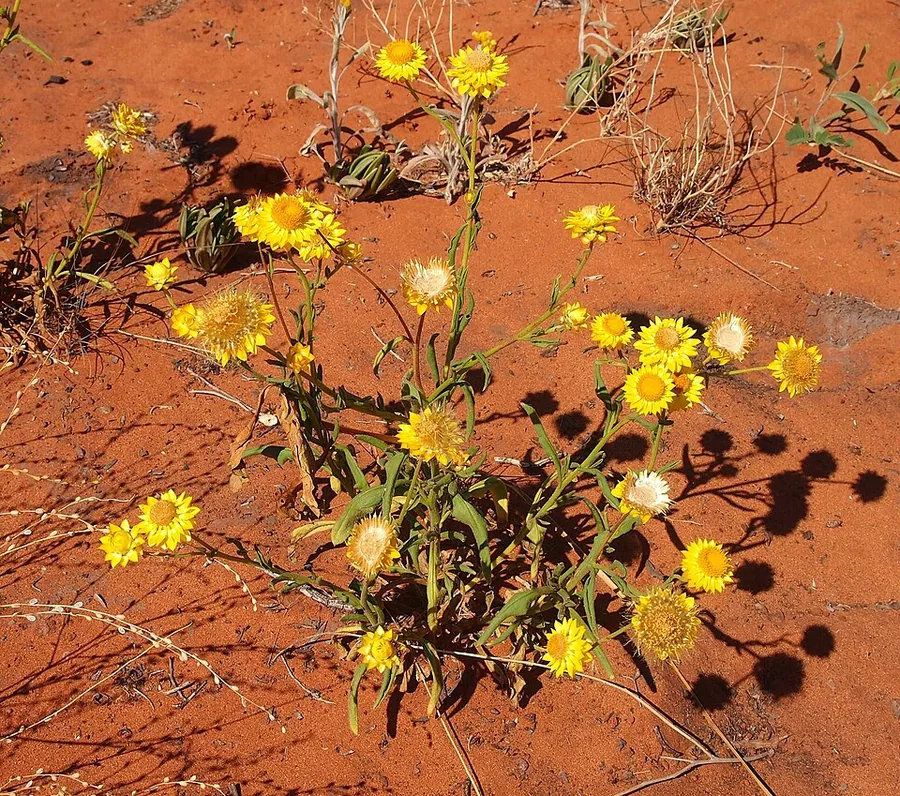
The strawflower, or golden everlasting, reveals its defining trait on contact: the showy structures are not petals but stiff, papery bracts that crackle to the touch and retain pigment for months after cutting. A member of the daisy family native to Australia, the species performs across most garden sites as a warm-season annual.
Cultural demands are modest. Full sun, free-draining ground, and established roots let it withstand heat and extended dry periods with little intervention. Flower color spans gold, bronze, pink, and white, and the open heads draw bees and butterflies through the summer.
Its chief value lies in the cutting garden. Harvest the stems while the bracts remain partly closed and dry them inverted, and the result is everlasting material that holds form and color for winter arrangements long after the parent plant has finished outdoors.
Care
The short version: full sun and free-draining soil held on the dry side. Irrigate only after the surface dries, deadhead to sustain flowering, and stake the taller selections before they lodge.
Light
Provide full sun, six or more hours daily, for the strongest performance. Light afternoon shade is tolerated, but insufficient light causes the stems to etiolate and lean and sharply reduces the yield of papery blooms.
Water
Allow the top half of the soil to dry between irrigations. The plant is drought tolerant once established, so the principal error is overwatering, which triggers root rot. Average to dry soil suits its physiology far better than saturated ground.
Soil
Use well-drained loam of average fertility. It accommodates a wide pH range from 5.5 to 8.0 and tolerates the dry, low-nutrient conditions that limit less adaptable species. Drainage is the governing factor, not fertility.
Humidity
Ambient outdoor humidity is adequate, so no target value applies. The operative factor is air movement, since still, humid air within a crowded planting creates the leaf-surface conditions that favor mildew.
Feeding
As a light feeder, the plant performs well in average soil and needs little input. A balanced general-purpose fertilizer applied monthly through the growing season is sufficient, and higher rates yield no benefit.
Pruning
Deadhead spent blooms as they fade to prolong flowering, since removing them redirects the plant from seed set back into new bloom. A light pinch on young plants encourages a bushier, sturdier framework, and taller forms may require staking.
Size & spacing
Mature height ranges by cultivar from 12 inches to a towering 1 to 5 feet (30 to 152 cm), with a spread of 6 to 18 inches (15 to 45 cm). Space plants so air circulates freely between them.
When to plant
The strawflower demands warmth and will not survive frost, which sets the schedule. Sow under cover in early spring, transplant only once frost risk has passed and the soil has warmed, and expect flowering from early summer until the first autumn frost terminates the display.
Northern hemisphere
Southern hemisphere
Typical months for a temperate climate: start earlier in warm zones, later where spring frosts linger.
- Sow: 6 to 8 weeks before the last spring frost; do not cover seed, as light aids germination
- Plant: After the last frost when soil has warmed
- Harvest: Blooms summer to fall (about June until frost); harvest for drying when bracts are partly open
Hardiness
USDA hardiness zones: 8–10
Temperature: down to -12°C
Troubleshooting
Sited correctly, the strawflower is largely trouble-free, and most disorders trace to excess moisture or restricted air movement. Read the early symptoms on foliage, stems, and roots, and intervene before a minor problem escalates.
Collapse and yellowing with soft decay at the crown
A plant that wilts while the soil remains saturated points to root rot, the predictable result of overwatering or poor drainage. Waterlogged soil starves the roots of oxygen, they darken and turn mushy, and once damaged they can no longer conduct water, so the top collapses despite the moisture below. Withhold irrigation and let the profile dry, then correct the drainage or relocate the plant to ground that does not hold water.
Fix:
- Stop overwatering and let soil dry
- Improve drainage or move to a better-drained site
A white powdery or downy layer coating the foliage
That layer is powdery or downy mildew, a fungal infection favored by two conditions the record names: stagnant air and foliage that stays wet. Both raise humidity right at the leaf surface, which is where the spores germinate. Thin or respace the planting to restore air movement, direct water to the soil so leaves dry fast, and remove the colonized foliage. A full-sun, open position denies the fungus the still, damp microclimate it depends on.
Fix:
- Improve spacing and air flow
- Water at the soil line and avoid wetting foliage
- Remove and discard affected leaves
Leaning, lodging stems on the taller selections
The taller cultivars carry their flower mass high on the stem, making them top-heavy, so wind or the added weight of rain-soaked blooms levers them over. Set stakes early, while the stems are still short and can be trained upright. Pinching young plants also helps, because removing the growing tip promotes lateral branching and a lower, more self-supporting habit.
Fix:
- Stake or provide support for tall plants
- Pinch young plants to promote sturdier branching
Toxicity
For households with pets or children, the record is reassuring: the strawflower is non-toxic in all parts. The ASPCA lists it as safe for cats, dogs, and horses, and the same status extends to rabbits, livestock, birds, and people. Incidental ingestion presents no risk of poisoning.
Safe for
People · Cats · Dogs · Horses · Rabbits · Livestock · Birds
Cats None
Non-toxic to cats. The ASPCA classifies the strawflower as safe, so investigative nibbling will not induce poisoning.
Dogs None
No toxic risk to dogs. Ingesting leaf or flower tissue causes no poisoning, though a large volume of any foliage can still irritate a sensitive digestive tract.
Horses None
Safe for horses. The species carries the non-toxic classification, so grazing in its vicinity presents no hazard.
Rabbits Safe
Rabbits may browse it without consequence, as the plant contains no compounds toxic to them.
Livestock Safe
Cattle, goats, and sheep can graze the same ground safely, since the plant holds no toxins that affect ruminant stock.
Birds Safe
Birds face no hazard from it, whether they take the seed heads or move through the stand.
People Safe
Non-toxic to people. The papery inflorescences are prized for drying, and routine handling poses no risk to children.
Varieties
Selections range from dwarf forms to specimens near three feet, so height alone can guide the choice. The named cultivars below are worth sourcing.
Bright Bikini
A dwarf strain topping out near 15 inches across a mixed color range, which suits it to container culture.
Dargan Hill Monarch
A grey-foliaged cultivar bearing large golden-yellow flower heads.
Kimberly Sunset
A further grey-foliaged selection distinguished by soft pink flowers.
Kingsize Mixed
Selected for enlarged blooms on plants attaining roughly 3 feet in height.
How to propagate
The strawflower propagates readily from seed or from stem cuttings, and the appropriate method follows from the objective: seed for variety, cuttings for genetic fidelity.
SeedEasy
Start indoors 6 to 8 weeks before last frost; surface-sow as light aids germination · Germinates in roughly 1 to 3 weeks; blooms within the first season
Seed is the standard method, sown indoors 6 to 8 weeks before the last frost. Because germination is light-dependent, surface-sow and leave the seed uncovered; it will emerge in about 1 to 3 weeks. Transplant the seedlings after frost has passed and they flower within the first season.
Stem cuttingsEasy
During active growth in the growing season · Several weeks to root
Vegetative propagation by cuttings preserves a named cultivar true to type. Take the cuttings during active growth and allow several weeks for roots to form; the resulting plant is genetically identical to the parent, unlike the variable progeny that seed produces.
Myths
Strawflowers are true everlasting flowers that never fade or die.
The common name overstates the biology. What persists is the involucre of stiff papery bracts, which retains color and form for an extended period once dried and accounts for the everlasting epithet, whereas the living plant is short-lived and grown as an annual. The dried structure endures; the organism does not.
You can save seed from a favorite cultivar and get identical plants.
Because named cultivars do not come true from seed, saved seed segregates into variable offspring rather than reproducing the parent phenotype. To preserve a specific selection, propagate it vegetatively by stem cuttings instead of collecting seed.