Ornamental · Asteraceae
Stokes Aster
Stokesia laevis
A resilient southeastern native that carries fringed blue flower heads through the summer with minimal input.
Full sun
Every 5–10 days
USDA 5–9
12–24 in · 30–61 cm
Overview
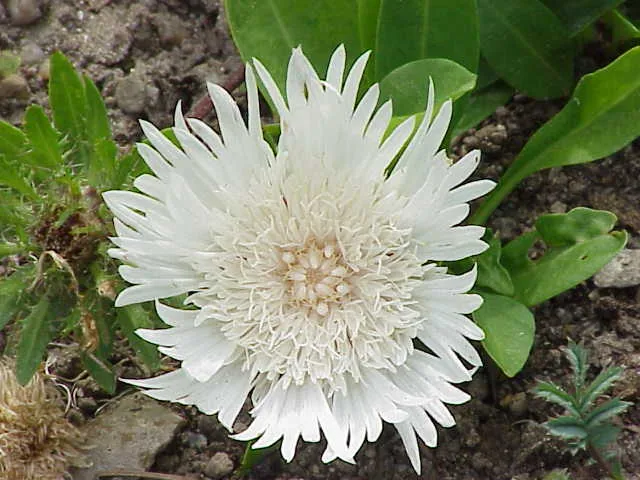
Stokesia laevis is a clump-forming herbaceous perennial native to the southeastern United States, its genus commemorating the botanist Jonathan Stokes. The fringed, daisy-like flower heads present in lavender-blue, white, and creamy yellow above a basal rosette of glossy, strap-shaped foliage. Despite its refined appearance, the species tolerates the heat and humidity that check less adaptable perennials.
Flowering is the plant's principal ornamental asset. Individual heads reach up to 5 inches (13 cm) across from early summer, and prompt removal of spent blooms extends the display while sustaining nectar for bees and butterflies. The evergreen rosette persists through mild winters, giving the plant structural presence outside the flowering period.
Cultural demands are modest once the plant is established: full sun, competent drainage, and periodic division supply nearly all of its requirements. Its single critical intolerance is saturated soil during winter dormancy, the factor that most often separates a colony that expands over years from one lost to crown rot.
Care
The short version: site Stokesia in full sun and average, well-drained soil, supply consistent moisture across the growing season, and keep the root zone dry through winter, because cold, saturated soil is the principal cause of death.
Light
Full sun produces the firmest stems and the heaviest flowering, since ample light promotes short, self-supporting growth. Partial shade is tolerated, but in excessive shade the plant stretches, lodges, and flowers sparingly.
Water
Maintain average to medium moisture through the growing season, irrigating roughly every 5 to 10 days when rainfall is insufficient. Drainage outweighs frequency here, because it is prolonged winter saturation, rather than an occasional dry spell, that proves fatal.
Soil
Average, well-drained soil best supports the species, which also accommodates sandy substrates and transient wetness during active growth. Hold the pH between 5.5 and 7.0, and correct impeded drainage before addressing any other cultural detail on a wet site.
Temperature
As a cold-hardy perennial, it withstands roughly -20°F to 95°F (-29°C to 35°C) and performs dependably across USDA zones 5 through 9. Southern heat and humidity are tolerated without stress, while a winter mulch buffers the crown at the colder margin of its range.
Humidity
Ambient outdoor humidity poses no difficulty, so no target range applies. Air movement is the more consequential factor, drying the foliage and reducing conditions that stress the crown.
Feeding
Fertility requirements are low. A single balanced spring feeding, or an equivalent compost topdressing, meets the plant's needs, and excess nitrogen only produces soft, lodging-prone stems.
Pruning
Deadheading spent heads prolongs bloom and removes tissue that would otherwise senesce, while trimming tattered foliage maintains appearance. Lifting and dividing the clump every few years restores vigor as the center ages.
Repotting
Container specimens warrant repotting only when they exhaust the pot or when a congested crown suppresses flowering. In the ground, division every 3 to 4 years serves the same rejuvenating function.
Size & spacing
Mature plants stand 12 to 24 inches (30 to 61 cm) tall with a spread of 12 to 18 inches (30 to 46 cm). Spacing at approximately that distance sustains air circulation and allows each clump to develop fully.
When to plant
Stokesia is governed by a warm-season rhythm. Sow indoors in late winter, transplant after the last frost in spring, and expect the fringed heads from early summer into July, with a frequent second flush in fall once temperatures ease.
Northern hemisphere
Southern hemisphere
Typical months for a temperate climate: start earlier in warm zones, later where spring frosts linger.
- Sow: Late winter to early spring (about 6-8 weeks before last frost)
- Plant: Spring after danger of frost has passed
- Harvest: Early to mid summer (May to July), sometimes reblooming into fall
Hardiness
USDA hardiness zones: 5–9
Temperature: down to -29°C
Troubleshooting
Stokesia laevis is regarded as essentially problem-free, so the few disorders it shows are easily diagnosed. Lodging stems and caterpillar damage are cosmetic, whereas winter crown rot is lethal. Identify the symptom below and prioritize the serious one.
Failure to re-emerge following a wet winter
A plant that does not re-emerge in spring has almost certainly succumbed to crown rot, the leading cause of loss in this species. Roots and crown held in saturated cold soil turn soft and dark, after which the plant collapses or fails to break dormancy. Excise the rotted crowns, then reconstruct drainage with a raised bed or slope and apply winter mulch in colder zones.
Fix:
- Improve drainage by amending soil or planting on a raised bed or slope
- Remove and discard rotted crowns
Lodging stems after heavy rainfall
Lodging follows when top-heavy flower heads load the stems with absorbed rain or wind. Shade and excessive fertility compound it by producing soft, drawn-out growth that never firms sufficiently. Relocate the plant to full sun, restrain feeding, and install grow-through support beneath taller cultivars ahead of flowering.
Fix:
- Provide light staking or grow-through support for tall cultivars
- Site in full sun to promote sturdier stems
- Avoid over-fertilizing
Perforated, ragged leaf margins
Perforated foliage accompanied by frass indicates caterpillar feeding. The damage is largely aesthetic, since the plant tolerates light defoliation while continuing to support pollinators. Remove caterpillars by hand and disregard incidental grazing.
Fix:
- Handpick caterpillars
- Tolerate minor feeding as the plant supports pollinators and is generally pest-free
Toxicity
For households with pets and children, the record is unambiguous: Stokesia laevis is without reported toxicity. No extension or botanical authority classifies it as poisonous, and none document dermatitis, so it may be sited wherever animals or children have access.
Safe for
People · Cats · Dogs · Horses · Rabbits · Livestock · Birds
Cats None
No toxicity is documented for cats, so an exploratory nibble carries no risk. A cat consuming a large quantity of any plant may nonetheless regurgitate slightly or experience transient gastric upset, comparable to its response to grass.
Dogs None
The species presents no poisonous constituents to dogs. The maximum expected response to a substantial mouthful is minor, self-limiting gastrointestinal upset.
Horses Safe
No toxicity advisories exist for horses, making the plant suitable along a pasture margin or in any bed within their reach.
Rabbits Safe
Rabbits may browse the foliage without harm, as the plant contains no toxins. They will, however, graze the leaves and flowers freely, so enclose the clump where bloom is the objective.
Livestock Safe
Cattle, goats, and sheep face no poisoning hazard from this plant. No extension or botanical source enumerates it among species injurious to livestock.
Birds Safe
Birds are entirely safe in its presence. The flowers attract bees and butterflies, and seed-eating birds may work the spent heads without consequence.
People Safe
The plant is non-toxic to humans, with no records of poisoning or dermatitis. It is not cultivated as food, so no part is intended for consumption, yet an accidental taste by a child is harmless.
No special handling precautions noted; wash hands after gardening as general practice.
Varieties
The named selections of Stokesia are distinguished chiefly by flower color and habit compactness. The following cultivars are the ones most often encountered in cultivation.
Blue Danube
A compact selection notable for outsized lavender-blue heads measuring up to roughly 5 inches (13 cm) across.
Alba
A white-flowered clone selected for gardeners preferring a cool tone to the customary blue.
Mary Gregory
Distinguished by pale creamy-yellow heads, a color uncommon in a species that tends toward blue.
Peachie's Pick
A compact, prolific cultivar valued for deep blue heads borne across an extended season.
How to propagate
Stokesia propagates readily by three routes: division of the crown, seed, and cuttings.
DivisionEasy
Spring (or early fall) · One growing season
The most reliable method is to lift and divide an established crown in spring, or in early fall where preferred. Repeating the operation every few years also rejuvenates an aging clump as its center thins, and each division reestablishes within one growing season.
SeedModerate
Spring; readily self-sows in the garden · Blooms typically in the second year from seed
Seed may be started indoors in late winter or sown directly outdoors in spring, and the species self-sows freely where conditions suit it. The limitation is time, as seedlings generally defer flowering until their second year.
Stem cuttingsModerate
Growing season · Several weeks to root; root cuttings are also effective
Stem cuttings taken during the growing season root over several weeks. Root cuttings are equally effective, so a segment of the rootstock will also regenerate into a new plant.
Myths
Stokes aster is a true aster classified within the genus Aster.
The vernacular name misleads. The species occupies its own genus, Stokesia, erected for the English botanist Jonathan Stokes, and it relates to the true asters only at the family level within the Asteraceae. The capitulum resembles a true aster, but taxonomically the plant is a relative rather than a member.
Stokes aster requires perpetually wet soil because its wild habitat includes bogs and savannas.
The species does accept damp ground during active growth, which explains the bog association. Even so, adequate drainage is obligatory, and winter waterlogging is its foremost cause of mortality. Supply summer moisture, then enforce a dry root zone through the dormant season.