Houseplant · Polypodiaceae
Staghorn Fern
Platycerium bifurcatum
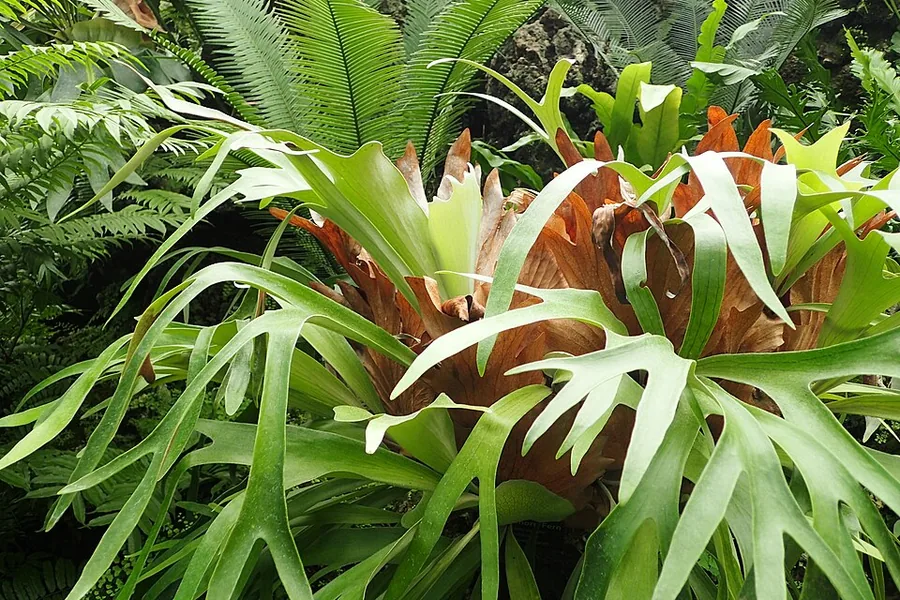
Mounted on a board under bright indirect light with a regular soak, Platycerium bifurcatum sends up antler fronds in its natural epiphytic form.
Bright indirect
Every 7–14 days
55–75°F · 13–24°C
USDA 9–12
Overview
The forked, antler-like fronds that name this fern belong to Platycerium bifurcatum, an epiphyte that in the wild anchors to tree trunks and branches rather than soil. That growth habit is why cultivation on a board suits it far better than a pot, which cannot reproduce the airflow and drainage its roots evolved to expect. Tropical in origin, it carries a bold, sculptural form uncommon among houseplants.
The plant produces two functionally distinct frond types. The green antler fronds are fertile and form the visible, forking display, while the flat, papery shield fronds clasp the base and brown as they mature. That browning is not senescence in the ordinary sense but a deliberate function, since the shields form a protective collar over the root crown.
Growth is slow, and the species rewards a correct, stable culture over frequent intervention. Given appropriate light, a sound mount, and a disciplined watering cycle, an established staghorn persists for years and continues to produce new antler fronds. The care it needs is specific rather than demanding.
Care
The short version: bright indirect light, periodic soaking of the mounted root ball followed by a partial dry-down, warm temperatures, and high humidity paired with steady air movement.
Light
Provide bright indirect light, illumination strong enough to fill the room without direct sun contacting the fronds. The plant tolerates partial shade and mild sun, but direct rays scorch the frond tissue while insufficient light produces weak, limp growth. The filtered canopy habitat it comes from is diffuse rather than exposed, which is why indirect light performs best.
Water
Irrigate on a 7 to 14 day interval, permitting the root ball to dry slightly but never to complete desiccation. The effective method is to soak or immerse the mounted root ball, excluding the fertile fronds, for several minutes and then allow it to drain, which recharges the moss reservoir the way rainfall would in habitat. Frequency rises during warm active growth and falls in winter as metabolism slows.
Soil
Conventional potting soil is unsuitable because it holds water against the roots and starves them of air. Use an epiphytic medium of sphagnum moss with orchid bark, or mount the plant on a board with moss packed around the root ball. A pH of 5.0 to 6.0 suits it, and sharp drainage with free air movement is what keeps the roots sound.
Temperature
Hold the plant within 55°F to 75°F (13°C to 24°C), a range that coincides with normal warm interiors. It has no frost hardiness, so exposure to cold drafts and chilled winter glazing should be avoided.
Humidity
Ambient humidity of 50% to 80% matches the moist air of its native canopy. Bathrooms and kitchens often supply this, and grouping plants or operating a humidifier raises it in dry rooms. Because standing moisture in stagnant air favors fungal black spot, that humidity must be combined with active ventilation.
Feeding
Apply a balanced diluted liquid fertilizer monthly through spring and summer, the period of active growth. Feeding is unnecessary in the low-light months, when growth slows and the plant draws down little in the way of nutrients.
Pruning
Pruning requirements are minimal. Remove only antler fronds that are fully dead, brown, and shriveled. The brown shield fronds at the base must be left intact, as they are living, functional tissue that protects the root crown rather than spent material.
Repotting
Remounting is seldom required, on the order of once every few years and only when the plant exceeds its board. Indications include shield fronds extending past the edges of the mount, a root ball displacing the plant from its board, and a top-heavy, unstable posture. Absent these signs, the plant is best left undisturbed.
Size & spacing
Indoors the species reaches roughly 2 to 3 feet (61 to 91 cm) in height with a comparable spread. Site it so the antler fronds can extend without contacting a wall or an adjacent plant, since crowding restricts both the display and the airflow.
Troubleshooting
Most disorders in this fern resolve to a single variable: moisture, at the roots or on the fronds, and the air surrounding them. The foliage signals early, so reading it promptly allows correction before tissue is lost. Identify the symptom below and intervene while intervention still changes the outcome.
Dark spots enlarging across the fronds
The cause is black spot, a fungal infection that establishes where humid air stagnates and free water persists on the foliage. Increase air movement around the plant, direct irrigation to the root ball rather than the fronds, and excise any severely affected frond. Correcting ventilation removes the condition that sustains the fungus.
Fix:
- Improve air circulation around the plant
- Reduce misting and avoid wetting the fronds when watering
- Remove badly affected fronds
Antler fronds softening with browning tips
Loss of turgor in the antler fronds indicates the root ball has dried completely, the definition of underwatering here, confirmed by a mount that has become very light. Immerse the root ball for several minutes, drain it thoroughly, and reinstate a regular interval before it desiccates again. Turgor typically returns once the moss rehydrates.
Fix:
- Immerse the root ball (not the fertile fronds) in water for several minutes
- Drain thoroughly and resume regular watering before it fully dries
Webbing, cottony masses, or brown bumps on the fronds
These signs indicate spider mites, mealybugs, aphids, and scale, opportunists that exploit the stress of low humidity. Remove them mechanically with a damp cloth, then apply insecticidal soap sparingly over the felt-covered fronds to avoid smothering their coating. Isolate the specimen until the population is controlled, since these pests spread to neighboring plants.
Fix:
- Wipe pests off with a damp cloth
- Treat with insecticidal soap, avoiding heavy coating of the felt-covered fronds
- Isolate the plant until controlled
Toxicity
For households with pets or children, the record is unambiguous: Platycerium bifurcatum is non-toxic. The ASPCA rates it safe for cats, dogs, and horses, and its fronds contain no compounds hazardous to people or other animals. Ingesting a large quantity of any plant can provoke mild, transient gastrointestinal upset, which is the extent of the risk here.
Safe for
People · Cats · Dogs · Horses · Rabbits · Livestock · Birds
Cats None
Cats are unaffected, as the fronds contain no constituents toxic to them. Consumption of a large amount may produce brief, mild gastrointestinal upset, as with any plant material.
Dogs None
Dogs face no toxic risk from the fronds. Overconsumption of plant matter can cause transient vomiting, but nothing of clinical concern.
Horses Safe
Horses are not affected, since the fronds hold no compounds harmful to equines. A sampled frond presents no hazard.
Rabbits Safe
Rabbits can consume the fronds without toxic effect. A large quantity of unfamiliar vegetation may loosen the gut briefly, so limit intake.
Livestock Safe
Grazing stock are not endangered by this fern, which lacks the toxic compounds that render some ornamentals unsafe in pasture or barn.
Birds Safe
Companion birds are unharmed by the plant, its fronds being free of any poisonous constituent. Incidental pecking carries no risk.
People Safe
The fern is safe to handle and cultivate for adults and children. It is not a food plant, but incidental ingestion causes no toxicity.
No special handling needed; non-toxic if nibbled, though eating large amounts of any plant may cause mild, temporary stomach upset.
Varieties
The straight species accounts for most material in cultivation, though a single named selection appears with some regularity in the trade.
Platycerium bifurcatum 'Netherlands'
The selection 'Netherlands' is a compact, sturdy clone bearing broader and more upright forked fronds, and it dominates indoor cultivation of the species.
How to propagate
Vegetative increase is slow in this species, but a mature plant provides one reliable method of propagation.
Offsets & pupsModerate
Spring · Several months to about a year
Propagation proceeds most reliably from offsets, the pups that arise on the rhizome. In spring, detach a pup bearing a few of its own roots and mount it on a separate board; establishment is gradual, requiring several months to about a year. Spore propagation is possible but slow and technically exacting.
Myths
The brown, papery shield fronds are dead tissue that ought to be removed.
The browning shield fronds remain alive and perform a defined role. They clasp the root crown, accumulate water and fallen leaf litter, and buffer the root ball against drying. They should be left in place, because detaching them injures the roots they enclose.