Shrub · Hypericaceae
Shrubby St. John's Wort
Hypericum frondosum
A tough, drought-adapted native shrub that answers full sun with a canopy of bright yellow summer flowers.
Full sun
Every 7–14 days
730–1095 days
USDA 5–8
Overview
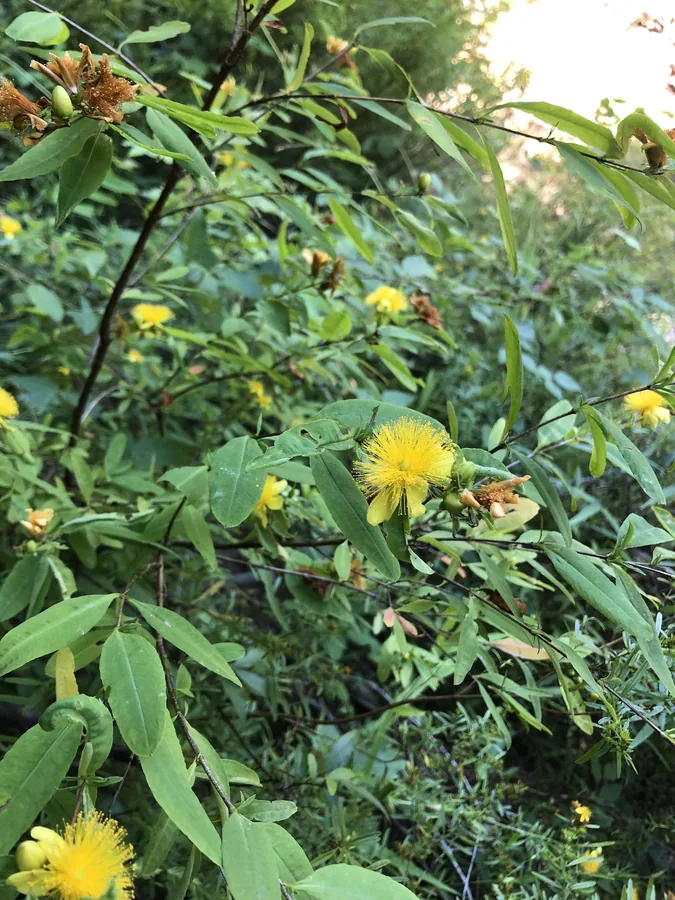
Shrubby St. John's wort earns its garden place through a long early-summer display of bright yellow flowers, each centered on a dense boss of golden stamens that gives the bloom its depth. Structurally it forms a compact, rounded shrub of 3 to 4 feet in both height and spread, carrying cool blue-green foliage over bark that exfoliates to reddish-brown on mature stems. That even, mounded habit reads well in a mixed border or repeated through a mass planting.
Its resilience comes from a wide site tolerance rather than any single trick. It performs on poor, rocky, dry ground, accepts full sun to light shade, and once its root system is established it draws down soil moisture efficiently enough to be drought tolerant. Rated for zones 5 to 8, it withstands winter lows to -20°F (-29°C).
The genus name carries a real caveat. The tissues hold hypericin, a photodynamic compound that sensitizes skin to sunlight, which is why the plant is toxic to pets and grazing livestock and why the medicinal form warrants caution in people. Factor that into where you site it.
Care
The short version: full sun and free drainage drive both bloom and long-term health. Water through establishment, then reduce it as drought tolerance develops, prune in late winter to protect the summer flowering wood, and feed sparingly if at all.
Light
Site it in full sun to maximize flowering, since bloom density tracks light directly; partial sun or light shade is tolerated but costs you flowers. More light also tightens the canopy, producing a denser shrub.
Water
Provide steady moisture through establishment, then taper off, because a developed root system makes the plant drought tolerant. Allow the top half of the profile to dry between irrigations, and avoid wet, poorly drained ground, where sustained saturation drives root rot.
Soil
The species is broadly adaptable in soil. It grows best in average, well-drained ground, ideally a rich sandy loam, yet tolerates dry, rocky, and nutrient-poor substrates that limit less flexible plants.
Temperature
Hardy across zones 5 to 8, it operates over a broad thermal range of -20°F to 95°F (-29°C to 35°C). That deep cold hardiness is what allows it to persist through winters that would kill more tender shrubs.
Humidity
Ambient outdoor humidity is adequate, so there is no target level to maintain. The relevant variable is air movement, because stagnant, humid air around dense foliage is what predisposes the plant to leaf diseases.
Feeding
As an adaptable native, it has low nutrient demand. A light spring application of balanced fertilizer or compost is sufficient, and many specimens perform well with no supplemental feeding at all.
Pruning
Because flowers form on new wood, prune in late winter or early spring before growth resumes and the coming season's bloom stays intact. The plant also tolerates hard renewal cuts, so you can reshape it or remove winter-damaged tips.
Repotting
In the ground the shrub effectively never needs repotting. In a container, pot up only when the roots circle the vessel or escape the drainage holes, or when water passes through without being absorbed, all signs the medium is spent.
Size & spacing
Mature dimensions run to a rounded 3 to 4 feet (91 to 122 cm) in height and spread. Space plants at roughly that interval so air circulates freely and the foliage dries, which limits disease.
When to plant
The plant's calendar follows temperature and daylength. Sow seed in late winter, transplant in spring once frost has passed, and the bright yellow flowers open across June and July before the display closes.
Northern hemisphere
Southern hemisphere
Typical months for a temperate climate: start earlier in warm zones, later where spring frosts linger.
- Sow: Late winter to early spring; seed benefits from cold stratification and surface sowing as it needs light to germinate.
- Plant: Spring after last frost, or early fall in milder zones.
- Harvest: June to July (summer), with showy bright yellow flowers bearing a prominent boss of golden stamens.
Hardiness
USDA hardiness zones: 5–8
Temperature: down to -29°C
Troubleshooting
A well-sited shrub is largely trouble-free, and the disorders it does show trace to two conditions: saturated soil at the roots or stagnant, humid air among crowded leaves. Identify the symptom, then correct the underlying condition rather than treating the surface.
Wilting and branch dieback despite consistent watering
Decline that continues while you water almost always signals root rot, driven by saturated, poorly drained soil and accelerated by hot, humid weather. Root-knot nematodes produce a parallel decline by disrupting water uptake at the roots. Excavate the plant and inspect the roots for browning, softening tissue, or knotty galls, then re-site it on the raised, rocky, well-drained ground the species prefers.
Fix:
- Improve drainage and reduce watering frequency
- Remove and destroy severely affected plants and avoid replanting susceptible species in nematode-infested soil
- Plant in raised or rocky, well-drained sites the species naturally prefers
Leaf spotting, powdery film, or rust pustules
Crowded, persistently damp foliage supports several fungal diseases together. Dark lesions indicate leaf spot, a white surface film indicates powdery mildew, and raised orange-brown pustules on the undersides indicate rust. All are cosmetic rather than fatal, so remove the affected leaves, prune to raise airflow through the canopy, and irrigate at the base so the foliage stays dry.
Fix:
- Remove and dispose of affected foliage
- Improve air circulation by spacing and selective pruning
- Avoid wetting foliage when irrigating
Toxicity
This is a toxic species, not a benign one. Its tissues contain hypericin, which sensitizes skin to light and produces poisoning when ingested. Keep it clear of pets and grazing livestock, and note that even the herbal preparation people use carries genuine risk.
Toxic to
Cats · Dogs · Horses · Rabbits · Livestock · Birds · People
Cats Mild
In cats the ingested hypericin produces mild systemic upset, seen as nausea, reduced appetite, and lethargy. The more significant effect is photosensitization, in which subsequent light exposure raises sore, sunburn-like lesions on thin-furred skin and around the mouth.
Dogs Mild
A dog that ingests the foliage typically shows salivation, vomiting, or diarrhea. Because hypericin sensitizes the skin, later sun exposure can blister the lightly furred areas of the belly, nose, and ears.
Horses Moderate
Grazing horses develop photosensitization that advances to ulcerative, exudative dermatitis on any pale or unpigmented skin, and continued sun exposure deepens the lesions.
Rabbits Moderate
Rabbits are affected by the same hypericin, so the plant is an unsafe food for them, producing gastrointestinal upset alongside the characteristic light-triggered dermatitis on exposed, thin-furred skin.
Livestock Severe
In cattle, sheep, and goats, heavy intake yields the most severe presentation: blistering, pruritic skin over unpigmented areas, elevated body temperature, and accelerated respiration and pulse as photosensitization progresses.
Birds Moderate
Birds should be excluded from contact with the plant. The hypericin delivers the same toxicity and light-driven dermatitis, so keep it away from pet birds and poultry.
People Caution
In people the herbal preparation still induces photosensitivity, so treated skin burns faster under sun. The greater concern is pharmacological, since hypericum interacts strongly with many prescription drugs, so anyone on medication should consult a physician before use.
No special handling needed for routine gardening; keep pets and grazing livestock from consuming large quantities of foliage.
Helpline numbers

United States
ASPCA Animal Poison Control: (888) 426-4435 (fee applies)
Poison Control: (800) 222-1222



Canada
Poison Centres: 1-844-764-7669
Varieties
Only two forms circulate in the trade, and the distinction between them is worth understanding before selection.
Sunburst
A compact selection that matures near 3 feet (91 cm) and produces slightly larger flowers, up to 2 inches (5 cm) across.
Hypericum frondosum (species)
The straight species reaches 3 to 4 feet (91 to 122 cm) in height and spread, distinguished by blue-green foliage and reddish-brown bark that exfoliates on older stems.
How to propagate
Three methods propagate this shrub, ranging from rapid vegetative division to slow reproduction by seed, each suiting a different timeline to flowering.
Stem cuttingsEasy
Late spring to summer using softwood cuttings · 4 to 8 weeks to root
Cuttings reproduce a named cultivar such as Sunburst with fidelity, which seed cannot. Collect softwood tip cuttings during active growth in late spring or summer, and they root in roughly 4 to 8 weeks.
DivisionEasy
Early spring before new growth emerges · One growing season
Division is the fastest and most reliable route on an established clump. Lift and separate the crown in early spring before growth breaks, and each division reestablishes over a single growing season.
SeedModerate
Late winter to spring · Germination in a few weeks; flowering plants in 2 to 3 years
Seed is the slowest option and demands specific handling. Surface sow in late winter or spring because the seed requires light to germinate, and a period of cold stratification raises viability. Seedlings emerge within a few weeks, but flowering follows only after 2 to 3 years.
Myths
Every St. John's wort is a dangerous invasive weed that should never be planted.
The species behind that reputation is common St. John's wort, Hypericum perforatum, a noxious invader of western rangelands that poisons grazing livestock. The ornamental shrub grown in gardens is a distinct species, Hypericum frondosum, and this well-behaved native holds no noxious-weed listing whatsoever.