Houseplant · Aizoaceae
Split Rock
Pleiospilos nelii
A mesemb that mimics cracked stone, thriving on strong sun and a hard, dry dormancy.
Full sun
50–86°F · 10–30°C
USDA 9–11
2–3 in · 5–8 cm
Overview
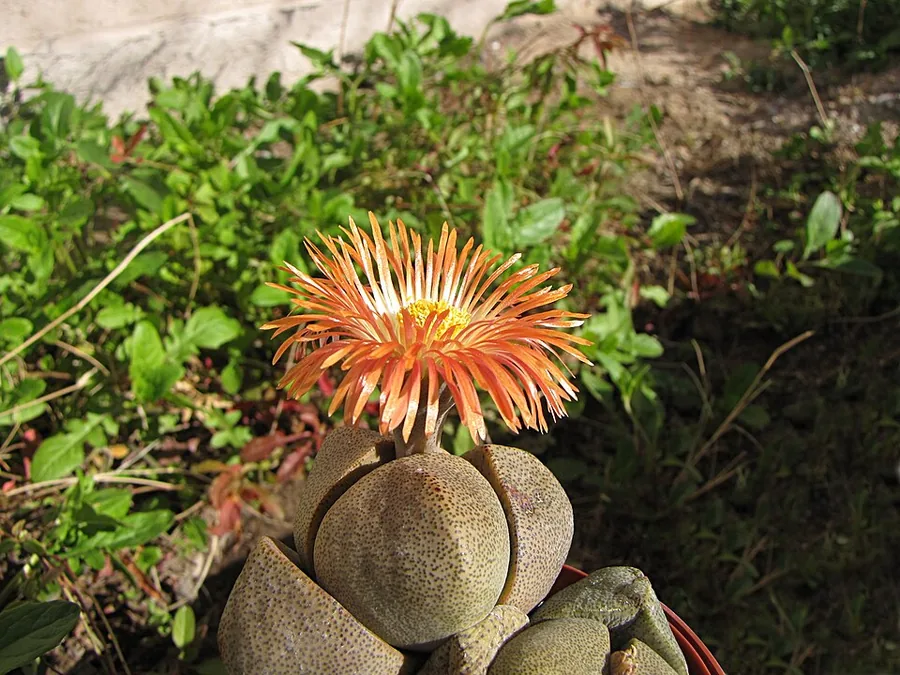
Split rock is a compact, stemless succulent from South Africa that survives by imitating the stones around it. Classified in the mesemb assemblage of the family Aizoaceae, it stores water in a pair of fat, fissured leaves that fuse into a body roughly the size of a large pebble. Sitting in gritty substrate, it reads as weathered granite, the crypsis that shields it from grazers in habitat.
Growth is slow, and the mature plant remains small at 2 to 3 inches (5 to 8 cm) tall, which suits year-round culture on a bright sill. At any moment it holds only one or two leaf pairs. Each season a new pair develops within the old, drawing moisture and reserves from the previous leaves until they collapse to a papery sheath.
The limiting factor in cultivation is not nutrition or pruning but water and its timing. The plant depends on a strict cycle and a fully dry summer dormancy, and excess moisture is the usual cause of collapse. Meet its water rhythm and it produces a daisy-like flower, yellow to orange, in late winter or spring.
Care
The short version: supply the strongest light available, a sharply draining mineral mix, and water only through spring and autumn growth, withholding it entirely during dormancy and leaf renewal to prevent rot.
Light
Site split rock in the strongest light on offer, ideally full sun at a south-facing window. That intensity drives the compact, stone-mimicking habit, because the plant holds its tight form only under high light. Reduce the light and it etiolates, going pale and elongated as it reaches for the source.
Water
Watering is the decisive variable. Apply water only during active growth in spring and autumn, and only after the substrate has dried through, so the roots never sit wet. Withhold it entirely through summer dormancy and while a new leaf pair is emerging, because water taken up at those stages swells the leaves past their limit and they split and rot.
Soil
Grow it in a very gritty, sharply draining mineral or cactus mix that sheds water quickly and holds none. The plant tolerates a pH of 6.0 to 7.5, so reaction is far less critical than porosity, which governs how long the roots stay wet.
Temperature
The comfortable band runs from 50°F to 86°F (10°C to 30°C), covered by normal room conditions across the year. A cooler, dry interval in summer reinforces the dormancy the plant depends on.
Humidity
Low ambient humidity matches the plant's arid origin, so no target figure applies. Dry air is protective, whereas humid, stagnant air keeps the surface and substrate damp and predisposes the plant to rot.
Feeding
Fertilize sparingly, and only within the spring and autumn growth windows. A dilute, low-nitrogen cactus or succulent feed supplies enough, since surplus nitrogen forces soft, water-laden growth that runs counter to the plant's tight habit.
Pruning
No pruning is warranted, and cutting the body is harmful. Allow the old leaf pair to desiccate as the new pair reabsorbs it, then lift away the papery remnant once it is fully spent. Intervening early only interrupts the reabsorption the plant relies on.
Repotting
Repot infrequently, on the order of every 2 to 3 years or once the plant fills its container. Roots protruding from the drainage holes, or the body heaving above the soil line, indicate the substrate is exhausted and a fresh gritty mix is due.
Size & spacing
Mature dimensions stay modest: about 2 to 3 inches (5 to 8 cm) in height and 3 to 4 inches (7 to 10 cm) across. A single specimen occupies a small pot fully, with no companion planting required.
Troubleshooting
Nearly every disorder in split rock originates with water applied out of phase with its cycle, and the leaves register it first. Assess turgor and count the pairs, since firm tissue, mushy tissue, and stacking pairs each point to a different fault. Identify the pattern below, then correct the watering.
Leaf tissue splitting or becoming soft and translucent
Soft, translucent, splitting leaves indicate rot driven by excess water, and the cause is nearly always water supplied out of phase. Susceptibility peaks during summer dormancy and while a new leaf pair emerges, when uptake should be nil. Cease irrigation, excise the necrotic tissue with a sterile blade, and transfer the plant to a grittier, faster-draining medium.
Fix:
- Stop watering immediately
- Cut away rotted tissue with a clean blade
- Repot into a much grittier, faster-draining mix
- Allow the plant to dry out fully before any further water
Multiple leaf pairs accumulating without reabsorption
A vigorous split rock maintains only one or two leaf pairs. Three or more stacked pairs signal that the plant was watered or fed during leaf renewal, which halted reabsorption of the old pair. Suspend watering so the plant consumes the older leaves, then resume the dry cycle once the surplus pairs are drawn down.
Fix:
- Withhold water so the plant draws on the old pair
- Resume the normal dry-cycle once excess pairs are reabsorbed
Elongated, pale growth abandoning the compact form
Upward, pale, elongating growth is the signature of light deficiency. The plant sustains its tight, stone-like body only under high irradiance, and a dim position drives etiolation. Relocate it to the brightest available position, one delivering several hours of direct sun.
Fix:
- Move to the brightest available position with several hours of direct sun
Toxicity
For a household with animals or children, the record is reassuring: split rock is non-toxic. The ASPCA does not list it, and mesembs across the family lack known toxic principles. The only plausible effect is transient gastric upset should an animal ingest a quantity of the gritty, fibrous leaf.
Safe for
People · Cats · Dogs · Horses · Rabbits · Livestock · Birds
Cats None
No toxic hazard applies to cats. Ingestion of leaf tissue may provoke brief, mild gastric upset owing to its fibrous nature, but no toxic mechanism is involved.
Dogs None
Dogs face no risk of poisoning. A persistent chewer may show transient loose stool or salivation from the gritty leaf, both of which resolve without treatment.
Horses None
The species poses no toxic concern to horses. Its diminutive size also leaves little material available for a horse to consume.
Rabbits None
The plant holds no compounds capable of harming a rabbit. A sampled leaf may cause slight flatulence, since the dense succulent tissue lies outside the normal diet.
Livestock None
Goats, sheep, and cattle encounter no toxic threat. A grazing animal might at most register a mild, short-lived digestive disturbance from the gritty tissue.
Birds None
Pet birds are unaffected, with no poisoning documented. A bird sampling a leaf risks nothing beyond a temporarily irritated crop from the fibrous material.
People None
The plant presents no toxic risk to adults or children during handling or cultivation. It is not a food species, however, and there is no reason to ingest it.
Its sharp gritty soil and fibrous leaf tissue could cause minor mechanical or digestive upset if a pet chews and swallows large amounts.
Varieties
Cultivated stock reduces to two forms, separated chiefly by pigmentation. Both are described below.
Pleiospilos nelii (species)
The wild species presents grey-green, fissured leaves that inflate into a near-spherical body closely resembling a cleft stone.
Pleiospilos nelii 'Royal Flush'
This cultivar substitutes deep purple to reddish pigmentation for the typical grey-green while retaining the identical split-stone architecture.
How to propagate
Increase is slow. Two routes work: raising plants from seed, or dividing an established clump at repotting.
SeedModerate
Sow in warm conditions during spring or autumn · Several months to over a year to reach a recognizable plant
Sow seed under warm conditions in spring or autumn, distributing it over the surface of a gritty medium and holding light moisture until germination, after which the strict dry regime resumes. Development is protracted, requiring several months to more than a year before a seedling resembles a mature plant.
DivisionModerate
During active growth when repotting an established clump · Several weeks to a few months
Once a clump has established, divide it during active growth at repotting. Separate an offset carrying a few roots, allow the cut surfaces to dry and callus, then pot it into a dry gritty medium. Establishment follows within a few weeks to a couple of months.
Myths
Split rock is a species of Lithops.
The two occupy separate genera despite a shared place in the mesemb group. Split rock belongs to Pleiospilos and bears markedly fatter, fewer leaves than any true Lithops, so the likeness is superficial and taxonomically misleading.
It can be watered on a regular schedule, as most succulents are.
This species runs on a strict cycle and requires a bone-dry summer dormancy. Routine year-round watering ruptures and rots the leaves, and it remains the quickest route to killing the plant.