Ornamental · Aizoaceae
Ice Plant
Delosperma cooperi
Provide full sun and sharp drainage, and this succulent forms a low carpet of jewel-toned flowers through the summer.
Full sun
USDA 6–10
3–6 in · 8–15 cm
Overview
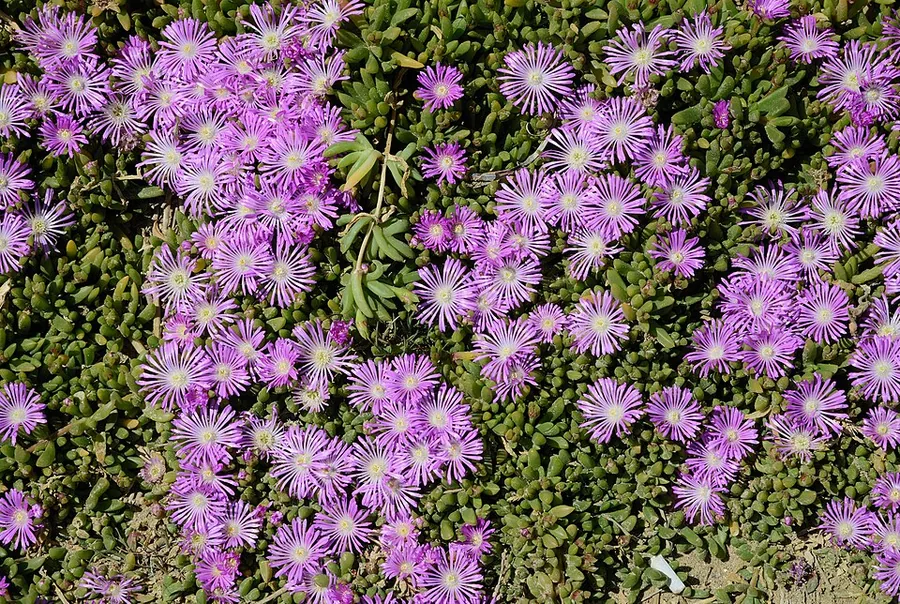
Ice plant is a low, mat-forming succulent native to South Africa that spreads by trailing stems into a dense carpet of fleshy, finger-like leaves. Those leaves store water, which underpins its drought tolerance, and through summer the plant produces daisy-like flowers in purple, pink, orange, and yellow whose petals refract light much like crushed glass. Since mature height rarely exceeds 3 to 6 inches, it functions well as groundcover, edging, or a spiller trailing over a wall or rockery.
Its defining trait among the many plants sharing the name is exceptional cold hardiness. Delosperma cooperi withstands winters to USDA zone 6, considerably colder than the tender ice plants most people associate with the name, because it enters dormancy and its stored reserves carry it through. Combined with strong drought and heat tolerance, this suits it to hot, dry banks where erosion control is difficult to achieve otherwise.
The corresponding weakness is an intolerance of wet feet, which is why drainage governs every aspect of its cultivation. In gritty soil and full sun it is close to self-sufficient, but soil that stays cold and saturated over winter deprives the roots of oxygen and the plant collapses. Address drainage first and the remaining requirements are minimal.
Care
The short version: full sun, gritty fast-draining soil, and a restrained hand with irrigation. Allow it to dry between waterings, hold it nearly dry through winter, and it demands little beyond that.
Light
Ice plant requires full sun, meaning 6 or more hours of direct light daily, because that intensity drives its flowering. It tolerates limited partial sun, but lower light induces etiolation, yielding weak, stretched growth and sparse bloom.
Water
Water sparingly, and only after the soil has dried completely, so the roots are never left in standing moisture. An occasional deep soak suffices during the growing season, and it should be held nearly dry over winter. As a true succulent it stores its own reserves, and overwatering is the fastest route to failure.
Soil
Drainage is the decisive factor. Establish it in a gritty, sharply drained sandy or gravelly medium, and where the native soil is clay, incorporate abundant grit or construct a raised bed. Standing moisture at the crown induces the rot that kills it.
Temperature
Its thermal tolerance is broad, spanning roughly -9°F to 100°F (-23°C to 38°C). That lower limit is what permits outdoor overwintering in zones where most succulents cannot survive.
Humidity
It favors low humidity and dry air, consistent with its origin on hot, dry banks. Damp, stagnant conditions predispose it to disease, so adequate air movement supports its health.
Feeding
Its nutrient demand is minimal. In lean, well-drained soil no feeding is necessary, and at most a light, balanced feed in spring is appropriate. Fertile soil and heavy feeding produce soft, floppy growth that lodges.
Pruning
Shear the mat lightly after the main flush of bloom to restore its form and stimulate a second flush of flowers. In spring, remove dead or frost-damaged tissue to clear space for emerging shoots.
Repotting
A container specimen needs repotting only every 2 to 3 years. Roots emerging from the drainage holes, or a mat thinning at its center, indicate the container has filled and the plant should be moved up.
Size & spacing
Height remains low at 3 to 6 inches (8 to 15 cm), while the plant spreads into a mat of 12 to 24 inches (30 to 60 cm). Space specimens so the mats meet and knit together without overlapping and mounding.
When to plant
Ice plant is a hardy perennial, so an established planting resumes growth from the same crown each spring rather than needing replacement. Set new plants out in spring once hard frost has passed, and flowering follows from June through September. The winter risk is not low temperature but saturated soil.
Northern hemisphere
Southern hemisphere
Typical months for a temperate climate: start earlier in warm zones, later where spring frosts linger.
- Harvest: Summer; flowers roughly June to September
Hardiness
USDA hardiness zones: 6–10
Temperature: down to -23°C
Troubleshooting
Ice plant is largely trouble-free, and the disorders it does show almost invariably originate in excess moisture at the roots. Recognizing the early indicators is what keeps a minor problem from becoming fatal. Identify your symptom below, then intervene before soft tissue spreads.
Post-winter blackening or failure to break dormancy
This is crown and root rot, and it is the primary cause of loss in an otherwise durable species. Waterlogged soil held against the crown through the cold months deprives the roots of oxygen and lets rot organisms soften the tissue, and dense clay compounds the problem by retaining that moisture. The remedy is drainage: incorporate grit, replant on a raised, sharply drained position, and use gravel rather than bark against the base so water does not linger there.
Fix:
- Improve drainage with grit or gravel and replant in a raised, sharply drained spot
- Avoid bark mulch over the crown; use gravel instead
- Provide a sheltered, drier site in marginal zones
Sticky residue and cottony deposits on the foliage
Two sap-feeding insects account for these symptoms. Aphids colonize the soft apical growth and their feeding distorts the developing tissue, while mealybugs deposit the characteristic white, cottony masses in the leaf axils and along the stems. A forceful jet of water dislodges most populations mechanically, and insecticidal soap is warranted only where they persist.
Fix:
- Rinse off with a strong jet of water
- Treat with insecticidal soap if populations persist
Poor flowering with weak, etiolated stems
The cause here is insufficient sunlight. Deprived of adequate light, the plant etiolates, extending weak stems toward the source and diverting resources away from flower production, whereas the same plant in an open position blooms heavily. Relocate it to a site that receives 6 or more hours of direct sun each day and flowering recovers.
Fix:
- Relocate to a position receiving 6 or more hours of direct sun
Toxicity
For households with pets or children, ice plant is not known to be toxic, and no poisoning reports are tied to it. That said, the ASPCA's non-toxic 'ice plant' listing actually covers a related genus, Lampranthus, rather than Delosperma cooperi itself, which has not been formally evaluated on its own, so it is best treated as low-risk rather than certified safe. As with any garden plant, pets and children are best discouraged from treating it as a snack.
Safe for
People · Cats · Dogs · Horses · Rabbits · Livestock · Birds
Cats Non-toxic
No toxic effect is expected in cats. A cat that samples a fleshy stem of this succulent should show no ill effects.
Dogs Non-toxic
Dogs face no toxicity risk. One that excavates a clump or chews the foliage should remain unaffected.
Horses Non-toxic
Grazing horses face no hazard from foliage encountered along a border or path.
Rabbits Non-toxic
Rabbits can consume the soft leaves without adverse effect, though they seldom target tissue this fleshy.
Livestock Non-toxic
Cattle, goats, and sheep are at no risk from either the mat or its flowers.
Birds Non-toxic
Garden birds and backyard poultry can forage on it without harm.
People Non-toxic
Handling presents no hazard, and accidental ingestion by a child constitutes no emergency.
Varieties
Breeding has expanded the color range of hardy ice plant considerably, and a few series and named selections warrant particular attention. The following are the cultivars worth identifying by name.
Jewel of Desert series
Compact, floriferous cultivars ranging in color from peridot-yellow to garnet-red, and widely catalogued by the RHS.
Wheels of Wonder series (e.g., Hot Pink Wonder, Orange Wonder)
Vigorous, spreading selections valued chiefly for flowers of unusually large size.
'Mesa Verde' (Delosperma 'Kelaidis')
A salmon-pink Plant Select introduction that originated as a sport of a dwarf alpine form of D. cooperi at Denver Botanic Gardens.
How to propagate
Ice plant propagates with unusual ease. Three reliable methods are available, each straightforward, whether the goal is a single replacement or a large batch of plants.
Stem cuttingsEasy
Spring to summer · 2-4 weeks to root
Vegetative cuttings are the most rapid method. Sever short, fleshy stem segments from spring through summer and allow the cut surfaces to callus for a day or two, which seals them against rot before insertion into a gritty medium, where roots form in 2 to 4 weeks.
DivisionEasy
Spring · One growing season
An established mat divides readily because its trailing stems root as they run. Lift the plant in spring and separate it, then transplant the already-rooted runners directly into their positions, where they close the gap over a single growing season.
SeedEasy
Spring · One growing season
Seed offers reliable propagation at scale. The seed is fine, so surface-sow it in spring and supply warmth and light for germination, after which seedlings attain planting-out size over one growing season.
Myths
Every plant called 'ice plant' is the same species and equally weedy or toxic.
The common name spans several unrelated Aizoaceae genera. The invasive coastal weed belongs to Carpobrotus, and the plant listed non-toxic by the ASPCA is Lampranthus piquetbergensis. Hardy Delosperma cooperi is a distinct ornamental species and should not be conflated with either.
Ice plant needs frequent watering to thrive.
As a drought-tolerant succulent it performs best in dry, sharply drained ground and stores its own moisture. Excess water is the limiting factor, since saturated soil deprives the crown and roots of oxygen and induces rot.