Vegetable · Aizoaceae
New Zealand Spinach
Tetragonia tetragonioides
Grow this heat-tolerant summer green and keep cutting tender leaves well past the point where true spinach bolts.
Full sun
Every 4–7 days
50–86°F · 10–30°C
50–70 days
Overview
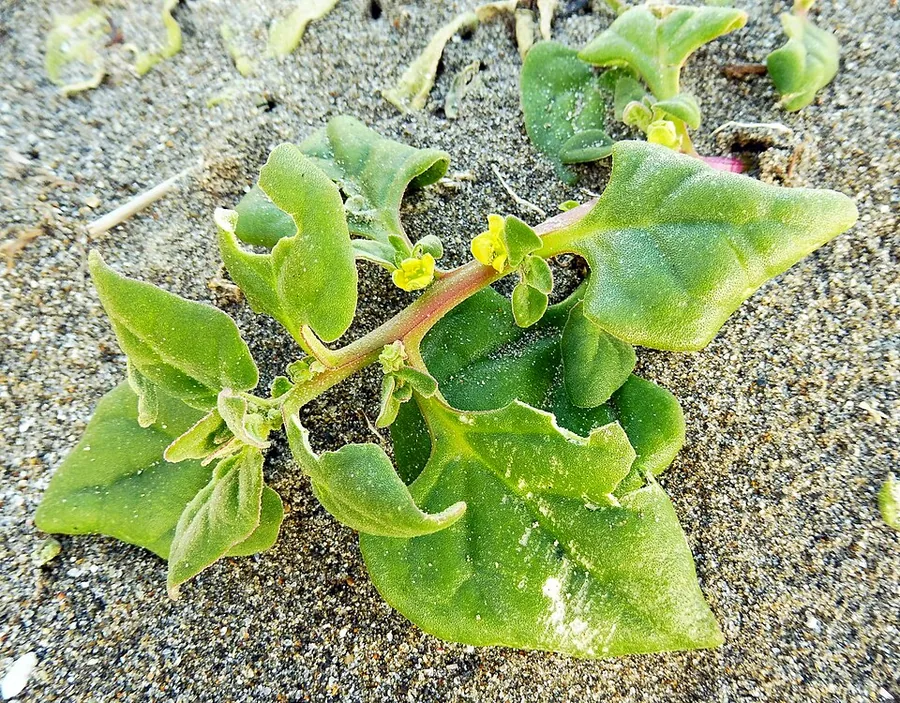
New Zealand spinach reaches peak productivity in the heat that sends true spinach to seed, which is precisely why growers turn to it. Despite the name it is no spinach but a prostrate member of the fig-marigold family, native to coastal New Zealand and Australia, where it colonizes dunes and shingle in the wild. Cooking transforms the thick, soft leaves into a mild green that eats much like true spinach.
Growth is low and lateral: the stems trail across the soil to form a dense mat a few feet across rather than building an upright frame. The plant performs where conditions run hot and dry and tolerates the saline and alkaline soils that limit most greens, a legacy of its coastal origins. Because pinching the tender growing tips removes apical dominance, each cut prompts fresh lateral shoots, and repeated harvest sustains supply until the first fall frost.
One agronomic caveat governs use: the raw leaves carry oxalates and saponins, so the crop is cooked rather than eaten raw in bulk. A brief blanch in boiling water followed by discarding that water leaches out much of both compounds, a small step that unlocks a green productive through conditions that stall most others.
Care
The short version: site it in full sun and warm soil, and supply consistent moisture through summer for the highest leaf quality. Feed monthly with a nitrogen-rich fertilizer, allow generous room for the sprawling habit, and harvest the tips regularly to keep new growth forming.
Light
Site it in full sun for the highest yield and best leaf flavor, since maximum light drives the leafy growth that is harvested. It tolerates partial shade and continues to produce, though at a reduced rate, so more sun means more harvestable tips.
Water
Once established the plant is heat- and drought-tolerant, but water quality drives leaf quality, and steady, even moisture through summer keeps the leaves tender and well flavored. Water every 4 to 7 days, favoring the shorter interval during heat waves or in fast-draining sandy soils.
Soil
It grows best in well-drained sandy loam enriched with organic matter, which supplies the nutrients that fuel continual leaf production. A pH of 6.5 to 7.5 is ideal, and its coastal ancestry lets it tolerate alkaline and even saline soils that most greens cannot.
Temperature
As a heat lover it performs across roughly 50°F to 86°F (10°C to 30°C) and grows most strongly in high summer. It has no frost tolerance, so planting out should wait until the soil has warmed after the last frost.
Humidity
Ambient outdoor humidity around 40% to 70% meets its needs, and the plant is indifferent within that range. No adjustment is required.
Feeding
Because harvested leaf tissue must be rebuilt from nitrogen, steady feeding sustains the crop and prevents the pale, bolting-prone growth of a starved plant. Apply a nitrogen-rich fertilizer monthly through the season, roughly 1/4 cup of N per 10 feet of row, which also suppresses premature flowering.
Pruning
Pruning and harvest are one operation, since removing the top 4 inches of the growing tips takes the crop while breaking apical dominance. Frequent cutting therefore drives tender new shoots and keeps the plant vegetative rather than reproductive.
Size & spacing
Mature plants reach only 12 to 24 inches (30 to 60 cm) in height but spread into a mat 3 to 4 feet (90 to 120 cm) across. Setting them about a foot apart within the row with roughly 3 feet between rows gives the prostrate stems room to run without crowding.
When to plant
New Zealand spinach is a warm-season crop with no frost tolerance, so timing follows soil temperature rather than the calendar alone. Start transplants indoors a few weeks ahead, set them out once frost has passed and the soil has warmed, and harvest young leaves and tips through the heat of summer until the first fall frost ends the season.
Northern hemisphere
Southern hemisphere
Typical months for a temperate climate: start earlier in warm zones, later where spring frosts linger.
- Sow: Start transplants indoors 3-4 weeks before the last spring frost
- Plant: After the last frost when soil is warm; soak the hard seed in water ~24 hours before sowing and plant about 1 in deep
- Harvest: Harvest young leaves and growing tips continually through summer heat until the first fall frost
Hardiness
USDA hardiness zones: 9–11
Temperature: down to -7°C
Troubleshooting
This is a tough, low-maintenance crop, and most of its problems are either cosmetic or traceable to inadequate fertility. Reading the few signs below lets you separate the disorders worth correcting from the ones a vigorous plant will grow past on its own.
Chlorotic, washed-out foliage with weak regrowth
Pale foliage and weak regrowth after cutting point to nitrogen deficiency, since leafy crops draw heavily on nitrogen to rebuild harvested tissue, and low fertility also pushes the plant toward early flowering. Correct it by side-dressing with a nitrogen fertilizer, about 1/4 cup of N per 10 feet of row each month, so the roots have a steady supply to convert into new leaves. Keep the soil evenly moist between feedings, because the plant can only take up dissolved nitrogen, and a monthly program holds both color and yield through the season.
Fix:
- Side-dress with a nitrogen fertilizer
- Apply about 1/4 cup N per 10 ft of row monthly
- Keep soil evenly moist between feedings
Shot-hole feeding damage peppering the leaf surface
Those small punctures come from chewing beetles, typically flea beetles that feed on young foliage and leave the classic shot-hole pattern. Because the damage is superficial and the leaf keeps functioning, a vigorous, well-fed plant simply outgrows the loss. Exclude the beetles from seedlings with a floating row cover during the vulnerable early stage, and turn to hand-picking or treatment only when feeding pressure begins to outpace the new growth.
Fix:
- Tolerate minor cosmetic damage; vigorous plants outgrow it
- Use floating row cover over young plants
- Hand-pick or treat only if damage becomes heavy
Stems sprawl and flop across the ground
The sprawl reflects the plant's growth form, not a fault, because it carries a naturally trailing, weak-stemmed habit and lays down a low carpet 2 to 3 feet wide instead of a self-supporting crown. Crowding intensifies the flopping, since competing stems have nowhere to run. Allowing 12 inches within the row and 3 feet between rows gives the prostrate stems ground to occupy, and pinching the tips redirects growth into lateral buds for a bushier, more branched plant.
Fix:
- Allow 12 in within rows and 3 ft between rows
- Let stems trail into open ground or train through other vegetation
- Harvest tips to promote bushier branching
Toxicity
This is a food crop rather than a poisonous plant, with one qualification worth understanding. The leaves contain natural oxalates and saponins, which is why they are cooked rather than eaten raw in quantity, and the same compounds make the raw greens a mild caution for pets and livestock. Cooking the leaves for the table and keeping large raw amounts away from animals resolves the concern for everyone.
Toxic to
Cats · Dogs · Horses · Rabbits · Livestock · Birds
Safe for
People
Cats Mild
A small nibble seldom registers, but a cat that consumes a large amount of the raw, oxalate-rich foliage may drool or develop digestive upset as the compounds irritate the gut. The plant is not a listed ASPCA toxin.
Dogs Mild
The oxalic acid and saponins can provoke mild gastrointestinal upset in a dog that ingests a large serving of raw leaves. Small tastes rarely deliver enough of either compound to cause a problem.
Horses Mild
The soluble oxalates make the raw greens unsuitable in quantity for horses, because sustained high-oxalate forage binds dietary calcium and disrupts its uptake. A single mouthful carries too little to trouble a healthy animal.
Rabbits Mild
Portion size is the deciding factor, since the oxalate load makes the raw leaves a poor staple for a rabbit. A small amount served alongside other greens is generally tolerated without issue.
Livestock Mild
Grazing animals handle modest intakes, but the oxalic acid accumulates when they feed on large amounts over successive days. Offering it within a varied diet keeps the cumulative dose low.
Birds Mild
Backyard hens and other birds sample the foliage with little consequence, though the oxalate content argues for offering the raw leaves only in small amounts.
People Edible when cooked
For people this is a culinary green, safe and palatable once cooked. Blanching the leaves for 1 to 3 minutes and discarding the water leaches out much of the oxalate and saponin content, and anyone prone to kidney stones should still limit raw quantities.
Blanch leaves in boiling water about 1-3 minutes and discard that water before eating to reduce oxalate and saponin levels; avoid eating large amounts raw, particularly for people prone to kidney stones.
Helpline numbers

United States
ASPCA Animal Poison Control: (888) 426-4435 (fee applies)
Poison Control: (800) 222-1222



Canada
Poison Centres: 1-844-764-7669
Varieties
Cultivar choice is minimal here, because New Zealand spinach is grown almost entirely as the plain species. A name or two still surfaces in seed catalogs for those who look.
Maori
This named selection appears in extension references, although the crop is grown almost entirely as the unimproved species rather than as distinct cultivars.
Common (species type)
The wild-type species is the form most gardeners grow, a reflection of how few named cultivars this plant has ever produced.
How to propagate
Establishing New Zealand spinach is straightforward and done from seed. The single technique that matters is overcoming the dormancy of the hard seed so that germination is prompt and even.
SeedEasy
After the last frost when soil is warm, or start indoors 3-4 weeks before the last frost · About 1-3 weeks to germinate (faster if seed is pre-soaked); roughly 50-70 days to first harvest
Propagation is by seed, and the hard, knobby fruit germinates unevenly unless it is softened first, so soaking it in water for about 24 hours before sowing improves and speeds emergence. Sow roughly an inch deep and thin the seedlings to a foot apart to match the spread. Germination follows in 1 to 3 weeks, sooner from pre-soaked seed, with the first harvest of leaves and tips in about 50 to 70 days.
Myths
Tetragonia is botanically a form of true spinach.
The common name misleads, because botanically the plant sits in the fig-marigold family (Aizoaceae) with no relation to true spinach. Its value lies in serving as a heat-tolerant summer substitute, cropping on through the warmth that sends true spinach to bolt.
The foliage is safe to consume raw without limit.
The leaves contain oxalates and saponins, which is why they are not suited to raw consumption in quantity. Blanching for 1 to 3 minutes and discarding the water leaches out much of both compounds, and raw portions are best kept modest.
The crop tolerates frost as well as true cool-season spinach.
This is a tender warm-season crop with no frost hardiness, and a frost will kill it outright. Sowing or transplanting should wait until the last frost has passed and the soil has warmed.