Houseplant · Aizoaceae
Baby Toes
Fenestraria rhopalophylla
Bright light and a near-dry mineral mix suit it best, because the windowed leaves are built to ration water.
Bright indirect
50–77°F · 10–25°C
USDA 9–11
1–3 in · 3–8 cm
Overview
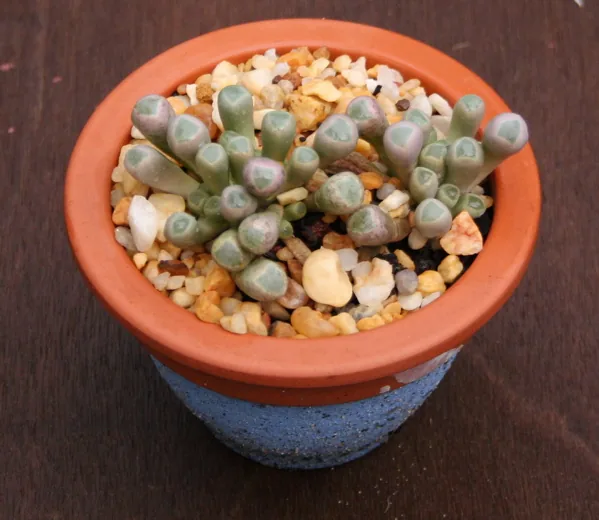
Fenestraria rhopalophylla is a small South African mesemb that grows as a clustered rosette of erect, club-shaped leaves, each tipped with a translucent epidermal pane. That window is the key to how it lives: in habitat the plant grows mostly submerged in sand, exposing only the panes, so light passes through them to the photosynthetic tissue while the bulk of the leaf stays shielded from heat and desiccation. Cultivated as a houseplant, growth is slow and the rosette stays compact, holding to no more than 1 to 3 inches (3 to 8 cm) in height.
The common name describes the morphology accurately, since the swollen, blunt leaf tips read as a cluster of pale toes at the soil surface. On an established plant, the cooler-season growth cycle culminates in daisy-like yellow to white flowers borne on short peduncles in late summer to autumn, with blooms approaching the diameter of the rosette itself.
The decisive factor in cultivation is water restraint. Because the leaves are water-storage organs with limited capacity, excess moisture in the rooting medium drives splitting and rot rather than growth. Pair a gritty substrate with disciplined watering and the plant performs reliably on a bright sill for years.
Care
The short version: supply bright light, a sharply drained gritty medium, and minimal water. Irrigate occasionally through the cooler months, hold the plant nearly dry across summer, and never allow the substrate to remain saturated.
Light
Provide bright light, optimally bright indirect exposure supplemented with gentle direct sun, since high irradiance maintains the compact rosette. The plant acclimates to full sun once hardened to it, but under deficient light the leaves etiolate and the cluster loosens, sacrificing the form the species is named for.
Water
Water management is the principal control point, because the storage leaves tolerate little excess. Irrigate sparingly and only during the cooler growing season, allowing the gritty medium to dry through completely between applications, and hold the plant nearly dry across the summer rest. Surplus moisture exceeds the leaves' capacity and produces splitting, bursting, or rot.
Soil
Root it in a very gritty, sharply drained mineral or cactus medium that sheds water immediately, since rapid drainage is what prevents moisture buildup around the leaf bases. A pH of 6.0 to 7.5 is appropriate. If the medium retains moisture beyond a day or two, amend it with additional grit or pumice.
Temperature
The plant performs at ordinary interior temperatures, within a working range of 50°F to 77°F (10°C to 25°C). It is not frost-hardy, so maintain it indoors or relocate it under cover before temperatures fall.
Humidity
Low ambient humidity is well tolerated, as this is a xerophyte adapted to dry air. No humidity intervention, misting or pebble trays, is warranted or beneficial.
Feeding
Fertilize rarely, and only during the cooler-season growth phase. A heavily diluted, low-nitrogen cactus or succulent feed at long intervals suffices, because excess nitrogen forces soft, structurally weak tissue at odds with the plant's habit.
Pruning
Routine pruning is unnecessary. Remove only shriveled or rotted leaves as they appear, which keeps the cluster tidy and removes tissue that could harbor rot.
Repotting
Repot at intervals of every 2 to 3 years, or sooner once a clump has outgrown its container and roots emerge from the drainage holes. Transfer it into fresh gritty medium and a marginally larger pot, then withhold water for several days so disturbed roots can re-establish before they meet moisture.
Size & spacing
Mature dimensions remain small, with height held to 1 to 3 inches (3 to 8 cm) and a clump spreading 4 to 8 inches (10 to 20 cm) across over time. The compact footprint suits a shallow dish or a position among other plants on a windowsill.
Troubleshooting
Fenestraria presents few disorders, and nearly all of them resolve to a water or light imbalance. Soft, fissured leaves point to surplus moisture in storage tissue, while elongated, chlorotic growth points to an inadequate light budget. Diagnose those two variables and the rest of the plant's behavior follows.
Swollen leaves that split, burst, or go soft
This is almost invariably overwatering, and it peaks in summer when the dormant plant draws very little. The storage leaves absorb more water than their tissue can accommodate, so they fissure or break down into soft, translucent mush. Suspend irrigation, let the gritty medium dry out completely, excise rotted leaves, and relocate the plant to a brighter position with better air movement.
Fix:
- Stop watering immediately and let the mix dry out completely
- Remove rotted leaves
- Move to a brighter, well-ventilated spot
- Repot into a grittier mineral mix if soil holds water
Pale, stretched leaves leaning toward the window
Elongated, chlorotic leaves angling toward the glass indicate a plant deprived of light. With insufficient irradiance the compact rosette opens out and loses its characteristic form. Move it to a brighter location, but raise the light level over a week or two so the tissue acclimates rather than scorches.
Fix:
- Move to a brighter location with strong indirect or gentle direct light
- Acclimate gradually to stronger light to avoid scorching
Toxicity
For households with pets or children, the verdict is favorable: Fenestraria is non-toxic. The ASPCA does not list the genus among toxic plants, so incidental ingestion by a cat, dog, or child carries no poisoning risk. The only plausible effect from a large quantity of the high-moisture leaf tissue is transient gastrointestinal upset.
Safe for
People · Cats · Dogs · Horses · Rabbits · Livestock · Birds
Cats Safe
Fenestraria is safe for cats, and ingestion will not poison one. A cat that consumes a quantity of the fleshy leaves may salivate or show brief gastric upset, consistent with the response to any unfamiliar plant material.
Dogs Safe
Dogs may occupy the same space as this plant with no poisoning risk. The most a persistent chewer encounters is loose stool from the high water content of the leaf tissue, which resolves without intervention.
Horses Safe
The plant contains nothing harmful to horses. Its diminutive size makes grazing improbable in any case, so it represents no meaningful concern in a stable or paddock.
Rabbits Safe
Rabbits may consume the leaves with no toxic effect. The succulent tissue carries a high water load, so a large intake can yield loose droppings, but nothing beyond that.
Livestock Safe
Cattle, goats, and sheep are subject to no poisoning from this succulent. It lacks the toxic compounds present in hazardous range species, and its small stature keeps it out of forage regardless.
Birds Safe
Pet birds and backyard poultry are at no risk around Fenestraria. A bird that pecks a leaf ingests only innocuous plant sap.
People Safe
Fenestraria is non-toxic to humans, including small children. It is not a culinary plant, yet a leaf placed in the mouth by a curious toddler causes no harm beyond possible mild gastric discomfort.
Varieties
The species reaches cultivation as a single dominant form, and the distinction rests on floral pigmentation.
Fenestraria rhopalophylla subsp. aurantiaca
This is the subspecies most often offered in cultivation, distinguished by bright yellow to orange flowers in place of the white blooms of the typical form.
How to propagate
Two routes apply: vegetative division of an established clump, which is reliable, and seed, which is slower and more exacting.
Offsets & pupsEasy
Cooler growing season · 4 to 8 weeks to root
The dependable method is vegetative division of an established clump during the cooler growing season. Separate a cluster, allow any cut or torn surfaces to dry and callus for a day or two so they resist rot, then set the divisions into a gritty medium. Root establishment follows in roughly 4 to 8 weeks.
SeedModerate
Cooler growing season · Several weeks to germinate, months to size up
Seed propagation is slower and demands closer management. Sow on the surface of a gritty medium in the cooler season, hold it lightly moist and warm, and germination proceeds over several weeks. Thereafter expect months of careful, restrained watering before the seedlings develop into recognizable plants.
Myths
The leaf windows mean the plant wants deep shade indoors.
The inference inverts the adaptation. The translucent panes evolved precisely so the plant could survive submerged in substrate, channeling incident light through the window to chlorophyll-bearing tissue below the sand surface. In cultivation, Fenestraria still requires ample bright light to hold its compact rosette, so the windows signal a need for light, not shade.