Houseplant · Aizoaceae
Lithops
Lithops
Tiny living stones adapted to survive on almost no water, so their care hinges on withholding it at the right times.
Full sun
41–77°F · 5–25°C
USDA 10–11
1–2 in · 2–4 cm
Overview
The pebble-like form of a lithops is a case of camouflage evolved for the dry grasslands of southern Africa, where blending into surrounding stones offers protection. Each plant is reduced to two fused, water-storing leaves capped by a translucent window that admits light into the interior. Growth is slow and the plants stay small, rarely exceeding 2 inches (5 cm) across, yet a well-managed specimen persists for decades.
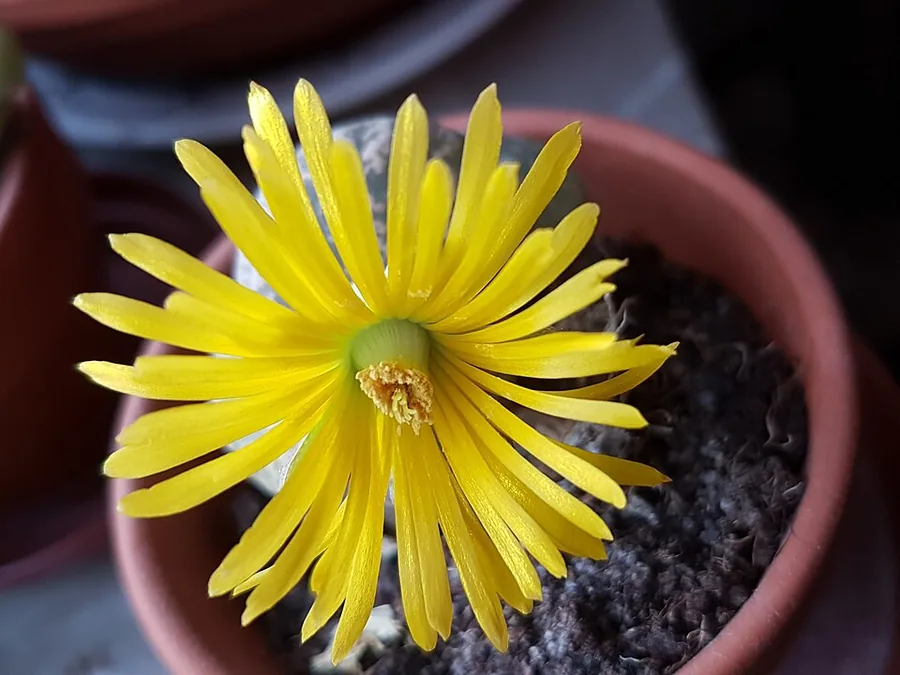
Their defining feature is an annual cycle geared to arid conditions. Across the heat of summer the plant enters dormancy and requires no water, conserving its stored reserves. A new leaf pair then develops inside the old one, splitting it and drawing on its moisture and nutrients, so renewal proceeds from internal resources rather than the soil. In late summer and autumn a single daisy-like flower, white or yellow, emerges from the fissure between the leaves.
These plants are not inherently difficult, but they demand a keeper who withholds rather than intervenes. The central skill is reading the cycle to know when to water and when to keep them bone dry. Managed to that rhythm, a lithops ranks among the toughest and longest-lived plants suited to a sunny sill.
Care
The short version: provide the brightest sun available, a sharply draining gritty mix, and water only during active growth in autumn and spring, keeping the plant completely dry through summer dormancy and the leaf split.
Light
Lithops require full sun or the strongest available light throughout the year, which a south-facing window supplies indoors. Under insufficient light the bodies elongate and pale rather than holding the flat, compact form that strong sun maintains.
Water
Watering governs success with this plant. Apply water only during active growth in autumn and spring, saturating the gritty medium and then allowing it to dry completely before the next application. Through summer dormancy and the leaf-renewal split, keep the plant bone dry, because moisture at those stages drives rapid rot.
Soil
Use a very gritty, sharply drained mineral or cactus mix that lets water pass through freely, with a pH between 6.0 and 7.5. Faster drainage reduces the interval of saturation and correspondingly lowers the risk of rot.
Temperature
The plant tolerates roughly 41°F to 77°F (5°C to 25°C). A cool, dry winter rest suits its dormancy, provided it is protected from hard frost at the low end and from heat that would prompt untimely water uptake at the high end.
Humidity
As a desert species it favors low humidity and moving air, so no target range applies. Damp, stagnant conditions promote the fungal rot that is its principal killer.
Feeding
Lithops have minimal nutrient demands. A dilute, low-nitrogen, high-potassium cactus fertilizer applied during autumn and spring growth is sufficient and largely optional. Excess nitrogen produces soft, weak tissue prone to failure.
Pruning
No pruning is warranted. As the old leaf pair shrivels during renewal, allow it to dry and be reabsorbed naturally, since peeling or pulling it prematurely interrupts the transfer of reserves and sets the plant back.
Repotting
Repot only every 3 to 5 years, and only once the clump has crowded the pot or extended roots through the drainage holes. The plant performs well pot-bound, so frequent repotting is unnecessary.
Size & spacing
Each plant remains diminutive at 1 to 2 inches (2 to 5 cm) tall and comparably wide, forming a clump gradually over successive seasons. A small, shallow pot accommodates several with adequate room for lateral spread.
Troubleshooting
Nearly every disorder in lithops resolves to a fault in watering or light, and most are preventable once the mechanism is understood. The plant registers stress in the body itself, softening, elongating, or wrinkling, so each sign should be interpreted against the plant's position in its annual cycle. Confirm the pattern below before adjusting water.
Translucent, softening tissue that collapses from the base
A body that has turned soft and glassy is failing to rot, and the trigger is nearly always moisture the plant could not use. Water taken up during summer dormancy or the leaf split has nowhere to go, and soil that holds water keeps the base saturated, so tissue breaks down from the bottom upward. Halt watering, excise the rotted tissue with a clean blade, and set the plant into dry, gritty mix so it can firm up before it draws water again.
Fix:
- Stop watering immediately
- Remove the plant and cut away any rotted tissue with a clean blade
- Repot into dry, gritty mineral mix and withhold water until firm growth resumes
Etiolated growth: a pale body gaining height and losing its compact form
A body that elongates and pales is reaching for light it isn't receiving, since the compact, flat-topped form depends on strong sun to hold. Under low light the plant invests in height rather than in a squat, sun-adapted shape. Relocate it to the brightest position available, and raise the light in stages so the surface acclimates rather than scorching under the sudden change.
Fix:
- Move to the brightest available position
- Introduce stronger light gradually to avoid scorch
Retained old leaf pairs stacking beneath the emerging new growth
When old leaves persist beside an emerging new pair, the plant has received water during the leaf split and no longer needs to draw on the old tissue. Renewal is designed to run on reserves in the shrinking old pair, not on soil moisture, so surplus water stalls the exchange and leaves the plant overstacked. Withhold water entirely until the old pair dries down and is fully reabsorbed.
Fix:
- Withhold all water until the old leaf pair fully dries and is absorbed
Wrinkling of the body during the autumn or spring growth phase
Wrinkling that appears while the plant is in active growth signals water loss the roots are not replacing, and a measured drink during that growth phase restores turgor. The distinction is seasonal. Shriveling through summer dormancy or during renewal reflects the plant's normal internal water transfer and calls for no intervention.
Fix:
- Resume careful watering only if the plant is in active growth
Toxicity
For households with pets or children, lithops present no toxic concern. Cats, dogs, rabbits, birds, and people can share a space with them safely, since the plant carries no reported toxic compounds. A stray nibble of the leaves warrants no alarm.
Safe for
People · Cats · Dogs · Horses · Rabbits · Livestock · Birds
Cats None
No toxic compounds affect cats, so ingestion poses no poisoning risk. A cat that swallows a mouthful of the gritty medium may vomit briefly, but that reaction traces to the mineral mix rather than the plant.
Dogs None
The plant contains nothing toxic to dogs, so chewing on one causes no harm. Its low, squat form also offers little to attract a dog in the first place.
Horses Safe
No compound in the plant is poisonous to horses, and at this size it presents almost nothing available to graze.
Rabbits Safe
The fleshy leaves carry no harmful compounds, so rabbits can sample the plant without risk.
Livestock Safe
Cattle, goats, and sheep encounter no toxic threat from it, and a windowsill succulent this small seldom enters their range.
Birds Safe
The plant holds no toxins that would affect birds, so pet birds may peck at it without consequence.
People Safe
It poses no hazard to people, children included. The plant is not cultivated for consumption, but a tasting causes no damage.
Varieties
The genus comprises dozens of species, valued in cultivation for the coloration and surface markings of their windowed tops. A handful recur consistently in collections.
Lithops aucampiae
Among the more tractable species for cultivation, it carries reddish-brown to coppery tops etched with darker, branching lines.
Lithops lesliei
A widely cultivated species identified by its finely netted, rusty-brown windowed tops and yellow flowers.
Lithops optica 'Rubra'
Sought after among collectors for the striking purple-red coloration of its bodies.
Lithops karasmontana
Its pale grey to pinkish bodies bear an intricate reddish pattern distributed across the surface.
Lithops salicola
With grey-green tops and translucent windows, it tolerates slightly more moisture than most of its relatives.
How to propagate
Lithops propagate by seed or by dividing an established clump, and neither method is quick. Both call for patience and disciplined control of moisture.
SeedModerate
Sow in spring or early autumn onto gritty mix and keep warm and lightly moist until germination. · 2 to 3 years to reach mature flowering size
Seed is the standard route for propagating lithops. Surface-sow onto gritty mix in spring or early autumn and hold the medium warm and lightly moist until germination. Expect a long timeline, since a seedling requires 2 to 3 years to reach mature flowering size and careful moisture management throughout.
DivisionModerate
Divide established multi-headed clumps at repotting during active growth. · Several months to root and re-establish
Established multi-headed clumps can be divided during active growth, most conveniently at repotting. Separate the heads while retaining roots on each division, allow the cut surfaces to callus and dry, then pot them individually and allow several months for rooting and re-establishment.
Myths
Lithops are a type of cactus.
They are leaf succulents in the family Aizoaceae and share no close phylogenetic relationship with the true cacti of the Cactaceae. The two lineages arrived at the same water-storing strategy independently, from separate branches of the plant kingdom.
Lithops require the routine watering schedule of a conventional houseplant.
Applying a conventional leafy-houseplant schedule accounts for most losses. The plant must remain completely dry through summer dormancy and the leaf-renewal split, and overwatering is the single most common cause of death.