Houseplant · Asparagaceae
Spider Plant
Chlorophytum comosum
Supply bright indirect light and water once the soil dries, and the spider plant grows quickly while staying safe around pets.
Bright indirect
Every 7–10 days
55–75°F · 13–24°C
USDA 9–11
Overview
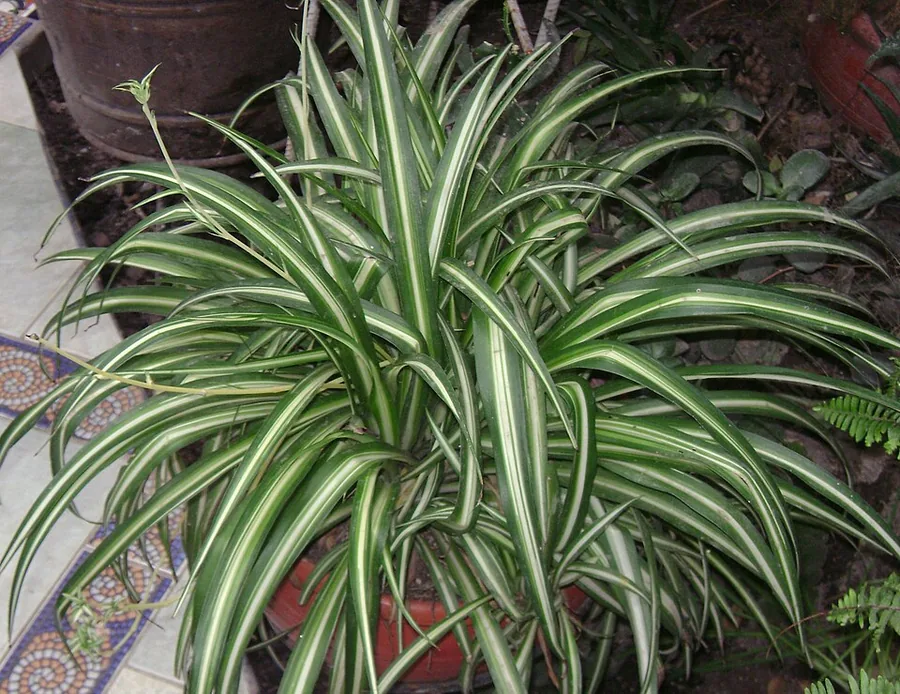
Among houseplants, few are as undemanding as the spider plant. It originates in the woodlands of southern Africa, growing under dappled canopy shade, and that native niche explains its tolerance for a dim indoor corner. The arching, ribbon-shaped foliage cascades past the rim of a container, which suits it to a shelf or a hanging basket.
Its signature trait is the offsets. A mature specimen extends long, wiry runners ending in small plantlets, often called spiderettes, that hang in midair like spiders suspended on silk. Each roots readily, so one parent yields a whole collection of free plants to distribute.
For many households the decisive feature is safety. The spider plant is non-toxic to cats and dogs, so a pet that paws the trailing leaves takes no harm. Provide indirect light and water as the medium dries, and it grows fast while forgiving nearly every novice error.
Care
The short version: provide bright indirect light while shielding the foliage from direct sun, irrigate every 7 to 10 days after the upper half of the medium has dried, pot in a free-draining mix, and hold the room between 55°F and 75°F (13°C to 24°C).
Light
Position the spider plant in bright indirect light and shield it from direct sun, which bleaches and scorches the blades by destroying chlorophyll. It still copes with medium light, shade, and a low-light corner, though the foliage colors hold richest under bright, filtered exposure. A window screened by a sheer curtain meets its needs almost exactly.
Water
Allow the top half of the soil to dry before the next watering, which generally falls around every 7 to 10 days. Scale back through winter, when growth slows and the medium stays wet longer. Because the fleshy roots store moisture, this plant withstands a skipped drink far better than a saturated pot.
Soil
Pot it in a well-draining general-purpose potting mix so water passes through rather than collecting around the roots. It shows little sensitivity to acidity, performing across a pH range of 6.0 to 8.0. Drainage is the single property that counts, since standing moisture invites root rot.
Temperature
Standard room warmth serves it, with the preferred band sitting between 55°F and 75°F (13°C to 24°C). Shelter it from cold drafts and any location nearing freezing, as it remains a tender plant at root. Steady indoor temperatures cover everything it requires.
Humidity
Ordinary household humidity suffices, so no target reading applies. Parched winter air can crisp the leaf tips, and those same conditions invite spider mites to establish. Rinsing the foliage or setting a water tray nearby helps when the air turns very dry.
Feeding
Apply fertilizer only across the spring and summer growth period, withholding it through fall and winter. A half-strength balanced houseplant fertilizer at occasional intervals is ample. Restraint matters, because surplus feeding scorches the leaf tips brown and curbs the plantlets you are after.
Pruning
A spider plant calls for little pruning beyond grooming. Trim browned leaf tips on a slant to preserve the natural blade outline, and cut faded flower stems back once spent. Plantlets can also be removed for propagation or simply to keep the plant tidy.
Repotting
Expect to repot every 1 to 2 years, or as soon as the plant becomes rootbound. The cues are roots crowding or cracking the pot, fleshy tubers heaving the soil upward, or rapid drying paired with fewer plantlets. Shift it up a single pot size and renew the medium.
Size & spacing
A spider plant reaches roughly 12 to 24 inches (30 to 60 cm) in height and extends from 12 to 35 inches (30 to 90 cm) as the blades arch over and the offsets trail down. Allow space for it to spill, since a shelf edge or a hanging basket displays it to best effect. Its fast growth fills a pot within one season.
Troubleshooting
Spider plant problems surface earliest in the foliage, with brown tips topping the list. Reading these signals promptly lets you correct a minor fault before it widens. Compare what you observe against the entries below, then respond while intervention still pays off.
Yellow leaves above soft, mushy roots
Yellowing foliage standing over waterlogged soil reflects root rot driven by overwatering, and the condition advances quickly once it sets in. Lift the plant from its pot, excise every brown and softened root, and replant into clean, sharply draining medium. From there, water less often and confirm the container drains freely.
Fix:
- Unpot and trim rotten roots
- Repot in fresh well-draining mix
- Reduce watering
Bleached, scorched patches across the sun-exposed foliage
Faded, scorched foliage indicates photodamage from direct sun striking the blades. This species is adapted to bright indirect light, so unfiltered rays on a warm sill destroy chlorophyll and leave the tissue pale. Set it back from the pane or diffuse the light with a sheer curtain so the harshest midday rays never reach the leaves.
Fix:
- Move to bright indirect light
- Shield from midday sun
Hard brown bumps fixed along leaf blades and stems
Immovable brown bumps along the tissue are scale insects, and the tacky film beside them is the honeydew these sap feeders excrete. Scrape the shells away with a cloth, then coat the plant in horticultural oil or insecticidal soap to reach the survivors. Examine any incoming plant before it sits beside the rest.
Fix:
- Wipe off scales
- Apply horticultural oil or insecticidal soap
White, cotton-like masses lodged in the leaf axils
Cottony white masses lodged where the leaves meet are mealybugs, a further sap feeder that coats the surface in sticky residue. Touch each colony with a cotton swab dipped in rubbing alcohol, which strips their protective wax, then follow through with insecticidal soap. Hold any new acquisition apart until it proves clean.
Fix:
- Dab with rubbing alcohol
- Apply insecticidal soap
Silken webbing paired with stippled, dusty leaf surfaces
Delicate webbing over stippled, speckled blades points to spider mites, an arachnid pest that thrives in dry indoor air. Rinse the foliage thoroughly at the tap, apply insecticidal soap or a miticide, and lift the humidity around the plant. Moist conditions make the leaf surface inhospitable and slow their spread.
Fix:
- Rinse foliage
- Apply insecticidal soap or miticide
- Raise humidity
Brown, papery tips forming at the end of each blade
Browning at the leaf ends is the most reported issue on this species, and it rarely signals real decline. The mechanism is mineral accumulation: fluoride, chlorine, and dissolved salts carried in tap water concentrate at the leaf margins, with dry air or excess feeding making it worse. Irrigate with distilled water or rainwater, periodically leach the pot to flush stored salts, and clip the dead ends on a slant.
Fix:
- Water with distilled or rainwater
- Flush pot to leach salts
- Trim browned tips
- Ease off fertilizer
Colonies of small soft-bodied insects massed on fresh shoots
Soft-bodied colonies massed on tender shoots, accompanied by a sticky coating, identify aphids. A firm jet of water at the tap dislodges the bulk of the population at once. Apply insecticidal soap should they return, and watch the emerging growth, which is the tissue they target first.
Fix:
- Rinse off with water
- Apply insecticidal soap
A vigorous specimen producing no offsets or plantlets
A vigorous plant that withholds plantlets is usually immature or sitting in too generous a pot. This species reserves offsets until it matures and the roots grow somewhat confined. Reduce the feeding, allow it to age, and supply short days paired with long, unbroken nights for roughly 3 weeks to cue the display.
Fix:
- Let plant mature and become slightly potbound
- Reduce fertilizer
- Give short days and long uninterrupted nights ~3 weeks
Toxicity
This is a houseplant you can keep without worry. The spider plant is non-toxic to cats, dogs, and people, so nothing needs to be stowed up high or out of reach. A pet that chews a blade is in no danger, which accounts for much of its standing in family homes.
Safe for
People · Cats · Dogs · Horses · Rabbits · Livestock · Birds
Cats Safe
Cats often swat and chew the arching blades with no ill effect. The most a heavy mouthful causes is brief, mild digestive upset.
Dogs Safe
Dogs can gnaw the foliage without consequence. Among leafy houseplants, few rank as gentler company for an inquisitive pup.
Horses Safe
Carries no toxicity for horses. An exploring muzzle can sample a blade and come away unharmed.
Rabbits Safe
Rabbits may nibble it without risk, though any leafy green belongs in modest portions within their diet.
Livestock Safe
Holds no poisoning hazard for grazing stock such as cattle, goats, or sheep.
Birds Safe
Harmless around companion birds and poultry. A pecked leaf does them no damage.
People Safe
Non-toxic to people and gentle around children, a quality that recommends it for households with inquisitive toddlers.
Varieties
A small set of named cultivars exists, separated chiefly by how the leaves are striped or coiled. The selections below are the ones most often sold under name.
'Vittatum'
The most familiar selection, marked by a pale creamy band tracing the center of every green blade.
'Variegatum'
Here the variegation reverses, with crisp white margins outlining the green rather than a stripe through the middle.
'Bonnie'
A space-saving form whose variegated leaves twist and curl into loose coils instead of arching cleanly outward.
'Milky Way'
Distinguished by a wide cream-to-white core that leaves only a slim green rim along each margin.
'Mandaianum'
A miniature cultivar bearing deep green leaves ruled with yellow, scaled for a narrow ledge or shelf.
How to propagate
Spider plants rank among the simplest houseplants to increase, and the dangling offsets handle most of the effort. You can root those plantlets, divide an overcrowded clump, or sow seed if patience allows.
Offsets & pupsEasy
Anytime plantlets present · 2-4 weeks
This route is both the most enjoyable and the simplest path to new stock. Pin a plantlet, known to some as a spiderette, against moist medium while it remains joined to the parent, or suspend it in water until roots emerge and then pot it. Roots typically develop within 2 to 4 weeks, after which you sever it to stand alone.
DivisionEasy
At repotting or spring · Few weeks
Once a mature clump has packed its container, dividing offers an alternative. During repotting or through spring, ease the plant free and tease the fleshy, tuberous root system into segments, each holding both leaves and roots. Set the divisions into their own pots and they establish over the following few weeks.
SeedModerate
Spring · Several weeks
Raising plants from seed is the patient, uncommon approach. Sow during spring and allow the seedlings several weeks to anchor. Bear in mind that seed-raised offspring can diverge from the parent, so a variegated mother may yield plain green progeny.
Myths
Chlorophytum comosum measurably purifies the air in a room.
The air-purifying reputation traces to a sealed-chamber experiment that does not reflect a lived-in room. A peer-reviewed review concluded that the share a single potted plant draws from household air is negligible against the exchange from a cracked window. Ventilate the room to clear the air, and grow the plant for the pleasure of it.
Tip browning indicates the specimen is in terminal decline.
The browned ends read as a crisis, yet the plant supporting them is generally sound. The trigger is almost always fluoride, chlorine, and salts in tap water, or parched air, rather than genuine failure. Move to distilled water or rainwater and the fresh growth emerges clean.
Spider plants need bright direct sun.
Unfiltered sun is precisely what this species cannot tolerate, since it bleaches the blades. The plant performs on bright indirect light and will persist in shade and low light as well. Keep it off a scorching sill and the foliage holds a deep, uniform green.
Chlorophytum comosum is poisonous to household cats and dogs.
This false fear bars an excellent plant from pet households without cause. The ASPCA lists the spider plant as non-toxic to both cats and dogs, which stands as its strongest credential. An animal that samples a leaf faces no risk whatsoever.
Generous fertilization increases plantlet production.
Loading on fertilizer produces the reverse of the intended result. Excess feeding suppresses plantlet output and scorches the leaf tips brown. Modest balanced feeding across spring and summer, given to a slightly potbound specimen, is what coaxes the offsets out.
Tap water is fine for spider plants.
Ordinary tap water is the standard culprit behind crisping leaf ends. Its fluoride and chlorine accumulate in the tissue and burn the tips as the months pass. Use distilled water or rainwater in its place, and leach the pot occasionally to carry the salts away.
Sources
- ASPCA
- NC State Extension Gardener Plant Toolbox
- University of Wisconsin-Madison Horticulture Extension
- Clemson Cooperative Extension HGIC
- Missouri Botanical Garden Plant Finder
- South Dakota State University Extension
- Royal Horticultural Society
- Journal of Exposure Science & Environmental Epidemiology (Cummings & Waring 2020)
- Drexel University