Shrub · Polygonaceae
Silver Lace Vine
Fallopia baldschuanica
A climber that reads full sun and thin soil as an invitation to cover a fence in a single season.
Full sun
Every 7–14 days
USDA 4–9
20–35 ft · 6.1–10.7 m
Overview
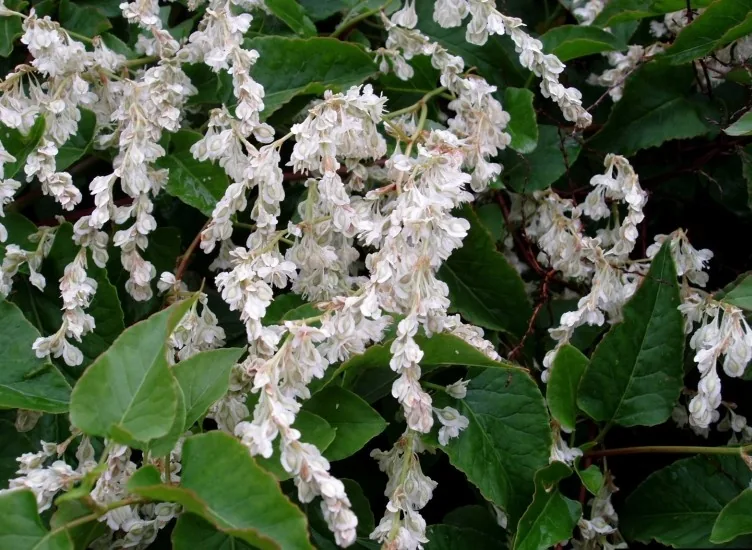
Silver lace vine is a fast, twining perennial climber grown for the froth of tiny creamy-white flowers it carries across a support by late summer. Because it blooms on the current season's growth, that display renews itself every year regardless of how hard it was cut. Its hardiness across zone 4 to 9 reflects a wide tolerance of cold, heat, drought, and poor soil that few ornamental climbers match.
The same vigor that makes it useful makes it a liability. New growth extending 10 to 15 feet in one season, combined with suckering, rhizomes, and self-sown seed, lets it move well past its support and into open ground. That behavior is the basis for its mile-a-minute vine name and for its weedy-to-invasive status across parts of the midwestern and northeastern US.
Managing it is a matter of working with that biology rather than against it. Site the plant on a strong, oversized support kept clear of trees, gutters, and valued beds, hold back nitrogen, and prune hard on an annual cycle. The lean, unfed conditions that would starve a needier plant are precisely what keep this one in bounds.
Care
The short version: grow it in full sun and any well-drained soil, water only through establishment, withhold fertilizer to avoid feeding its vigor, and prune hard each late winter before growth resumes.
Light
Site it in full sun, where flowering is heaviest; the density of bloom tracks directly with light. Partial sun and partial shade are tolerated, but each reduction in light yields correspondingly fewer of the lacy flower sprays.
Water
Irrigate young plants through their first season to establish the root system. After that, the vine is very drought tolerant and draws on established roots to withstand dry spells, so supplemental water is warranted only during prolonged drought, at intervals no closer than every 7 to 14 days.
Soil
Any well-drained soil serves, whether loam, silt, or sand, across a pH range of 5.5 to 8.0. Poor, lean ground is preferable by design, because low fertility restrains the vigor that drives the plant's invasive spread.
Temperature
Cold hardiness is a defining trait: the vine withstands the full span from -29°F to 100°F (-34°C to 38°C). Neither summer heat nor hard winter cold within that range checks its performance.
Humidity
Ambient outdoor humidity meets its needs, so no specific level applies. The plant is indifferent to seasonal swings in atmospheric moisture.
Feeding
Fertilizer is rarely justified. The vine's intrinsic vigor already outpaces most feeding, and a single spring application of a balanced or low-nitrogen product is warranted only where growth is genuinely weak. Surplus nitrogen intensifies the rampant growth, working against every effort to contain it.
Pruning
Pruning is the principal management task. Because flowering occurs on new wood, a hard cut in late winter or early spring both limits size and renews the framework, and it can be taken down to 1 to 3 feet for full renovation. Additional cuts through the season are expected to hold its dimensions.
Repotting
Container culture is uncommon and repotting seldom required. The diagnostic signs of a rootbound specimen are roots circling or emerging from the container, soil that dries unusually fast between waterings, and top growth that stalls despite adequate moisture.
Size & spacing
Allow substantial room and a structurally sound support. Mature height reaches 20 to 35 feet (6 to 10.5 m) with a spread of 2 to 25 feet (61 cm to 7.5 m), so position it at a distance from any planting or structure it could overtop.
When to plant
Plant silver lace vine in spring once frost has passed, or in early fall while soil warmth still favors root growth. Flowering runs from midsummer into fall on wood produced that same season, which is the reason the hard prune is timed for late winter: cutting before growth breaks removes none of the coming flowers and directs the plant's energy into fresh, flowering shoots.
Northern hemisphere
Southern hemisphere
Typical months for a temperate climate: start earlier in warm zones, later where spring frosts linger.
- Sow: Late winter to early spring, 6-8 weeks before last frost (seed propagation is uncommon; cuttings and layering are easier).
- Plant: Spring after last frost, or early fall.
- Harvest: Mid/late summer into fall (roughly July to frost).
Hardiness
USDA hardiness zones: 4–9
Temperature: down to -34°C
Troubleshooting
Pests and disease are minor concerns on this vine; the recurring problem is its own growth rate. Most interventions aim at containment rather than recovery. Identify the pattern below and respond early, since the plant's speed compounds any delay.
Vine overtopping its support and colonizing adjacent ground
This reflects the extreme vigor characteristic of the species, not a disorder. Single-season shoots reaching 10 to 15 feet, together with crown suckers and self-sown seed, carry the plant beyond its support and into open soil. Control depends on a hard late-winter cut, repeated summer pruning, and prompt removal of suckers and seedlings before they root in.
Fix:
- Prune hard in late winter and again through the growing season to keep it in bounds
- Cut back to 1-3 ft for full renovation when overgrown
- Remove suckers and pull or mow seedlings as they appear
- Install a sturdy, oversized support and keep it clear of trees, shrubs, and gutters
Ragged holes across the foliage during summer
The primary agent is the Japanese beetle, a metallic green-and-bronze insect that skeletonizes leaf tissue. Pale serpentine tracks within the leaf indicate leaf miners feeding internally. Because the vine outgrows this feeding readily, management is limited to hand-collecting beetles into soapy water at dawn and removing mined leaves.
Fix:
- Hand-pick Japanese beetles into soapy water in early morning
- Tolerate minor damage, as the vine outgrows it
- Remove and dispose of mined leaves
Toxicity
Silver lace vine carries no listing on ASPCA toxic-plant references and is treated as non-toxic to cats, dogs, and people. The management concern here is mechanical, not chemical: the risk lies in the heavy annual pruning the plant demands, not in ingestion of its foliage.
Safe for
People · Cats · Dogs · Horses · Rabbits · Livestock · Birds
Cats Safe
Silver lace vine is absent from the ASPCA toxic-plant list, so ingestion by cats carries no toxic consequence.
Dogs Safe
No toxic principle affects dogs; foliage may still cause transient digestive upset if a large quantity is consumed, as with most plant material.
Horses Safe
The species contains no equine toxin, and horses may graze the leaves and shoots without risk of poisoning.
Rabbits Safe
Rabbits face no toxic hazard, and the tender new growth is safe for them to browse.
Livestock Safe
Cattle, goats, and sheep can access the plant without exposure to any poisoning risk.
Birds Safe
Birds are unaffected by the foliage and frequently use the dense, fast-growing canopy for cover.
People Safe
There is no ingestion hazard for people. The only material risk is mechanical, arising from the heavy pruning the vine requires, so gloves and loppers are advised.
No special handling for toxicity; wear gloves and use loppers for the heavy seasonal pruning this vine requires.
Varieties
The species has produced few named selections. The two encountered in trade are separated chiefly by foliage color and ultimate size.
Lemon Lace
A more restrained, deer-resistant selection reaching roughly 20 to 30 feet, bearing the characteristic white flowers above chartreuse-to-gold foliage on red stems.
Species (Fallopia baldschuanica)
The unimproved species, and the most vigorous form in cultivation, distinguished by bright green heart-shaped leaves and frothy, lacy sprays of tiny fragrant flowers in creamy-white to greenish tones.
How to propagate
Silver lace vine roots readily from several methods, a propensity that underlies its capacity to spread. Cuttings, layering, and division each succeed with minimal intervention, and viable self-sown seed appears in surrounding soil without assistance.
Stem cuttingsEasy
Late spring to summer (softwood/semi-hardwood) · A few weeks to root; established in one season
The most reliable method. Softwood or semi-hardwood cuttings taken from new growth between late spring and summer root within a few weeks and reach established size within the first season.
LayeringEasy
Spring to summer · One season
A trailing stem pinned to the soil at any point from spring through summer forms roots at the contact point, yielding an independent plant in a single season.
DivisionEasy
Late winter to early spring · One season
Undertaken in late winter or early spring, division involves splitting the crown or lifting one of the freely produced rooted suckers; each piece establishes over the course of one season.
SeedModerate
Start indoors late winter to early spring · A season or more
Less common and slower. Seed sown indoors in late winter or early spring requires a season or more to establish, although the plant also self-sows into surrounding ground without cultivation.
Myths
Silver lace vine is simply another name for Japanese or giant knotweed.
Both belong to the same family, yet they are distinct plants. Silver lace vine is a white-flowered climbing ornamental, whereas Japanese and giant knotweed are upright, bamboo-like growers ranked among the most destructive invasives on record. Silver lace vine is the milder relation, though it too can behave weedily.