Ornamental · Polygonaceae
Mountain Fleece
Persicaria amplexicaulis
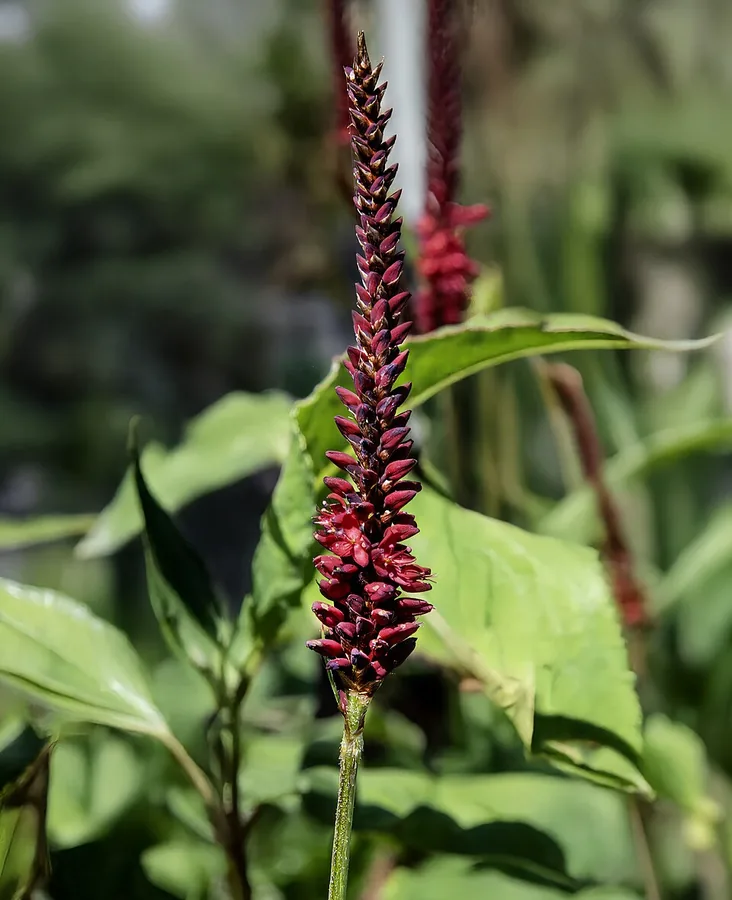
Hold the soil at steady moisture with room to spread, and mountain fleece raises red bottlebrush spikes from June to frost.
Full sun
Every 3–7 days
USDA 4–7
3–4 ft · 0.9–1.2 m
Overview
Mountain fleece is a durable herbaceous perennial that delivers an unusually long season of display. From June into October it carries slim red bottlebrush spikes above tidy clumps of green foliage, with little interruption to the bloom. It sits within the knotweed family, Polygonaceae, but its growth is restrained, forming a crown that broadens gradually rather than colonizing.
The species is adapted to the moisture-retentive end of the garden. It performs in average to wet soil, tolerates full sun where the root zone stays damp, and accepts part shade. Hardy to zone 4, it dies back to the crown each winter and resprouts reliably in spring, reaching 3 to 4 feet in both height and spread.
Maintenance is minimal. Cut the spent stems to the ground in late winter, divide a declining crown every few years to renew its vigor, and monitor for aphids and slugs. Deer and rabbits generally avoid it, a resistance that makes it a low-input structural plant for a border or a pondside planting.
Care
The short version: full sun to part shade over consistently moist soil. Cut it to the ground in late winter, divide the crown every 3 to 4 years to renew vigor, and allow each plant 3 to 4 feet to reach full size.
Light
Mountain fleece flowers most freely in full sun but performs acceptably in partial shade or partial sun. The limiting factor is water, because under full sun the soil must remain damp or the foliage wilts through the heat of summer.
Water
The species is moisture-demanding. Hold the soil consistently moist, watering on the order of every 3 to 7 days and more frequently under heat or strong sun. Its tolerance of wet ground and pond margins reflects an origin in damp habitats.
Soil
Site it in average, medium to wet but well-drained clay or loam. It withstands persistently damp conditions that would induce root rot in less adapted species, and it is indifferent to reaction, growing across a broad range from 6.0 to 8.0.
Temperature
Cold hardiness is exceptional, extending to -29°F (-34°C), with an upper comfort limit near 86°F (30°C). Because the plant retreats to its crown over winter and regenerates in spring, hard frost poses no threat to an established specimen.
Humidity
Ambient humidity outdoors is simply whatever the climate supplies, and the species is unaffected by it. Its requirement is moisture at the root, not in the air.
Feeding
Nutrient demand is modest. Incorporate a balanced general-purpose fertilizer or compost at the opening of the growing season in spring, and no more is needed. Restraint matters, since excess nitrogen drives soft growth that attracts aphids.
Pruning
Cut the entire clump to ground level in late winter or early spring to release the emerging shoots. Through the season, remove spent spikes to extend bloom and to reduce self-seeding.
Repotting
This is not a container subject, but the crown benefits from division every 3 to 4 years. Lift and split it once vigor declines, the center dies out, or the plant produces fewer and smaller flower spikes.
Size & spacing
Expect a mature clump of 3 to 4 feet (91 to 122 cm) in height and an equal spread. Allow each plant a matching 3 to 4 feet (91 to 122 cm) so the crown attains full size without competing with neighbors.
When to plant
The season for mountain fleece follows temperate rhythm. Sow seed indoors in late winter, transplant in spring once frost has passed or again in early fall, and expect the flowering spikes to run from June through October.
Northern hemisphere
Southern hemisphere
Typical months for a temperate climate: start earlier in warm zones, later where spring frosts linger.
- Sow: Late winter to early spring (about 6-8 weeks before last frost)
- Plant: Spring after the last frost, or early fall
- Harvest: June to October
Hardiness
USDA hardiness zones: 4–7
Temperature: down to -34°C
Troubleshooting
Mountain fleece carries a clean bill of health, with no serious insect or disease problems on record, so most issues amount to grazed foliage or storm-damaged stems. Identify the symptom below and intervene early, while control is straightforward.
Distorted shoot tips colonized by minute soft-bodied pests
The curl and distortion point to aphids, the pest that turns up most on mountain fleece. As they feed on phloem sap at the soft shoot tips, the growth deforms, and the sugary honeydew they excrete films the leaves below. A firm jet of water dislodges the colony, insecticidal soap breaks down the heavier clusters, and resident lady beetles and lacewings suppress what remains.
Fix:
- Spray plants with a strong jet of water to dislodge aphids
- Apply insecticidal soap or horticultural oil to affected growth
- Encourage natural predators such as lady beetles and lacewings
Foliage eaten into perforations and lacework between the veins
Two feeding habits produce this pattern. Japanese beetles, the metallic copper-and-green adults, graze the leaf between the veins in daylight and leave skeletonized tissue, while slugs and snails rasp ragged holes after dark and betray themselves with slime near the soil. Hand-pick the beetles into soapy water each morning, set iron-phosphate bait for the molluscs, and strip out the damp debris that shelters them.
Fix:
- Hand-pick Japanese beetles in early morning and drop them into soapy water
- Set out slug and snail traps or iron-phosphate baits
- Remove debris and mulch that shelter slugs and snails
Lodged or fractured flowering stems following stormy weather
The tall flowering stems act as a lever, so wind and heavy rain stress them at the base and larger clumps take the worst of it. Cut broken stems back to a clean node, from which new shoots can break. Ring exposed clumps with grow-through supports or stakes to spread the load, and where the site allows, place the plant out of the prevailing wind.
Fix:
- Remove broken stems with a clean cut
- Provide staking or grow-through supports for tall clumps
- Site plants in a location sheltered from strong wind
Volunteer seedlings and gradual clump expansion across seasons
Mountain fleece increases by two routes, self-seeding and slow rhizomatous creep, wherever the site suits it, so volunteers appear near the parent and the crown broadens season by season. The spread is incremental, and the species is on record as not invasive. Deadhead the spikes before the seed matures, remove volunteers while their roots are shallow, and lift and divide a crown once it has filled its allotted space.
Fix:
- Deadhead spent flower spikes before seed sets
- Pull or transplant unwanted seedlings while young
- Divide and reduce clumps that have spread beyond their space
Toxicity
For households with pets or children, the verdict is clear: mountain fleece is non-toxic. It is absent from the ASPCA listing, and horticultural references document no serious toxicity, so it can be planted without restriction where animals and children have access.
Safe for
People · Cats · Dogs · Horses · Rabbits · Livestock · Birds
Cats None
The ASPCA does not classify mountain fleece as toxic to cats, so a leaf sampled by a curious cat should cause nothing worse than transient digestive upset from the fibrous material.
Dogs None
No canine toxicity is documented. A quantity of foliage may briefly loosen the stool, as coarse plant matter often does, but the tissue holds no recognized poison.
Horses Safe
Records show no equine toxicity, and horses graze the plant without ill effect. Palatability is low, so the coarse spikes are usually left untouched.
Rabbits Safe
Browsing rabbits take no harm from it. The species is noted as rabbit-resistant, which explains why they favor softer neighboring plants instead.
Livestock Safe
Cattle, goats, and sheep face no documented hazard from mountain fleece, and no case of livestock poisoning has been reported.
Birds Safe
The species presents no risk to birds. Neither the small seeds nor the foliage carry a toxic principle, so it functions as a benign component of a wildlife border.
People Safe
The plant is safe around children. Grown solely as an ornamental, it presents no poisoning risk should a child handle or taste any part.
No special handling precautions are documented; as with any plant, discourage pets from chewing ornamental foliage to avoid mild stomach upset.
Varieties
The species is offered in several named selections that differ chiefly in stature and flower color. The two below are the most frequently encountered.
Firetail
A widely grown cultivar valued for its showy crimson to rose-red bottlebrush spikes held from June into October.
Golden Arrow
A compact selection restricted to 18 to 24 inches in height and spread, distinguished by golden-green foliage set against cardinal-red summer flowers.
Companions
Mountain fleece pairs best with plants that share its love of moist ground, and worst with anything that wants to stay dry.
Plant near
Ornamental grasses: Their upright vertical texture contrasts with the fleece flower spikes in borders and meadow plantings with similar moisture needs.
Astilbe: Shares a preference for moist soil and part shade, providing complementary plume-shaped blooms in similar conditions.
Keep apart
Drought-loving Mediterranean herbs such as lavender: These prefer dry, lean soil, which conflicts with the consistent moisture mountain fleece requires.
How to propagate
Mountain fleece propagates readily by division of the crown, by self-sown or collected seed, or by cuttings.
DivisionEasy
Spring or fall · One growing season
Division remains the most dependable method of propagation because it clones the parent and carries an established root system. Lift the rhizomatous clump in spring or fall, separate vigorous pieces, and reset them at the depth from which they came. Each division re-establishes and reaches its filled-out form within one growing season.
SeedModerate
Late winter to spring indoors, or self-sown outdoors · One to two growing seasons to reach flowering size
The plant self-sows freely, and collected seed can be started indoors from late winter into spring. Flowering is slow to arrive, since seedlings require one to two growing seasons to reach flowering size. Because seed does not reproduce cultivar traits reliably, seed-grown plants may diverge from a named parent.
Stem cuttingsModerate
Late spring to early summer · Several weeks to root, one season to establish
Softwood basal cuttings taken from non-flowering shoots in late spring or early summer offer a further route. Rooting occupies several weeks and full establishment takes a season, which is why most growers default to division.
Myths
Membership in the knotweed family guarantees invasive behavior, meaning mountain fleece is destined to overrun a planting.
The premise conflates distinct taxa. Mountain fleece does self-seed and creep outward slowly under favorable conditions, yet it is explicitly recorded as not invasive. Its habit bears no resemblance to that of the aggressive Japanese knotweed, and routine deadheading or division confines it easily.
The species harbors toxins that make it hazardous in households with animals or young children.
The evidence does not support this. The ASPCA does not list the species as toxic, and horticultural references cite no serious toxicity concerns. It is regarded as a fully non-toxic ornamental, appropriate for a garden shared with pets and children.