Vegetable · Polygonaceae
Rhubarb
Rheum rhabarbarum
A cold-hardy perennial that returns each spring with tart, edible stalks, while its oxalate-laden leaf blades stay firmly off the plate.
Full sun
Every 5–10 days
365–730 days
USDA 3–8
Overview
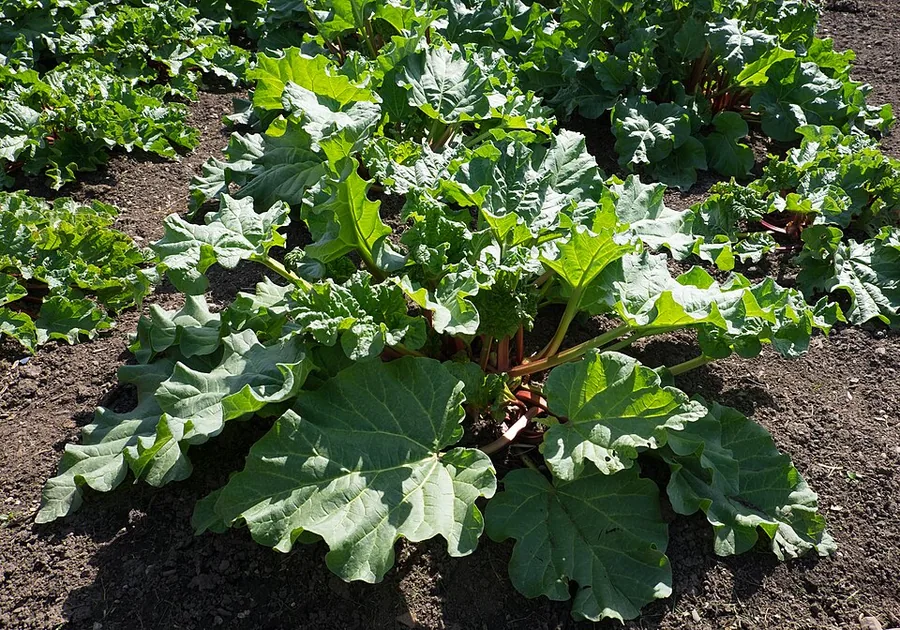
Rhubarb occupies an unusual niche: a vegetable grown for the dessert bowl. Its acidic red and green petioles cook into pies, crumbles, and jam, which is why it long carried the name pie plant. A member of the knotweed family, Polygonaceae, it withstands severe cold that would kill most garden crops, enduring winter lows near -40°F (-40°C).
The plant rewards a long view. Established from a single crown, it behaves as a long-lived perennial, producing fresh petioles each spring for a decade or more before the clump needs dividing. Harvest is withheld the first year and kept light the second so the root reserves can build, after which the plant yields well from the third season onward.
One distinction governs everything: the stalks are edible and the leaves are not. The expanded leaf blades concentrate oxalic acid and are toxic to people and animals, so they are cut off and discarded. Observe that single rule and rhubarb ranks among the least demanding crops to grow.
Care
The short version: grow rhubarb in full sun and deep, fertile soil, holding steady moisture at roughly an inch of water a week. Feed as the crown breaks dormancy in early spring, mulch to conserve moisture and keep the crown cool, and divide the crown every few years to sustain vigorous stalk production.
Light
Rhubarb performs best in full sun, tolerating partial shade only in warmer regions. Greater light drives more photosynthesis, which translates directly into thicker, more productive petioles.
Water
Maintain evenly moist but never waterlogged soil, equivalent to about an inch (2.5 cm) of water weekly. Deeper watering compensates during hot, dry spells, and a thick organic mulch conserves soil moisture while insulating the crown against heat.
Soil
Site rhubarb in deep, fertile, well-drained loam enriched with organic matter, at a pH of 6.0 to 6.8. Drainage is the critical variable, because a crown held in saturated soil is prone to rot.
Temperature
Rhubarb tolerates a broad thermal range, from -40°F to 86°F (-40°C to 30°C). It requires a genuine winter chill to enter dormancy and regenerate vigorously, which is why it performs poorly where summers remain persistently hot.
Humidity
Ambient humidity in the 40% to 60% range is entirely adequate and needs no management. Air movement around the large blades matters more, since stagnant, humid conditions favor the fungal leaf spots that disfigure the foliage.
Feeding
Apply a single feeding in early spring as the crown breaks dormancy, using a balanced fertilizer or well-composted manure. Rhubarb is a heavy feeder, so fertile soil and that annual boost support the dense, vigorous stalks the plant is grown for.
Pruning
Excise the central flower stalk at its base as soon as it emerges, since seed production diverts reserves away from petiole growth. Remove dead, yellowing, or frost-damaged leaves as well, and discard the toxic blades rather than feeding them to animals.
Repotting
Rhubarb remains in the ground, but the crown requires division every 5 to 10 years to sustain vigor. Thin, spindly petioles or a clump dying out at the center indicate congestion and signal the time to lift, split, and replant the strongest divisions.
Size & spacing
A mature plant attains 2 to 4 feet (60 to 120 cm) in height and an equal spread, so each crown should be allotted 3 to 4 feet (90 to 120 cm). That spacing supplies the air movement the large leaves require and room for the clump to develop.
When to plant
Rhubarb's cycle is driven by cold. Dormant crowns are set out in early spring the moment the soil can be worked, and harvest is withheld through the first season while the root system establishes. Petioles are gathered from spring into early summer, with full harvest reached in the third year once reserves are sufficient.
Northern hemisphere
Southern hemisphere
Typical months for a temperate climate: start earlier in warm zones, later where spring frosts linger.
- Sow: start seed indoors 8-10 weeks before the last spring frost (seed-grown plants are slow and variable)
- Plant: set out dormant crowns in early spring as soon as the soil can be worked (fall planting also works in mild areas)
- Harvest: harvest stalks in spring through early summer; do not harvest the first year, take only a few stalks the second year, and harvest fully from the third year onward
Hardiness
USDA hardiness zones: 3–8
Temperature: down to -40°C
Troubleshooting
Rhubarb is durable, and most disorders resolve to a few underlying causes: a congested crown, saturated soil, or heat stress. Reading the petioles and blades reveals the problem while it is still correctable. Match the symptom below and address the underlying cause, not only the symptom.
A softening, discolored crown and a collapsing plant
A soft, brown, mushy crown signals crown rot, typically caused by prolonged saturation and sometimes by a soilborne pathogen such as Phytophthora. Rotted tissue cannot recover, so excavate and destroy the affected crown. Replant healthy divisions on a raised, well-drained site, and keep mulch off the crown to prevent moisture accumulating against it.
Fix:
- Remove and destroy affected crowns
- Improve drainage and replant healthy divisions on a raised, well-drained site
A central flower stalk elongating above the foliage
The upright stalk bearing creamy panicles is bolting, a reproductive response to heat, long days, or an aging, congested crown. Because seed set draws on the same reserves that build petioles, cut the flower stalk at its base as soon as it appears. Sustained moisture, mulch, and periodic division of old crowns reduce the tendency in subsequent seasons.
Fix:
- Cut the flower stalk off at its base as soon as it is seen
- Keep plants consistently watered and mulched
Petioles emerging thin, short, and weak
Slender petioles most often indicate an overcrowded crown whose reserves are divided among too many buds, compounded by low fertility and over-harvesting. Lift and divide the crown in early spring, replant only vigorous pieces, and top-dress with compost or a nitrogen-rich fertilizer. Suspending harvest for a season allows the root reserves to recover.
Fix:
- Divide the crown in early spring and replant vigorous pieces
- Top-dress with compost or a nitrogen-rich fertilizer
- Reduce or stop harvesting for a season to let the plant recover
Discrete spots or feeding holes on the leaf blades
Round tan-to-purple lesions indicate a fungal leaf spot such as Ascochyta or Ramularia, whereas ragged holes reflect feeding by slugs or the rhubarb curculio. Remove and destroy the most affected blades, increase air circulation, and water at soil level to keep foliage dry. Hand-picking the beetles and managing slug populations limits further damage.
Fix:
- Remove and destroy badly affected leaves
- Improve air circulation and avoid overhead watering
- Hand-pick beetles and manage slugs
Toxicity
Rhubarb divides sharply into edible and toxic tissue, so the distinction is worth understanding. The cooked petioles are wholesome, but the leaf blades accumulate oxalic acid and anthraquinone glycosides that are toxic to people, cats, dogs, horses, and livestock. Cut the blades away, dispose of them beyond animal reach, and withhold trimmings from pets and grazing stock.
Toxic to
Cats · Dogs · Horses · Rabbits · Livestock · Birds
Safe for
People
Cats Moderate
A cat that ingests leaf-blade tissue typically drools and paws at an irritated mouth before vomiting and becoming lethargic. Larger quantities of soluble oxalates can precipitate tremors and impose measurable strain on the kidneys.
Dogs Moderate
Following ingestion of the foliage, a dog commonly shows drooling, gastrointestinal upset, appetite loss, and lethargy. A sufficient dose of the same oxalate crystals can provoke tremors and renal damage.
Horses Moderate
In horses the blades irritate the oral tissues and produce copious salivation, colic-like abdominal cramping, and weakness. A substantial intake risks lasting renal injury, so exclude horses from the foliage.
Rabbits Toxic
The oxalic acid concentration renders the leaves genuinely hazardous to rabbits, with no tolerable quantity. Keep all blades and trimmings entirely inaccessible.
Livestock Toxic
Cattle, sheep, and goats grazing the blades can develop severe oxalate poisoning, presenting salivation, abdominal pain, incoordination, and renal failure. Leaf trimmings must never be discarded into a pasture or pen.
Birds Toxic
The oxalic acid together with anthraquinone compounds makes the leaves unsafe for poultry and companion birds alike. Prevent backyard hens from foraging through discarded blades.
People Stalks safe
Cooked petioles are a long-established and safe food, but the leaf blades are not. Their oxalic acid content produces oral burning, nausea, and vomiting, so the blades are trimmed away and discarded.
The red or green leaf STALKS (petioles) are safe to eat when cooked, but the large LEAF BLADES are toxic to pets and people and must never be eaten or fed to animals. Cut blades off and dispose of them; do not leave trimmed leaves where pets or livestock can reach them.
Helpline numbers

United States
ASPCA Animal Poison Control: (888) 426-4435 (fee applies)

United Kingdom
Animal PoisonLine: 01202 509000 (fee applies)

Australia
Animal Poisons Helpline: 1300 869 738
Varieties
Comparatively few rhubarb cultivars dominate cultivation, separated chiefly by stalk color, sweetness, and durability under stress. The following selections are the ones most worth knowing by name.
Victoria
Victoria is a vigorous heirloom bearing green petioles flushed pink at the base, and it is the cultivar most commonly raised from seed.
Canada Red
Canada Red retains a deep red pigment along the entire petiole and eats sweeter and less fibrous than most cultivars.
MacDonald
MacDonald produces tender, bright red petioles combined with notable resistance to root rot, making it the preferred choice on heavier soils.
Glaskins Perpetual
Glaskins Perpetual carries a lower oxalic acid content, which permits harvesting later into the season than other cultivars.
How to propagate
Rhubarb is propagated most reliably by dividing an established crown, a vegetative method that preserves the parent's characters. Seed is a secondary option for those willing to accept a slower timeline and genetic variability.
DivisionEasy
Early spring while the crown is dormant (fall is also possible) · 1-2 years before light harvest, with full harvest by the third year
Division is the most dependable method of propagation and the one that preserves cultivar identity. Lift a dormant crown in early spring and cut it into sections, each retaining one or two strong buds and an ample portion of root, then replant with the buds set at or just below the soil surface. A year or two should pass before a light harvest, with full production by the third year. Every division reproduces the parent's characters faithfully.
SeedModerate
Start indoors 8-10 weeks before the last spring frost, then transplant out · 2-3 years to a full harvest
Propagation from seed is feasible but slow and genetically unpredictable. Sow indoors 8 to 10 weeks before the last spring frost, transplant the seedlings outdoors, and anticipate 2 to 3 years to full production. Because seedlings segregate and do not reproduce a named cultivar, seed suits experimentation while division remains the standard for known varieties.
Myths
The whole rhubarb plant is poisonous, so none of it can be eaten.
Only the leaf blades are toxic, owing to oxalic acid and soluble calcium oxalates. The cooked petioles are a safe, established food, the basis of pies and crumbles for generations. Removing and discarding the blades leaves the stalks entirely edible.
Rhubarb stalks become poisonous once the plant flowers or after hot weather.
Neither flowering nor heat alters the toxicity of the petioles. The toxic compounds are confined to the leaf blades, so a bolted plant remains safe to harvest. Removing the flower stalk simply redirects the plant back toward petiole production.