Ornamental · Polygonaceae
Buckwheat
Fagopyrum esculentum
Given warm soil, buckwheat closes over open ground, suppresses weeds, and feeds pollinators in just a few weeks.
Full sun
Every 5–10 days
70–90 days
USDA 3–10
Overview
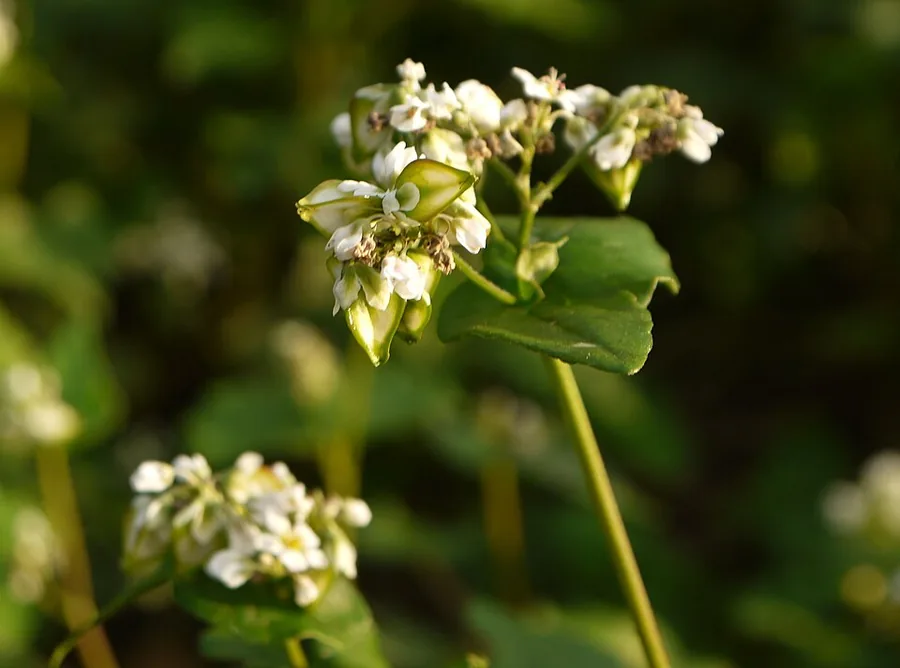
Buckwheat ranks among the fastest plants you can put in the ground. The name is misleading: it has no relation to wheat and is not a grass. It is a broadleaf pseudocereal in the knotweed family, grown both for its triangular grain and as a quick summer cover crop. Within weeks of sowing, the canopy of heart-shaped leaves closes over bare soil under a haze of small white to pinkish flowers.
Its real strengths are buying time and conditioning the soil. A buckwheat stand smothers weeds before they establish, scavenges phosphorus and leaves it more available to following crops, and pulls in bees and other pollinators in numbers. What it cannot do is fix nitrogen, because it is not a legume, so growers pair it with a legume cover crop when that is the need.
It demands very little and grows on poor, low-fertility ground that would starve more particular plants. The limit is its lack of toughness. Buckwheat wilts in heat and dies at the first frost, so it functions as a warm-season filler between main crops rather than a year-round fixture.
Care
The short version: direct-seed into warm, frost-free soil, provide a sunny site with sharp drainage held at consistent moisture, withhold fertilizer entirely, and terminate at the onset of bloom before viable seed develops.
Light
Buckwheat performs best in full sun and takes partial sun without much penalty. More light drives faster cover and stronger flowering, which is the entire point of growing it.
Water
Hold it at steady, even moisture, because buckwheat is not drought tolerant and wilts fast in hot, dry spells. It also rejects wet feet and fails on waterlogged or heavy soils, so the target is moist but well drained.
Soil
It thrives on light to medium, well-drained loams and actually prefers low-fertility ground, performing poorly on heavy, wet, or high-lime sites. A pH anywhere from 5.0 to 7.0 suits it, and it handles poor and slightly acidic soil better than most crops.
Temperature
Buckwheat is a warm-season annual operating from about 45°F to 95°F (7°C to 35°C). It is frost-tender, so one cold night kills it, and growth stalls under extreme heat.
Humidity
Ordinary outdoor humidity covers it, so there is no number to chase. It responds far more to cool, moist soil than to the air around it.
Feeding
Skip the fertilizer. Buckwheat is grown on low-fertility soils by design, and extra nitrogen only pushes it to lodge. It is not a legume and fixes no nitrogen, but it does scavenge phosphorus and leave it more available for the next crop.
Pruning
Grown as a cover crop, mow or till at early bloom, roughly 7 to 10 days after the first flowers open. That ends the crop before viable seed forms and stops it from reseeding as a weed.
Repotting
none
Size & spacing
Plants reach 2 to 4 feet (60 to 120 cm) tall with a narrow spread of 6 to 12 inches (15 to 30 cm). Because it is sown thickly as a stand rather than spaced out, that slim footprint is what lets the canopy knit together and shade out weeds.
When to plant
Buckwheat runs on warmth and tolerates no cold. Direct sow it into warm soil from late spring through midsummer once all danger of frost has passed, expect flowers within 3 to 6 weeks, and then either terminate it at early bloom as a cover crop or take the grain at about 10 to 12 weeks, before the first fall frost ends it.
Northern hemisphere
Southern hemisphere
Typical months for a temperate climate: start earlier in warm zones, later where spring frosts linger.
- Sow: Not recommended; direct sow only.
- Plant: Direct sow in warm soil after all danger of frost has passed, late spring through midsummer.
- Harvest: Small white to pinkish flower clusters appear within about 3 to 6 weeks; grain harvested at about 10 to 12 weeks.
Hardiness
USDA hardiness zones: 3–10
Temperature: down to -40°C
Troubleshooting
Buckwheat carries few real pests, so most trouble traces to timing and weather rather than disease. Match the signs below to what the stand is showing and act while it still makes a difference.
Self-sown buckwheat returns among following crops
What you are looking at is volunteer reseeding, and the cause is mechanical: a stand left standing long enough to flower and ripen seed will shed that seed into the ground for next season. Timing is the lever. Cut or till at early bloom, about 7 to 10 days after the first flowers open, while the seed is still soft and not yet viable, and pull the heart-shaped seedlings young, before they anchor.
Fix:
- Mow or till at early bloom, about 7 to 10 days after flowering begins, before any seed hardens
- Cultivate or hoe out volunteer seedlings while young
- Avoid letting any stand mature fully to seed
Blackened, wilted growth following a near-freezing night
The blackening tells you what happened: buckwheat is a frost-tender warm-season annual with no cold hardiness, so freezing or near-freezing tissue ruptures and the foliage darkens and collapses. Nothing brings it back once frost lands, so read it as the crop's natural end and turn the soft residue into the soil. The defenses are calendar-based: sow only once frost has passed, and for grain, time the harvest to land ahead of the first fall frost.
Fix:
- Accept frost kill as the natural end of the crop and incorporate residue
- For grain, harvest before the first frost
Thin, weak stand in hot or dry ground
The cause sits at both ends of the moisture range. Buckwheat is not drought tolerant, so it wilts under midday heat and a dry root zone, yet it also fails on heavy, waterlogged, or high-lime ground. Target the middle. Sow into light to medium, well-drained soil that holds steady moisture without saturating, and avoid both parched and soggy sites.
Fix:
- Sow into adequately moist, well-drained soil
- Avoid heavy, wet, or droughty sites
Following crops gain no nitrogen credit
Here is the mechanism behind the disappointment: buckwheat is a non-legume in the knotweed family, so it forms no root nodules and pulls no nitrogen from the air, no matter how green the canopy gets. Put it to work on what it physically does, namely fast weed suppression, phosphorus scavenging, and a heavy load of quick biomass. Where the rotation needs nitrogen, pair it with a legume cover crop or follow it with one.
Fix:
- Use buckwheat for weed smothering, phosphorus scavenging, and quick biomass rather than nitrogen
- Pair or follow with a legume cover crop if nitrogen is needed
Toxicity
For people the verdict is good: the grain is a wholesome, gluten-free food and the flowers are a prized honey and pollinator source. The caution lies with the green plant. Its flowers and foliage carry a pigment called fagopyrin, and grazing animals that eat large amounts and then stand in sun can develop fagopyrism, a sunburn-like skin reaction. The seed holds none of it.
Toxic to
Cats · Dogs · Horses · Rabbits · Livestock · Birds
Safe for
People
Cats Caution
Greens rarely tempt a cat, so exposure is uncommon, but one that eats a good portion of the flowering plant can develop digestive upset, and the fagopyrin absorbed can leave pale or thinly furred skin reactive to sunlight. The practical step is exclusion: keep an inquisitive cat clear of cut bouquets and of plants standing in bloom.
Dogs Caution
An occasional leaf seldom causes a dog any harm, though consuming a large quantity of the green, flowering plant can produce digestive upset. With pale-skinned or short-haired dogs, watch exposed skin for redness or itching after time outdoors in sun, since that is where the photosensitivity shows.
Horses Moderate
Grazing horses carry genuine risk, because heavy intake of flowering buckwheat plus sun exposure can drive fagopyrism. The reaction concentrates on white-marked and lighter areas of the muzzle and legs, which blister, peel, and itch. Remove an affected horse from direct sun and off the plant.
Rabbits Moderate
Do not let rabbits graze large amounts of the green plant. The fagopyrin in foliage and flowers can sensitize light skin and thinly furred areas, the ears most of all, so that sunlight produces inflamed, sunburn-like patches on those spots.
Livestock Moderate
Cattle, sheep, goats, and pigs are the textbook cases of fagopyrism. Heavy grazing on flowering buckwheat followed by sun exposure leaves their light-colored or exposed skin swollen, blistered, and itchy. Keep them off dense stands while in bloom to break the chain.
Birds Caution
Birds take the cleaned grain readily with no harm, because the seed holds no fagopyrin. The green plant is the concern: heavy feeding on flowering tops could sensitize bare or pale-skinned birds to sun, which places the risk squarely on the foliage and not the seed.
People Grain safe
Hulled grain and buckwheat flour are a wholesome, gluten-free food and safe to eat. The single caveat is the raw green plant: in rare cases, handling or eating a great deal of the flowering tops has sensitized light skin to sun, so keep in mind that the seed is the part people eat, not the foliage.
The cleaned grain and buckwheat flour are safe to eat. Keep pets and livestock from grazing large amounts of the flowering green plant, and be aware that affected light-skinned animals (and rarely people) should be kept out of direct sun after heavy ingestion.
Helpline numbers

United States
ASPCA Animal Poison Control: (888) 426-4435 (fee applies)

United Kingdom
Animal PoisonLine: 01202 509000 (fee applies)

Australia
Animal Poisons Helpline: 1300 869 738
Varieties
A few buckwheat types recur, whether the aim is grain, flour, or a fast cover crop. These are the ones worth knowing by name.
Common buckwheat (Fagopyrum esculentum)
This is the species behind nearly every planting, a fast warm-season broadleaf with white to pinkish flowers and named cultivars such as Mancan and Manor that work for both grain and cover.
Tartary buckwheat (Fagopyrum tataricum)
A hardier relative carrying small greenish self-pollinating flowers, this species handles cold better and holds more rutin, at the cost of a grain that tastes distinctly more bitter.
Silverhull
A long-grown common-buckwheat type valued for milling, Silverhull bears silvery-gray, thin-hulled seed that mills into flour with little resistance.
How to propagate
Buckwheat is straightforward from seed, which is the only way most growers start it.
SeedEasy
Direct sow in warm soil after all danger of frost, late spring through midsummer. · Germinates in about 3 to 5 days and covers the ground within a few weeks.
Direct seeding straight into the ground is how nearly everyone starts buckwheat. Sow into warm soil once all danger of frost has passed, any time from late spring through midsummer, and the seed emerges in just 3 to 5 days. The speed of that emergence is exactly what lets the canopy close over bare ground within a few weeks and shade weeds out so effectively.
Myths
Being a cereal grass related to wheat, buckwheat carries gluten.
The name is the source of the confusion. Buckwheat is a broadleaf pseudocereal in the knotweed and smartweed family, unrelated to true wheat and sharing nothing with cereal grasses. It is naturally gluten-free, which is precisely why its flour works for people who cannot eat wheat.