Herb · Lamiaceae
Shiso
Perilla frutescens
Pinch it early and often for tender, fragrant leaves, and it keeps producing for the pickle jar, the garnish, and the wrap.
Full sun
Every 2–4 days
59–86°F · 15–30°C
70–90 days
Overview
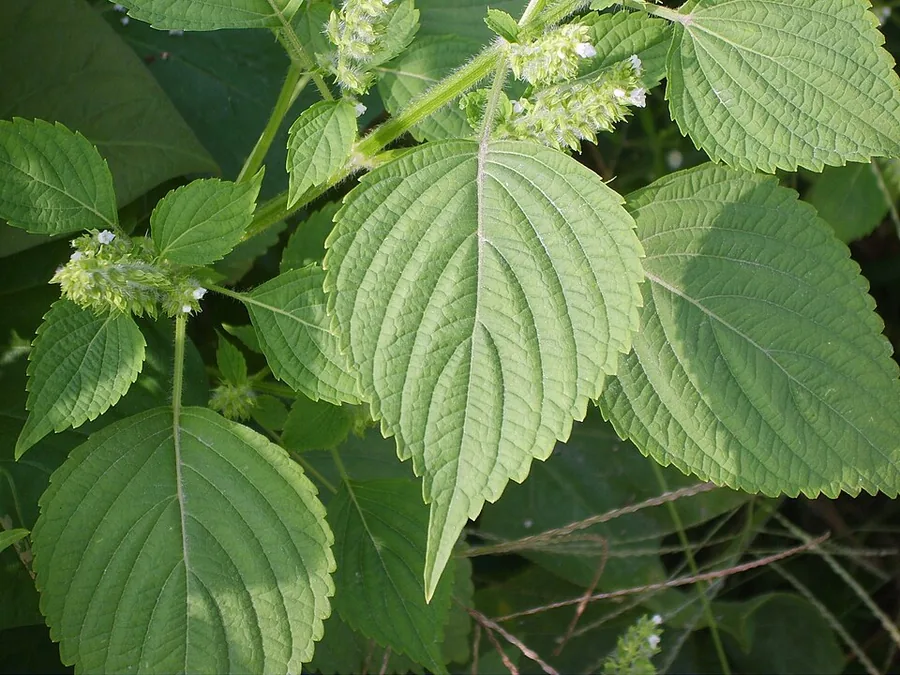
Shiso is a member of the mint family (Lamiaceae) raised for fragrant foliage rather than bloom. As a warm-season annual it completes its cycle in one season, moving from seed to a leafy plant of roughly knee height by midsummer given its fast growth rate. It holds a central place in Japanese, Korean, and Vietnamese cooking, used fresh, pickled, and as a wrap.
Three forms are grown, and each earns its place through leaf chemistry as much as looks. The red type carries anthocyanin pigments that color and flavor pickles, the green type offers a milder aromatic leaf for fresh use, and ruffled bicolors serve both roles. Culture is identical across them, since the differences lie in pigment and aroma rather than in growth needs.
Two traits define how shiso is managed. Because flowering diverts resources away from leaf production, the plant bolts and the foliage turns bitter unless steady harvest and pinching hold it vegetative. It also self-sows prolifically and can naturalize, and the foliage is a documented pulmonary toxin to grazing cattle and horses, so siting matters as much as culture.
Care
The short version: full sun to light shade, soil held evenly moist, and frequent pinching to keep the plant vegetative so tender leaves keep forming instead of flowers.
Light
Shiso yields best in full sun, where high light drives the pigment and essential-oil content that give the leaves their color and aroma. It tolerates partial shade, which is useful in hot climates where midday sun can scorch the foliage, though shade trades some of that leaf color and aroma for protection.
Water
Hold the soil evenly moist but not waterlogged, roughly every 2 to 4 days in warm weather, because the thin foliage transpires fast and wilts under dry heat. Drought stress is more than cosmetic here, since it triggers early bolting, and once the plant turns reproductive the leaf quality drops.
Soil
Grow shiso in rich, well-drained loam high in organic matter, which supplies the steady moisture and fertility that fast leaf growth demands while draining freely enough to protect the roots. A pH of 5.5 to 6.5, slightly acidic, keeps nutrients available.
Temperature
The workable range runs 59°F to 86°F (15°C to 30°C), and warmth in the upper part of that band drives the fast growth shiso is known for. It carries no frost tolerance, so cold below the range stops growth and kills the plant, which is why you wait for settled warmth before transplanting.
Humidity
Average humidity of 40% to 60% suits shiso and matches typical summer air outdoors. Airflow around the foliage matters more than the exact reading, since moving air keeps the leaf surface dry and limits the damp conditions that favor slugs and disease.
Feeding
Feed monthly through spring and summer with a balanced fertilizer or dilute liquid feed to support continuous leaf production. Keep nitrogen moderate, because excess drives soft, watery growth at the expense of the essential oils that carry the aroma.
Pruning
Pinch the growing tips regularly to break apical dominance, which forces lateral branching and a fresh supply of tender leaves. Remove flower spikes as they emerge, since preventing flowering is what delays bolting and extends the productive leaf harvest.
Repotting
Shiso is grown as a fresh annual from seed each year, so routine repotting does not apply. In containers, circling roots, rapid wilting between waterings, and premature bolting indicate the roots have filled the pot, at which point the plant is best replaced or moved into a larger volume.
Size & spacing
Expect mature plants of 18 to 35 inches (45 to 90 cm) tall and 12 to 18 inches (30 to 45 cm) wide. Spacing to that spread keeps air moving through the canopy, which lowers humidity at the leaf surface and reduces slug and disease pressure.
When to plant
Shiso is frost-sensitive and needs warm soil to establish, which sets its calendar. Sow indoors 6 to 8 weeks before the last frost, transplant only after frost has passed and the soil has warmed, then harvest through summer while removing flower spikes to keep the plant in leaf production.
Northern hemisphere
Southern hemisphere
Typical months for a temperate climate: start earlier in warm zones, later where spring frosts linger.
- Sow: 6 to 8 weeks before the last spring frost; surface-sow and do not cover, as seed needs light to germinate
- Plant: After all danger of frost has passed and soil has warmed in late spring
- Harvest: Harvest leaves through summer once plants are established; pinch flower spikes to prolong harvest. Late-summer flowering and seeding is when perilla-ketone concentration and livestock-poisoning risk peak.
Hardiness
USDA hardiness zones: 2–11
Temperature: down to -46°C
Troubleshooting
Nearly every shiso problem registers on the foliage, either as feeding damage from pests or as the small, bitter leaves that signal the shift to flowering. Reading the symptom correctly points to the cause, and an early response preserves leaf quality. Match the sign below, then correct the underlying condition.
Terminal flower spikes with smaller, tougher, less aromatic leaves
This is bolting, the shift to reproductive growth triggered by shortening days, heat, or stress, and it redirects the plant's resources from leaf to flower. The new leaves come in small, tough, and low in aroma as a result. Pinch out the flower spikes as they form, harvest more often to push the plant back toward vegetative growth, and make successional sowings so tender leaves remain available as older plants decline.
Fix:
- Pinch out flower spikes as soon as they appear
- Harvest leaves more frequently to encourage vegetative growth
- Make successional sowings for a continuous supply of tender leaves
Self-sown volunteers appearing well beyond the planted area
Once shiso flowers and sets seed it becomes a self-sowing invasive, and the abundant seed produces volunteers across the garden and beyond it. Perilla frutescens has naturalized into pastures and woodland edges in parts of the country, so the escape carries ecological and livestock consequences. Cut the flower spikes before the seed matures, remove young volunteers while they are shallow-rooted, and never compost or discard seeding plants where the seed can establish in the wild.
Fix:
- Remove flower spikes before seed set
- Pull volunteer seedlings while young
- Do not compost or dump seeding plants where they can naturalize
Fine shot-hole pitting concentrated on the newest foliage
The pitting is flea beetle feeding, caused by small dark beetles that spring away when approached and target soft tissue, which is why new growth is hit hardest. Exclude them with a row cover until the foliage matures and toughens, remove nearby weed hosts that harbor them, and keep growth vigorous so the plant replaces damaged leaf area faster than the beetles remove it.
Fix:
- Cover young plants with floating row cover until established
- Remove nearby weed hosts
- Apply an approved insecticidal product only if damage is severe and the crop is not being harvested for food within the label interval
Scalloped leaf margins and dried mucus trails after damp weather
This is slug and snail damage, done at night by mollusks that favor the humid conditions damp weather creates. The dried mucus trails on leaves and soil at dawn confirm it. Hand-pick after dark to remove the active feeders, thin heavy mulch that shelters them near the base, and reduce watering so the soil surface dries between waterings and becomes less hospitable.
Fix:
- Hand-pick at night
- Set out shallow traps and remove mulch harboring slugs
- Use iron-phosphate baits where appropriate
Toxicity
For people the leaves are a safe and long-established culinary herb, so the table poses no concern. For grazing animals the picture is different: Perilla frutescens contains perilla ketone, a pulmonary toxin that produces severe, frequently fatal respiratory distress in horses and cattle that consume it, with toxin levels and risk peaking in late summer at flowering and seeding. Keep it out of pastures, hay, and reach of grazing animals.
Toxic to
Cats · Dogs · Horses · Rabbits · Livestock · Birds
Safe for
People
Cats Mild
Perilla ketone acts on the lungs of grazing mammals, but a cat that nibbles a leaf typically shows no more than transient drooling or mild gastrointestinal upset. Monitor a cat that has chewed the plant and provide fresh water.
Dogs Mild
As with cats, the exposure risk is low, and a dog that chews a leaf may drool briefly or pass a soft stool that resolves on its own. Redirect a curious dog from the plant and no further action is usually needed.
Horses Toxic
Horses that graze perilla can develop severe respiratory distress as perilla ketone damages the lung tissue, producing rapid, labored, open-mouthed breathing while fluid accumulates in the lungs. The injury is acute and frequently fatal, so exclude horses from the plant entirely, with the greatest care in late summer when toxin levels peak at flowering and seeding.
Rabbits Caution
Because perilla ketone is a pulmonary toxin in grazing mammals, a rabbit that eats the foliage faces a real hazard rather than a safe forage. Withhold it and provide only greens confirmed to be safe.
Livestock Severe
In cattle, goats, and sheep, ingested perilla ketone injures the lungs and produces acute respiratory distress, open-mouthed panting, and atypical interstitial pneumonia. The toxin concentration and the risk both peak in late summer as the plant flowers and seeds, and the outcome is often fatal, so perilla should be removed from pastures and hay before animals can reach it.
Birds Caution
Documented cases in birds are scarce, but the same pulmonary toxin makes exposure inadvisable for poultry and pet birds. Keep them away from the foliage and seed heads as a precaution.
People Leaves safe
The leaves have a long culinary history across East Asia, eaten fresh, pickled, and as a garnish, and are safe for people. The pulmonary toxin that harms grazing animals is the concern in pastures, not in the kitchen.
Safe to handle and harvest for cooking; the concern is ingestion by grazing livestock, not skin contact.
Helpline numbers

United States
ASPCA Animal Poison Control: (888) 426-4435 (fee applies)

United Kingdom
Animal PoisonLine: 01202 509000 (fee applies)

Australia
Animal Poisons Helpline: 1300 869 738
Varieties
Shiso is grown in a few distinct forms, and the choice comes down to leaf pigment and aroma: color for pickling or a milder leaf for fresh use.
Red/Purple shiso (akajiso)
Its deep red-purple leaves are pigmented with anthocyanins, the trait that makes it the choice for coloring and flavoring pickles such as umeboshi.
Green shiso (aojiso)
The flat green leaves carry a milder citrus-anise aroma that suits fresh use as a herb and garnish rather than pickling.
Bicolor / ruffled (chirimen) types
The crinkled bicolor leaves, green above and purple beneath, combine ornamental value with culinary use in a single plant.
How to propagate
Shiso propagates readily from seed, and because it sets seed freely it tends to establish self-sown volunteers for successive years without any intervention.
SeedEasy
Start indoors 6 to 8 weeks before last frost, or direct-sow after the soil warms in late spring · 2 to 3 weeks to germinate and several more weeks to reach harvestable size
Shiso propagates readily from seed, started indoors 6 to 8 weeks before the last frost or direct-sown once the soil warms in late spring. Surface-sow and leave the seed uncovered, since it requires light to germinate, and a preceding cold period improves and evens out germination. Germination takes 2 to 3 weeks with several more to reach harvestable size, after which the plant reliably self-sows for years.
Myths
Since people eat shiso, the entire plant is harmless to every animal.
The leaves are safe for culinary use, but Perilla frutescens produces perilla ketone, a documented cause of fatal pulmonary poisoning in grazing cattle and horses. Edibility for people says nothing about safety for grazing livestock.
Shiso remains confined to where it is planted.
It self-sows heavily and has naturalized as an invasive weed across the southeastern and central United States, moving into pastures and woodlands. Removing the flower spikes before seed set is the reliable way to keep a planting contained.