Ornamental · Asteraceae
Shasta Daisy
Leucanthemum × superbum
Give it full sun and genuinely sharp drainage, and this hybrid daisy carries clean white bloom right through summer.
Full sun
Every 7–10 days
USDA 5–9
12–35 in · 30–90 cm
Overview
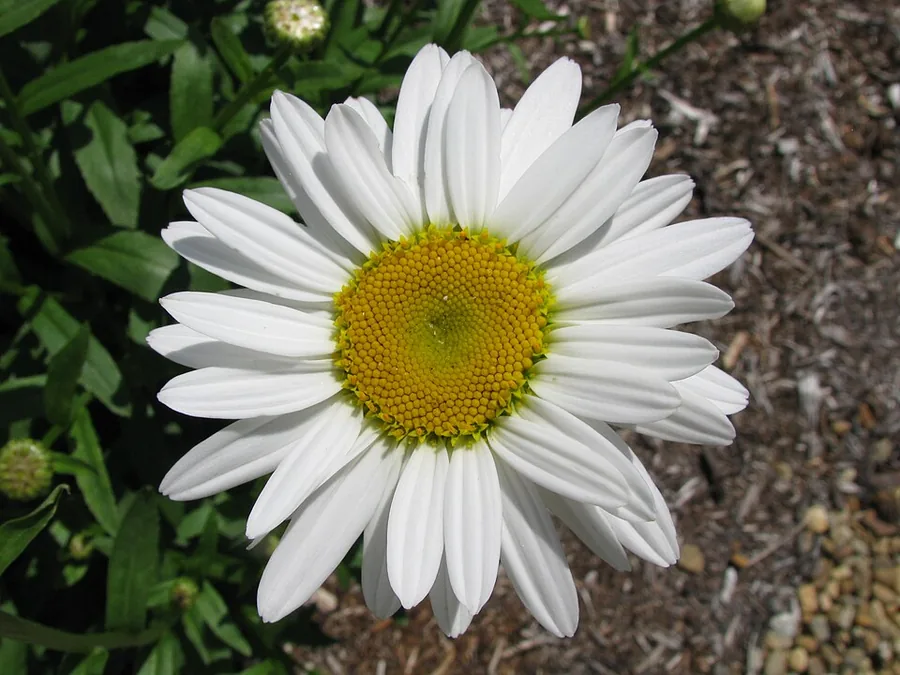
Leucanthemum × superbum is the summer border's white daisy, lifting golden-centered ray flowers on erect stems above dark green basal foliage. It arose as a garden hybrid within the Asteraceae, selected off the wild oxeye daisy for greater vigor and a bolder flower. Sited well, it behaves as a returning perennial, flowering June into September.
Its requirements reduce to two. Full sun and a freely draining medium let it withstand heat and dry soils, since the species is drought adapted once rooted. The limiting factor is winter wet: saturated soil around the crown drives rot and kills the plant outright, which is why drainage outranks every other input.
Cultivars span low edging forms to tall cut-flower types, so mature scale is a selection choice. Because it is a short-lived perennial, a clump loses vigor as its center ages out, and lifting and dividing it every couple of years both restores flowering and yields new plants.
Care
The short version: full sun and sharp drainage set the ceiling on performance, water only after the upper half of the profile dries, deadhead through summer to hold bloom, and divide every 2 to 3 years to counter the clump's natural decline.
Light
Flowering is light-driven, so give it full sun, six or more hours of direct exposure daily. It accepts light afternoon shade, but under deeper shade the stems etiolate into weak, leaning growth and flower numbers drop sharply.
Water
Allow the top half of the root zone to dry before rewetting, which in practice falls near every 7 to 10 days. An established plant is drought tolerant, and the operative risk is excess water rather than deficit, particularly across winter when saturated soil rots the crown.
Soil
It tolerates average loam, clay, or sand provided the medium drains, and it is indifferent to reaction across 6.0 to 8.0. Free drainage is non-negotiable, because standing moisture at the crown is the direct route to fatal rot.
Humidity
Ambient outdoor humidity is adequate and needs no adjustment. Air movement is the variable that matters, since still air over dense foliage sustains the leaf wetness that leaf spot and crown rot exploit.
Feeding
Fertility demand is low, so a single light spring application of balanced fertilizer suffices. High fertility is counterproductive: it drives soft, elongated growth that lodges and undermines stem strength.
Pruning
Deadheading removes spent heads and redirects the plant from seed set back into fresh bud, prolonging bloom. Once the main flush ends, cutting stems down to the basal rosette renews the crown and extends the working life of a short-lived perennial.
Size & spacing
Mature height runs 12 to 35 inches (30 to 90 cm) by cultivar, over a clump spreading 12 to 24 inches (30 to 60 cm). Spacing to that width preserves the air movement that keeps foliar disease in check.
When to plant
Its schedule tracks a temperate spring. Sow indoors in late winter to give transplants a head start, move them out once hard frost has passed, and expect flowering from June into September. Early spring, before growth accelerates, is also the correct window to lift and divide established clumps.
Northern hemisphere
Southern hemisphere
Typical months for a temperate climate: start earlier in warm zones, later where spring frosts linger.
- Sow: 6 to 8 weeks before the last spring frost
- Plant: Spring after danger of hard frost has passed
- Harvest: June to September
Hardiness
USDA hardiness zones: 5–9
Temperature: down to -29°C
Troubleshooting
The great majority of Shasta daisy failures reduce to two causes: impeded drainage and an overmature clump. Both announce themselves early on the foliage and at the crown, so a diagnosis made in time usually saves the plant. Match the sign, identify the mechanism, and correct it.
Wilt and stem collapse in the presence of adequate moisture
Collapse despite moist soil signals a root and vascular problem rather than drought. In impeded soils, verticillium wilt or phytophthora crown and root rot colonizes the plant, and a crown that has turned soft and brown is beyond recovery. Remove and destroy the failed plants, correct the drainage, and divide sound crowns into a better-drained position.
Fix:
- Remove and discard severely affected plants
- Improve drainage and avoid overwatering
- Divide and replant healthy crowns in a better-drained site
Reduced bloom with a dead center and marginal growth
A clump that flowers only at its margins over a dead center has reached the point where it has outgrown its space, the predictable senescence of an aging division. Lift it in early spring, discard the woody, exhausted core, and replant the vigorous perimeter to reset flowering.
Fix:
- Divide the clump in early spring
- Replant vigorous outer divisions and discard the woody center
Discrete dark lesions developing on the foliage
Dark lesions that expand under wet conditions indicate fungal or bacterial leaf spot, which colonizes the lower, older leaves first. Management is cultural. Remove affected foliage, keep the leaf surface dry, and increase spacing so the canopy dries faster between wettings.
Fix:
- Remove and destroy affected foliage
- Avoid overhead watering
- Improve air circulation
Distorted shoots, honeydew, or foliar stippling
Deformed tips under a sticky honeydew film indicate aphids feeding on soft apical growth. Stippled, mottled leaves or pale serpentine tracks instead implicate spider mites or leaf miners. Dislodge aphids with a forceful water spray, reserve insecticidal soap for heavy pressure, and excise mined leaves to remove the larvae.
Fix:
- Hose off aphids with a strong stream of water
- Apply insecticidal soap if infestation is heavy
- Remove and destroy mined leaves
Toxicity
This is not a wholly benign plant around animals. Like its Asteraceae relatives, including the toxic chrysanthemum, it contains pyrethrin-like sesquiterpenes, so ingestion of leaf or flower can provoke drooling, vomiting, or dermal irritation. The response is generally mild, and the bitter foliage self-limits intake, yet curious pets and small children are best kept from feeding on it.
Toxic to
Cats · Dogs · Horses · Rabbits · Livestock · Birds · People
Cats Mild
A cat that chews the foliage may drool, retch, or vomit, and contact with the sap can leave the mouth or skin transiently irritated. The bitter taste generally deters ingestion before intake reaches a harmful level.
Dogs Mild
A dog consuming several flower heads may develop gastrointestinal upset with drooling and loose stools. Repeated handling of cut stems can also raise a mild contact dermatitis on thin-skinned individuals.
Horses Mild
Horses generally reject the bitter foliage, but a grazed mouthful can produce salivation and a short episode of digestive upset. Sap contact may leave the muzzle mildly irritated.
Rabbits Caution
The same pyrethrin-like constituents make the plant unsuitable for rabbits, so it is best kept beyond reach. Provide their standard greens rather than permitting them to browse the foliage.
Livestock Caution
Cattle, goats, and sheep almost always avoid the bitter plant, yet a hungry animal ingesting a large quantity could experience mild digestive upset. Excluding it from overgrazed paddocks removes the risk.
Birds Caution
Birds have little incentive to feed on it, and the irritant constituents make it prudent to keep cage birds away from cut flowers. Wild birds taking seed from the heads are not at risk.
People Caution
No part of the plant is intended for consumption, and the sap can leave sensitive skin reddened and itchy after handling. Prevent small children from chewing the flowers, though an isolated petal warrants no concern.
Most pets ignore the bitter foliage; a nibble may cause mild stomach upset or skin irritation rather than serious harm.
Helpline numbers

United States
ASPCA Animal Poison Control: (888) 426-4435 (fee applies)
Poison Control: (800) 222-1222



Canada
Poison Centres: 1-844-764-7669
Varieties
Selection within the species has produced a useful spread of stature and flower structure. The cultivars below are the ones worth knowing by name.
Becky
A tall cultivar reaching 3 to 4 feet on stems rigid enough to remain self-supporting, presenting 3 to 4 inch white ray flowers around yellow central disks.
Crazy Daisy
A double-flowered selection whose frilled, somewhat shaggy ray florets produce a fuller, looser flower than the single form.
Snowcap
A compact cultivar limited to 15 to 18 inches, suited to the front of a border or to container culture.
How to propagate
The species propagates readily by two routes, one that fixes a cultivar's traits and one that generates volume quickly from seed.
DivisionEasy
Early spring, every 2 to 3 years · One growing season to re-establish and resume strong flowering
Division is the reliable method for renewing an aging clump, undertaken in early spring every 2 to 3 years. Discard the woody, spent center and reset the vigorous outer divisions into well-drained soil, allowing a full season for re-establishment and the return of strong flowering.
SeedEasy
Start indoors 6 to 8 weeks before the last spring frost, or sow outdoors in spring · Often blooms the first or second year from seed depending on sowing time
The species and many cultivars germinate readily, started indoors 6 to 8 weeks before the last frost or sown outdoors in spring, with flowering commonly in the first or second year. Named cultivars, being hybrids, do not come true from seed and should be perpetuated by division.
Myths
Shasta daisies are entirely safe and pets may eat them at will.
The species sits in the same family as the toxic chrysanthemum and shares comparable pyrethrin-like sesquiterpenes, so ingestion can produce drooling, vomiting, or a dermal rash. The Shasta daisy is a mild irritant, not forage, although its toxicity is well below that of a true mum.
Shasta daisies are durable, long-lived perennials that need no intervention.
In fact the species is short-lived, and a clump declines quickly without division every 2 to 3 years. Sharp drainage and a hard post-bloom cut-back are the two levers that sustain it, so modest management returns several additional seasons.