Herb · Lamiaceae
Summer Savory
Satureja hortensis
Sun and sharp drainage suit this Mediterranean annual best, and harvesting just before bloom secures peak leaf quality.
Full sun
Every 5–10 days
59–86°F · 15–30°C
50–70 days
Overview
Summer savory (Satureja hortensis) is a fast-growing annual in the mint family, Lamiaceae, valued in the kitchen for the warm, peppery character it lends to beans and stews. Its Mediterranean origin explains its preferences: strong sun, free-draining soil, and roots that are never left saturated. The culinary tradition runs deep enough that one of its long-standing common names is simply the bean herb.
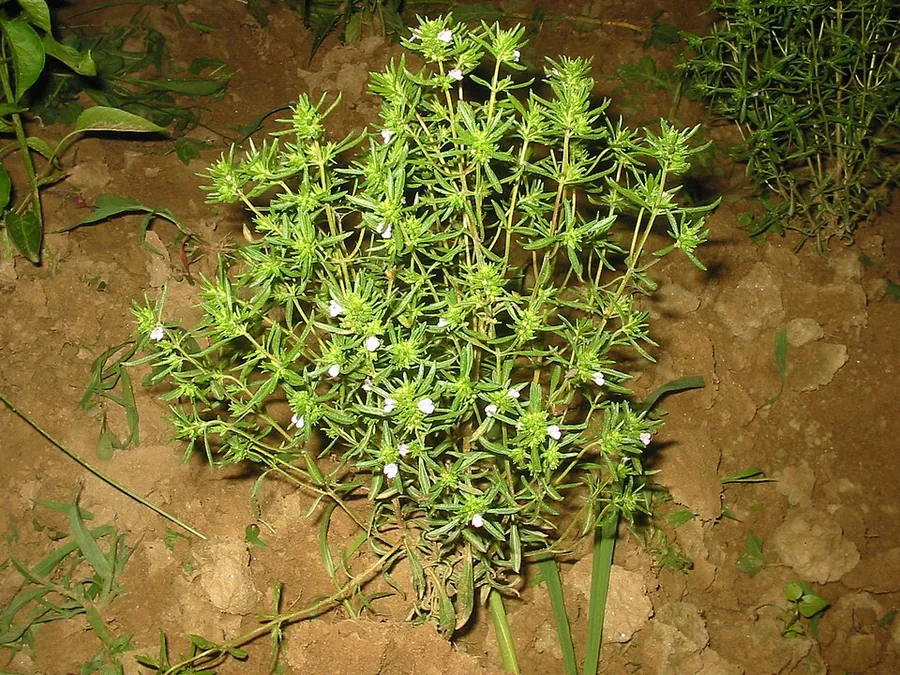
In habit it is a modest plant, generally 10 to 18 inches (25 to 45 cm) tall, bearing slender stems and narrow gray-green foliage. Small tubular flowers, white to pink, appear in summer, and their arrival marks a physiological turning point, because leaf quality is highest in the days immediately before the buds open. Frequent pinching and harvest hold the plant in vegetative growth, which sustains the supply of tender leaves.
Savory is forgiving because its requirements are few: rapid germination, minimal fertility, and good drought tolerance once the root system is established. Its two genuine intolerances are waterlogged soil and heavy shade, and nearly every disorder met in cultivation traces back to one of those conditions.
Care
The short version: full sun, sharply drained soil, and measured watering. Feed lightly, pinch the growing tips to hold the plant in leaf, and harvest the leafy tops in the narrow window just before flowering.
Light
Savory requires full sun, on the order of 6 or more hours daily. In lower light it etiolates, stretching and flopping on thin, woody stems as it reaches for the light it lacks. Ample sun is what holds the plant compact and concentrates its flavor.
Water
Allow the top of the soil to dry between waterings. Keep moisture even while the plant establishes, then reduce it, since this Mediterranean species is adapted to dry spells and intolerant of saturated soil. Overwatering, not drought, is the usual cause of decline.
Soil
Grow savory in well-drained loam enriched with organic matter, though it performs acceptably in poorer ground. It tolerates a broad pH range, 6.0 to 8.0, so mildly alkaline soils present no obstacle.
Temperature
Optimal growth falls in the warm range of 59°F to 86°F (15°C to 30°C). Because the plant is frost-tender, transplanting should wait until cold has passed, and the first hard freeze terminates the annual cycle.
Humidity
As a dry-climate species, savory favors low humidity, around 30% to 50%. Stagnant, humid air around the canopy encourages problems, so spacing and air movement matter more here than added moisture.
Feeding
Fertility needs are low. Savory is a light feeder, and a modest application of balanced or low-nitrogen fertilizer at planting meets its requirement. Excess nitrogen drives soft, weak growth and diminishes the flavor concentrated in the leaves.
Pruning
Pinch and harvest the leafy tips regularly, before flowering, to promote branching and prolong tender leaf production. Removing developing flower buds delays the shift to reproduction, which is what turns the flavor sharp and the foliage coarse.
Size & spacing
A mature specimen reaches roughly 10 to 18 inches (25 to 45 cm) in height with a spread of 8 to 12 inches (20 to 30 cm). Allow adequate spacing so air circulates through the canopy and the root zone drains and dries between waterings.
When to plant
As a frost-tender annual, savory needs warmth and stops at the first freeze. Sow indoors a few weeks before the last frost or direct-sow into warmed spring soil, then harvest the leafy tops through summer until flowering signals the close of the productive period.
Northern hemisphere
Southern hemisphere
Typical months for a temperate climate: start earlier in warm zones, later where spring frosts linger.
- Sow: About 4-6 weeks before the last frost; sow shallowly because light aids germination
- Plant: After all danger of frost has passed and soil has warmed in late spring
- Harvest: Harvest leafy tops just before or as the plant comes into flower; small tubular white-to-pink flowers appear in summer
Hardiness
USDA hardiness zones: 2–11
Temperature: down to -46°C
Troubleshooting
The common savory disorders share two root causes, excess moisture and insufficient light, and both express early on the roots, stems, and leaves. Reading those signs and correcting the underlying condition resolves most cases. Match the symptom below and address the cause rather than the symptom.
Wilting and yellowing over soft, dark roots
The pattern points to root rot, a consequence of saturated soil rather than water shortage. Savory's Mediterranean adaptation leaves it poorly suited to persistently wet ground, so the remedy is improved drainage and a longer interval between waterings. Where the rot remains limited, lifting a container plant and repotting into fresh, fast-draining medium can arrest it.
Fix:
- Improve drainage and reduce watering frequency
- Move container plants to a sunnier, better-drained spot
- Replant in well-drained soil if rot is limited
Honeydew and small insects on shoot tips
The soft-bodied insects clustering on new growth are aphids, and the sticky film they deposit is honeydew. A strong jet of water dislodges most colonies, and because the crop is destined for the kitchen, harvesting and using the affected tips is often the cleaner response than treatment. Insecticidal soap is warranted only when an infestation persists despite these measures.
Fix:
- Rinse off insects with a strong spray of water
- Harvest and use affected tips
- Use insecticidal soap only if needed on an herb intended for eating
Elongated, floppy stems with sparse foliage
Stretched, woody stems indicate etiolation, the plant's response to inadequate light, compounded by too little pinching. Relocating it to full sun of 6 or more hours daily and harvesting the tips frequently redirects growth into branching. Regular cutting is what keeps the canopy dense rather than drawn out.
Fix:
- Move to full sun (6+ hours)
- Pinch and harvest tips frequently to promote branching
Declining leaf quality at flowering
The drop in flavor accompanies flowering, as the plant redirects resources from leaf production toward seed set. Leaf quality peaks just before the buds open and falls once bloom begins, so harvest at first bud and remove flower buds to delay the transition. Successive sowings every 3 to 4 weeks maintain a supply of young leaves through the season.
Fix:
- Harvest leafy tops before or at first bud
- Pinch off flower buds to extend the leaf harvest
Toxicity
For households with pets, the record is clear: summer savory is an edible culinary herb with no documented toxicity. Its leaves are eaten routinely and pose no risk to cats, dogs, rabbits, or grazing animals that sample the foliage. No part of the plant requires exclusion.
Safe for
People · Cats · Dogs · Horses · Rabbits · Livestock · Birds
Cats None
No toxicity to cats is recorded, and an incidental nibble of this culinary herb has no adverse effect.
Dogs None
Dogs are unaffected, as the foliage contains no compound known to harm them if grazed.
Horses Safe
Horses may browse the plant safely, the leaves holding no toxins of concern to them.
Rabbits Safe
Rabbits tolerate the leaves without incident, though dietary variety remains advisable.
Livestock Safe
Cattle, goats, and sheep can graze the plant without documented ill effect.
Birds Safe
Pet birds and poultry are unharmed by it, the herb presenting nothing toxic to them.
People Safe
Eaten as a culinary herb it is entirely safe, and the leaves season beans, stews, and roasts.
Aromatic edible herb that is safe to handle and grow around people and pets.
Varieties
Two savories are worth distinguishing, the tender annual grown in most gardens and its hardy perennial relative.
Winter savory (Satureja montana)
The hardy perennial relative is evergreen across roughly USDA zones 5 to 10 and carries a stronger, faintly bitter flavor, allowing it to substitute for the milder annual throughout the year.
How to propagate
Savory establishes readily from seed, and staggered sowings maintain a continuous supply of young, tender leaves across the season.
SeedEasy
Sow indoors about 4-6 weeks before the last frost, or direct-sow outdoors after frost danger passes; sow shallowly because light improves germination. · Germinates in roughly 1-2 weeks and is typically harvestable within about two months of sowing.
Seed propagation is straightforward. Sow indoors about 4 to 6 weeks before the last frost, or direct-sow into warm spring soil once frost has passed, setting the seed shallow because light promotes germination. Emergence follows in a week or two, with harvestable leaves in about two months. Repeating the sowing every 3 to 4 weeks sustains a continuous supply of tender foliage.
Myths
Interplanting summer savory with beans reliably repels bean beetles.
Savory's association with beans is culinary, earned at the table where it complements bean dishes, and its old name reflects that use rather than any field effect. The pest-repellent claim is a separate assertion and a weaker one. Extension sources caution that companion-planting charts of this kind frequently lack supporting research.