Tree · Lauraceae
Sassafras
Sassafras albidum
A fast native valued for three leaf shapes and orange-red-purple fall color, driven by clonal roots that colonize open ground.
Full sun
Every 7–14 days
USDA 4–9
30–60 ft · 9.1–18.3 m
Overview
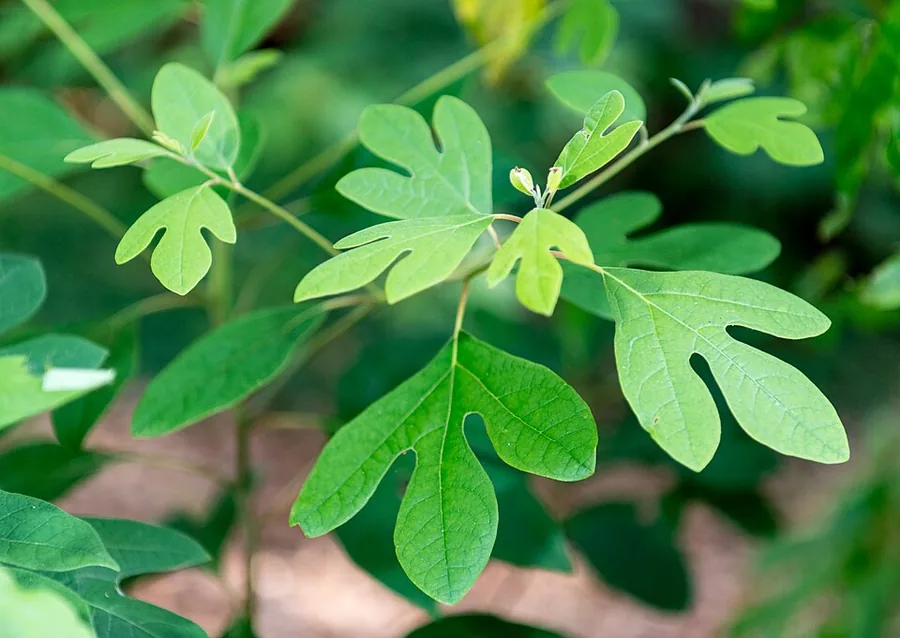
Sassafras albidum reads as a member of the Lauraceae in every part, since aromatic oils sit in the leaves, bark, and roots. The species carries three distinct leaf outlines on one plant, ranging from an unlobed oval through a two-lobed mitten to a three-lobed form. In autumn the foliage colors through orange, red, and deep purple, and the crushed leaf or scratched bark releases the spicy scent tied to its historic culinary and root-beer use.
Growth is fast, and the tree performs best in full sun to partial shade on moist, acidic, well-drained soil, with cold hardiness reaching zone 4. Its defining habit is clonal: shallow lateral roots produce suckers that develop into a single-clone thicket over time. That trait makes it a natural colonizer of woodland edges and a persistent spreader in maintained ground.
The tree's aroma comes from safrole, concentrated in the roots and bark. Safrole is a hepatotoxin that produced liver tumors in animal studies, and the FDA removed it from the food supply in 1960. That chemistry, rather than any growing difficulty, is the reason the plant is valued as an ornamental and wildlife tree and not as a food source.
Care
The short version: grow it in full sun to part shade on moist, acidic, well-drained soil, keep young trees watered until the root system is established, allow space for clonal spread, and prune out suckers where a single trunk is the goal.
Light
Sassafras reaches its best in full sun, where the high light drives the most intense fall color, though it tolerates partial sun and partial shade. Young trees lean toward the brightest exposure as they grow, so an open site yields the most even canopy.
Water
Young trees have limited root systems, so keep the soil evenly moist and water every 7 to 14 days until they establish. Once the root network is developed the species is notably drought-tolerant. It favors moist, well-drained ground and declines in soggy clay, where poor aeration stresses the roots.
Soil
The species is adapted to moist, acidic, well-drained loam or sandy soil, with an optimum pH of 6.0 to 7.0. It tolerates clay and dry sites, though alkaline ground can bring on chlorosis, the yellowing of foliage that signals the tree is struggling to feed at high pH.
Temperature
Cold hardiness is a defining strength: the tree withstands winter minimums near -29°F (-34°C) and summer highs to 100°F (38°C). That tolerance spans the temperate eastern US, which is why the species ranges so widely without protection.
Humidity
Ambient outdoor humidity meets the tree's needs, so no adjustment applies. The variable that matters is air circulation, since good airflow reduces leaf surface moisture and holds the minor foliar fungi in check.
Feeding
An established sassafras draws enough from the soil that supplemental feeding is rarely warranted. On poor ground, a balanced slow-release tree fertilizer applied in spring supports early growth, while trees on adequate soil need none.
Pruning
Prune in late winter during dormancy, removing dead or crossing wood and cutting root suckers to maintain a single-trunk form. Because the species resprouts strongly, cutting the whole plant to the ground every 2 to 3 years keeps it at shrub size.
Repotting
The species develops a deep taproot, which is why container culture and the transplanting of established specimens both fail so often. Site selection is effectively permanent, so place the tree where it can remain and root undisturbed.
Size & spacing
Allow for a large tree: mature height runs 30 to 60 feet (9 to 18 m) with a spread of 25 to 40 feet (7.6 to 12 m). Factor in the clonal habit as well, since suckering extends the effective footprint beyond the crown of the original stem.
When to plant
The tree's phenology tracks the temperate northern hemisphere. Plant young stock in spring once frost risk has passed, expect greenish-yellow flowers from March to May at or before leaf-out, and look for bluish-black drupes on red stalks ripening from late summer into early fall.
Northern hemisphere
Southern hemisphere
Typical months for a temperate climate: start earlier in warm zones, later where spring frosts linger.
- Sow: Not typical; seed needs cold-moist stratification, so sow outdoors in fall or stratify 2-4 months before spring sowing
- Plant: Spring, after the last frost, using young container or root-sucker plants
- Harvest: Greenish-yellow flowers March to May before or with leaf-out; bluish-black drupes on red stalks ripen late summer to early fall
Hardiness
USDA hardiness zones: 4–9
Temperature: down to -34°C
Troubleshooting
Two of the three common concerns trace to the tree's biology: clonal root spread and foliar pests that rarely threaten a mature specimen. The exception is laurel wilt, a vascular disease of real consequence in the southeast. Read the symptom, then address the underlying cause below.
Rapid dieback with vascular streaking in the sapwood
The cause is laurel wilt, in which the fungus Raffaelea lauricola, introduced by the redbay ambrosia beetle, colonizes and occludes the sapwood until the tree can no longer move water. Diagnostic signs include pinhole beetle galleries, toothpick-like frass tubes on the trunk, and dark vascular discoloration under the bark, best confirmed by a diagnostic lab within the southeastern range. No cure exists, so removal with chipping or burning of affected wood, and strict avoidance of moving untreated wood, are the only effective responses.
Fix:
- No effective cure once infected; remove and properly dispose of (chip or burn) dead and dying trees to reduce beetle breeding sites
- Do not move untreated wood that could spread the beetle
Suckers colonizing the ground around the parent stem
This is root suckering, the clonal spread that defines the species, driven by shoots arising along shallow lateral roots. Disturbing or severing those roots stimulates further suckering, so mechanical damage tends to worsen it. Manage the colony by mowing or cutting suckers through the season, excavating unwanted shoots with attached root, and installing a root barrier or a mowed strip to define the perimeter.
Fix:
- Mow or cut suckers to the ground repeatedly through the season
- Dig out unwanted suckers with attached root where practical
- Install a root barrier or maintain a mowed strip to contain the colony
Skeletonized foliage with fungal spotting
Chewed and skeletonized leaves indicate Japanese beetles and other feeding or sucking insects such as scale, while blotches point to leaf spot fungi or powdery mildew. On an established tree the damage is cosmetic and does not warrant aggressive treatment. Hand-pick or knock beetles into soapy water, remove fallen leaves to reduce fungal inoculum, and reserve horticultural oil for heavy scale.
Fix:
- Hand-pick or knock Japanese beetles into soapy water
- Tolerate minor leaf spot; rake and remove fallen leaves to reduce fungal inoculum
- Treat heavy scale infestations with horticultural oil
Toxicity
The concern with sassafras is ingestion, not contact. The roots, bark, and distilled oil hold safrole, a hepatotoxin classed as a likely carcinogen and banned from food since 1960. Foliar contact carries little risk, so the practical rule is to prevent people and animals from consuming the woody tissue or homemade preparations.
Toxic to
Cats · Dogs · Horses · Rabbits · Livestock · Birds · People
Cats Caution
Risk to cats comes from ingestion of the woody tissue, since the roots and bark concentrate safrole, a compound toxic to the liver. Foliage contact is not the concern, so the control measure is to keep cut roots, bark, and sassafras oil inaccessible.
Dogs Caution
A dog ingests safrole by chewing bark, excavating roots, or contacting sassafras oil, and repeated exposure burdens the liver. The leaves themselves are low-risk, so restrict access to fallen branches and any stored root material.
Horses Caution
Browsing on bark or roots delivers the same hepatotoxic safrole to horses. Exclude them from any tree within reach with fencing, and remove prunings from the paddock so they are not consumed.
Rabbits Caution
Small body mass means a small quantity of safrole is enough to affect a rabbit, and the compound concentrates in bark and roots. Prevent access to the trunk and to any trimmings.
Livestock Caution
Cattle, goats, and sheep that strip bark or chew exposed roots take in safrole, which accumulates in the liver. Supervise grazing near the tree and clear felled wood from pasture before it is browsed.
Birds Caution
The ripe bluish-black drupes are eaten by wild birds without harm, because safrole is held in the woody roots and bark rather than the fruit. The precaution applies to caged or backyard birds, which should be kept from bark and root fragments.
People Caution
Although traditional teas and file powder derive from this tree, safrole is a hepatotoxin and likely carcinogen that the FDA banned as a food additive in 1960. No quantity of homemade root or bark tea or sassafras oil is considered safe, and children should be kept from chewing the bark.
Foliage contact is low-risk, but do not let people or pets chew or ingest roots, bark, or sassafras oil. Avoid homemade root/bark teas and oil.
Helpline numbers

United States
ASPCA Animal Poison Control: (888) 426-4435 (fee applies)
Poison Control: (800) 222-1222



Canada
Poison Centres: 1-844-764-7669
Varieties
Sassafras is grown almost entirely as the wild species, so cultivar selection is not a meaningful part of choosing this tree.
Sassafras albidum (species)
The plant is offered almost exclusively as the straight native species, selected for its three leaf forms and its orange-red-purple autumn color rather than any named cultivar.
How to propagate
Propagation works best through the tree's own root system, since dormant root pieces and rooted suckers regenerate readily while true cuttings do not. Seed is viable but slow, requiring a cold-moist period to break dormancy.
SeedModerate
Sow outdoors in fall, or cold-moist stratify 2-4 months and sow in spring · Several months to germinate; 1-2 seasons to establish
Seed is physiologically dormant and will not germinate until it has passed through a cold, moist period, so sow it outdoors in fall or provide 2 to 4 months of cold-moist stratification before a spring sowing. Remove the fleshy pulp from the fruit first, since it can inhibit germination. Expect several months to germination and one to two seasons for the seedling to establish.
Stem cuttingsDemanding
Dig dormant root pieces or detach rooted suckers in late winter to early spring · One growing season
The reliable vegetative route is to dig dormant root pieces or detach the tree's own rooted suckers in late winter to early spring, while the plant is dormant. These typically establish within a single growing season. Moving a larger, established plant generally fails because of the deep taproot.
LayeringModerate
Spring · One to two seasons
The species self-layers through its spreading root suckers, so a small suckered plant can be severed in spring and relocated. Allow one to two seasons for it to root down and become self-supporting.
Myths
Sassafras root and root-beer flavoring are a harmless natural tonic.
The aromatic principle of the root is safrole, a documented hepatotoxin and likely human carcinogen. It induced liver tumors in animal testing, and on that evidence the FDA banned safrole and sassafras oil as food additives in 1960. Natural origin has no bearing on toxicity, so the traditional root preparations are not safe to consume.