Herb · Lauraceae
Bay Laurel
Laurus nobilis
An evergreen Mediterranean laurel that, grown slowly and sheltered from frost, yields kitchen leaves for decades.
Full sun
Every 5–10 days
USDA 8–11
3–10 ft · 0.9–3 m
Overview
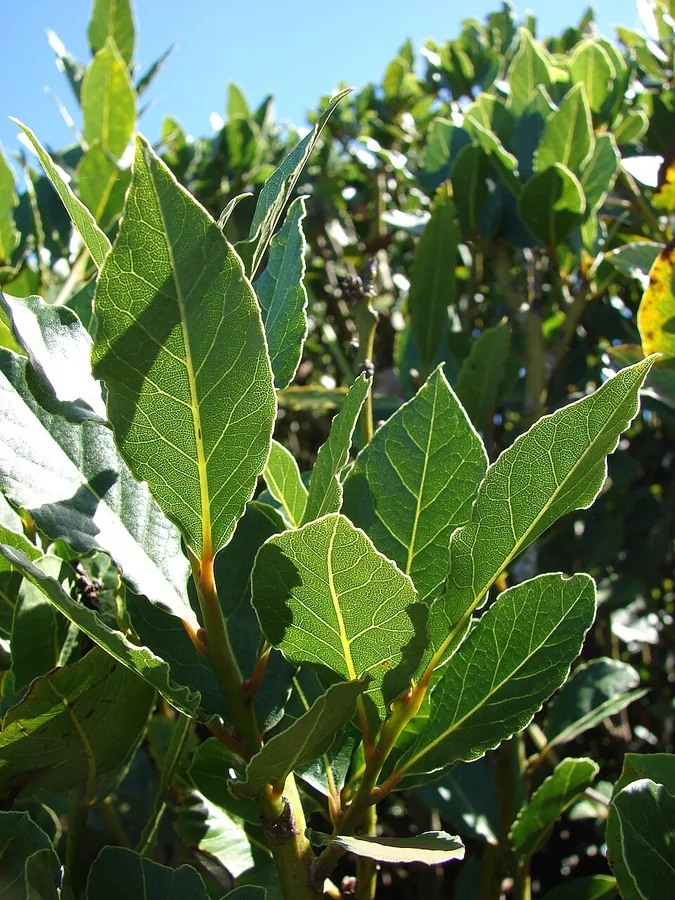
Bay laurel is the evergreen tree of the spice-rack bay leaf, native to the Mediterranean, where it matures into a tall aromatic shrub or small tree. The glossy, leathery leaves are an adaptation to that warm, dry climate, and the plant carries the same foliage in a garden bed or a container. Its long history in cultivation rests on two uses, the culinary leaf and its response to clipping, which makes it a classic subject for topiary and standards.
Its slow growth is the governing trait, and most of its care follows from it. Slow extension means a bay recovers shape gradually, which is precisely why it tolerates hard pruning and holds a trained form, but it also means cold or mechanical loss is not made good quickly. The species is hardy in milder zones yet frost-tender below about 25°F (-4°C), so in colder regions container culture is the practical route, since a pot can be moved under cover before winter.
Established bay is undemanding. Sun, free-draining soil, and watering that avoids waterlogging meet its needs, and in return it supplies leaves you can harvest year-round. The two failures that account for most losses are root rot from wet soil and frost injury, and both are mechanistic and preventable once the cause is understood.
Care
The short version: full sun to part shade, freely draining soil so the roots are never anaerobic and wet, a balanced feed across the growing season, and protection from hard frost, since bay is tender below about 25°F (-4°C).
Light
Bay performs best in full sun, while tolerating partial shade, and ample light is what keeps internodes short, growth dense, and leaf color saturated. Indoors, the brightest available window is the practical minimum.
Water
Hold the soil evenly moist but never soggy, allowing the surface to dry slightly between waterings so the rootzone is not continuously saturated. Containers are the critical case, because impeded drainage lets standing water induce root rot, so reduce irrigation in winter as growth and water demand fall.
Soil
Site it in fertile, well-drained loam or a quality potting mix; the plant accepts a range of textures provided the ground is not waterlogged, since saturation is the limiting factor rather than fertility alone. It performs across a pH of 6.0 to 7.5.
Temperature
Bay's functional range runs from about 25°F to 86°F (-4°C to 30°C), and the lower bound is the meaningful constraint. Being frost-tender, its tissue browns under a hard freeze, and a deeper cold event can be lethal.
Humidity
Average humidity of 40% to 60% suits it and is met without effort outdoors. The winter indoor risk is not low moisture itself but the dry, still air that favors scale, so maintain air movement around the canopy.
Feeding
Apply a balanced general-purpose fertilizer through spring and summer during active growth, when nutrient uptake supports new extension. Container plants deplete a confined soil volume quickly, so monthly feeding through the season sustains them.
Pruning
Prune in spring to early summer, the period of vigorous regrowth, to shape, restrict size, or train as a topiary or standard, since bay responds well to hard cutting and clipping. The same window is the time to excise damaged, frost-burned, or crossing wood.
Repotting
Repot container specimens into fresh medium every 2 to 3 years, or top-dress annually in the interim to renew surface nutrients. The cues are roots circling the pot or emerging from drainage holes and water that runs straight through a root-filled mass.
Size & spacing
Growth is slow toward a mature 3 to 10 feet (90 cm to 3 m) in height and 3 to 8 feet (90 to 240 cm) in spread, though clipping constrains it to any target dimension. Allow an in-ground plant the footprint to reach those figures, or restrict it in a container.
When to plant
As an evergreen, bay has no defined planting season the way a determinate crop does, because it is never dormant in the leaf-drop sense. Set young plants out after the last frost once the soil has warmed enough to drive root growth, prune for shape from spring into early summer when regrowth follows quickly, and harvest leaves at any point. In cold zones the operative calendar is overwintering: a potted plant goes under cover before frost and returns once the threat has passed.
Northern hemisphere
Southern hemisphere
Typical months for a temperate climate: start earlier in warm zones, later where spring frosts linger.
- Sow: Seed can be started indoors but germination is slow and erratic; cuttings are more common
- Plant: Plant outdoors after the last frost once soil has warmed; in cold zones grow in containers and move indoors or to a sheltered spot before winter frost
- Harvest: Small, inconspicuous yellowish flowers appear in spring on mature plants; aromatic leaves can be harvested anytime, year-round
Hardiness
USDA hardiness zones: 8–11
Temperature: down to -12°C
Troubleshooting
Bay's problems are largely physiological and pest-driven rather than infectious, and water relations and cold explain most of them. The leaves and roots register stress first, so read those. Identify the disorder below from the symptom, then intervene before localized injury progresses to dieback.
Yellowing, wilting top growth over soft, sour-smelling roots
This is root rot, the consequence of soil held too wet for the roots to respire. Unpot and assess, since healthy roots are firm and white whereas rotted tissue is brown, soft, and sloughs away under handling. Reduce watering, repot into fresh free-draining mix with the dead roots cut off, and never let the pot stand in a saucer of water.
Fix:
- Reduce watering and allow soil to dry appropriately
- Repot into fresh, well-drained mix, trimming away rotted roots
- Ensure pots have drainage holes and never leave plants standing in water
Sticky leaves, black film, and small bumps along the stems
The bumps are scale insects, sap-feeders whose excreted honeydew forms the sticky coating, and the black sooty mold then colonizes that honeydew. Clean the leaves and stems, treat with horticultural oil or insecticidal soap, and remove heavily encrusted shoots. Because scale establishes on indoor plants overwintered in still air, improved circulation is the durable preventive.
Fix:
- Wipe off scale and sooty mold with a damp cloth or soft brush
- Treat with horticultural oil or insecticidal soap, repeating per label
- Prune out heavily infested shoots
- Improve air circulation and reduce overwintering stress
Scorched, browned foliage and dieback following cold
Bay is frost-tender, with injury beginning below about 25°F (-4°C), so a hard freeze or a cold desiccating wind browns the foliage and kills the tips. Scratch the stems to locate living green cambium, then defer pruning to spring and cut the dead wood back to that live tissue. In cold zones the structural solution is container culture, moving the plant under cover or indoors before winter.
Fix:
- Wait until spring and prune out clearly dead, brown wood back to live tissue
- Move container plants to a sheltered, frost-free location
- Protect in-ground plants with mulch and wind protection
Toxicity
Bay leaves flavor a dish, but they are neither edible whole nor safe to leave within reach of animals. The hazard is twofold: essential oils including eugenol irritate the gastrointestinal tract, and the leaf's rigid lamina, which never softens with cooking, presents a mechanical choking and laceration risk. Keep trimmings from pets, livestock, and small children, and remove the leaf from the pot before serving.
Toxic to
Cats · Dogs · Horses · Rabbits · Livestock · Birds · People
Cats Mild
A cat that ingests the leaves typically develops vomiting and diarrhea driven by the essential oils, and a swallowed rigid leaf adds a mechanical choking and gut-laceration risk.
Dogs Mild
After a dog consumes the foliage, expect gastrointestinal upset with vomiting and loose stool, compounded by the genuine choking and laceration hazard of the inflexible whole leaf.
Horses Toxic
In horses the same aromatic oils irritate the digestive tract, producing stomach upset and drooling, so clippings should be kept well out of reach.
Rabbits Toxic
A rabbit's sensitive gut cannot tolerate the concentration of bay's oils, which can cause anorexia and diarrhea, so the leaves should be excluded from the hutch entirely.
Livestock Caution
Grazing animals tend to avoid the bitter, oily foliage, but an animal that does eat it can suffer digestive upset, so prunings should never be discarded into a pasture.
Birds Caution
For a small bird the concentrated oils are hazardous and the rigid leaf is a choking risk, so the plant is best kept away from pet birds.
People Caution
Bay functions as a culinary herb that flavors a dish and is removed before serving; the leaf is never eaten whole because it remains stiff and can choke or cut, so it must be taken out of the pot.
Keep leaves and trimmings away from pets and small children. Beyond the mild GI upset from the essential oils, whole bay leaves are stiff and do not soften, so a swallowed whole leaf is also a choking and laceration hazard; bay leaves are removed from food before eating.
Helpline numbers

United States
ASPCA Animal Poison Control: (888) 426-4435 (fee applies)
Poison Control: (800) 222-1222



Canada
Poison Centres: 1-844-764-7669
Varieties
Commerce is dominated by the straight species, but a few named selections appear, chosen for foliage character or marginally greater hardiness. The following are worth identifying.
'Aurea'
Its young foliage emerges golden yellow, a color expressed most intensely when the plant receives ample light.
'Angustifolia' (willow-leaf bay)
Narrow, willow-like leaves distinguish it, and it has a reputation for slightly greater cold tolerance than the species.
'Undulata'
It is identified by the wavy, crinkled margin running the length of every leaf.
How to propagate
Bay is among the more difficult herbs to propagate, and the limiting factor is the slow, unreliable rooting and germination rather than method. Because both routes take so long to yield a usable plant, buying a young specimen is the pragmatic choice for most growers.
Stem cuttingsDemanding
Late summer to autumn using semi-ripe cuttings · Several months; cuttings root slowly and unreliably, often taking a season or more to establish
Take semi-ripe heel cuttings in late summer to autumn, treat the base with rooting hormone, and hold them warm and humid. Anticipate a long wait, because bay roots slowly and unevenly, and a cutting commonly requires a full season or more to establish.
SeedDemanding
Spring, from fresh seed · Slow; germination is erratic and seedlings grow slowly over several years to reach usable size
Sow fresh seed in spring, since viability is far higher than in stored seed once it is soaked and kept warm. Germination is erratic and the start is slow, so the seedlings will need several years of slow growth to reach a usable size.
Myths
Any plant called laurel is interchangeable, so any laurel leaf works like a bay leaf in cooking.
Only true bay, Laurus nobilis, is the culinary laurel. Several unrelated plants share the common name and are genuinely poisonous, including cherry laurel, which is cyanogenic, mountain laurel, which contains grayanotoxins, and oleander, which is toxic throughout. Verify the botanical name before any leaf goes near food.
Bay leaves contribute nothing to a dish because you remove them before eating.
The whole leaf is removed solely because it never softens and so can choke or lacerate on the way down. During simmering, that leaf is releasing its aromatic oils into the food, and infusing the dish is the entire reason it was added.