Herb · Musaceae
Banana
Musa acuminata
Supply warmth, rich soil, and steady water, and this giant herb regenerates new stems from its rhizome for years.
Full sun
Every 2–4 days
59–86°F · 15–30°C
270–600 days
Overview
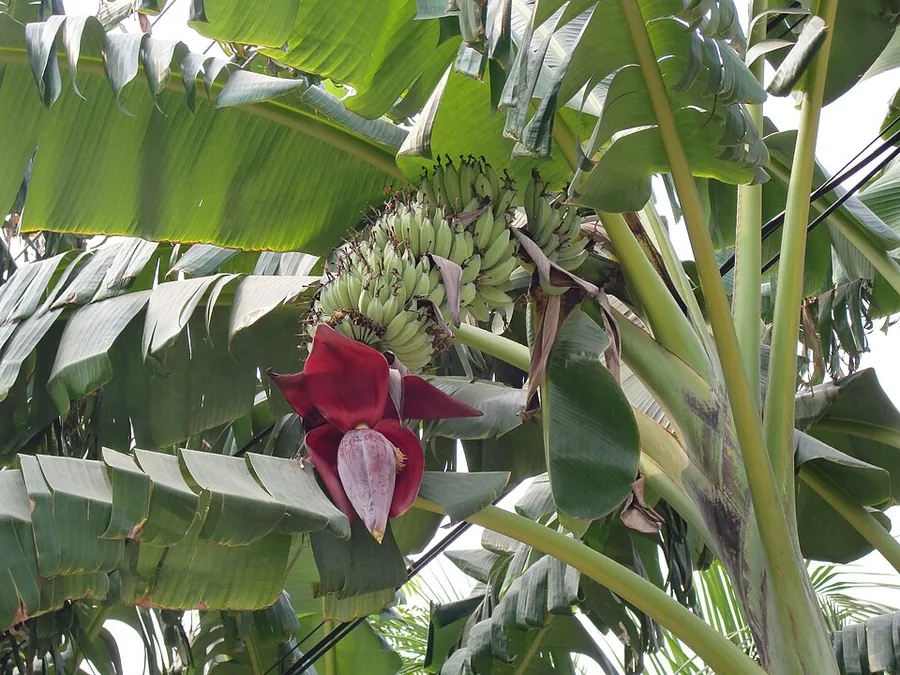
The banana is a giant herb, the largest in existence, and not a tree, since it lays down no true wood. The upright structure mistaken for a trunk is a pseudostem, a column of tightly furled leaf sheaths that bears the plant's weight until inflorescence. Each pseudostem grows quickly, flowers and fruits a single time, then senesces, while the lateral suckers at its base take over the perennial cycle.
As a tropical species, banana requires sustained heat and humidity to perform. It is hardy outdoors in USDA zones 9 to 11, and growers in colder climates maintain it in a large container moved under cover for winter. Supplied with sun, deep fertile soil, and abundant water, a single individual develops into a self-renewing clump.
Production rewards patience. A new pseudostem needs 9 to 20 months from planting to harvest, so the return is slow to arrive. Once a clump is established, however, successive followers mature in sequence, and the large paddle-shaped leaves justify the plant on form alone.
Care
The short version: full sun and warmth, deep fertile soil held evenly moist, and consistent high-potassium feeding through the growing season, with cold protection applied as soon as frost is forecast.
Light
Banana performs best in full sun, which supplies the photosynthate its fast, demanding growth requires, though it tolerates partial shade with reduced vigor. Higher light yields a stouter pseudostem and superior fruit development.
Water
Water demand is high. Maintain the soil evenly moist at all times yet never waterlogged, irrigating every 2 to 4 days and more frequently under heat or wind, which raise transpiration. Deep, well-drained soil permits heavy irrigation without inducing the anaerobic conditions that injure the roots.
Soil
Site the plant in deep, fertile, well-drained loam rich in organic matter, which both supplies nutrients and buffers the moisture banana requires. A soil pH between 5.5 and 7.0 keeps nutrient availability in the optimal range.
Temperature
The optimal range lies between 59°F and 86°F (15°C to 30°C). Growth decelerates as temperatures fall toward 60°F (16°C), and a freeze at or below 32°F (0°C) destroys the foliage, so adequate warmth is prerequisite to cropping.
Humidity
Reflecting its tropical origin, banana favors humidity around 50% to 80%. Low humidity raises transpirational stress and browns the leaf margins, so a sheltered, humid position outdoors or a misted location indoors preserves foliage quality.
Feeding
Banana is a heavy feeder with a pronounced potassium requirement tied to fruit fill. Apply a high-potassium fertilizer at roughly a 3-1-6 N-P-K ratio about monthly through the warm growing season to sustain chlorophyll and bunch development.
Pruning
Excise dead or damaged leaves as they form, and because each pseudostem fruits only once, cut the fruited pseudostem to the ground after harvest. Thin the suckers to one or two followers per clump so the rhizome's reserves are concentrated on productive shoots.
Repotting
A container specimen requires potting on every 1 to 2 years, or sooner when roots circle the pot, growth slows, or suckers crowd the surface. Transplant into a larger container at the onset of the warm season so root establishment precedes the period of rapid growth.
Size & spacing
This is a large plant, attaining 6.5 to 16 feet (2 to 5 m) in height and 5 to 10 feet (1.5 to 3 m) in spread. Allow generous open ground, as the clump expands progressively with each new sucker recruited at the base.
When to plant
Banana responds to accumulated warmth rather than to a fixed frost calendar. Plant in spring once soil and air temperatures have risen, allow the pseudostem to develop across the long growing season, and anticipate fruit anywhere from 9 to 20 months later. In climates with hard winters, container culture brought under cover before cold sets in is the reliable approach.
Northern hemisphere
Southern hemisphere
Typical months for a temperate climate: start earlier in warm zones, later where spring frosts linger.
- Plant: Spring, after the last frost when soil and air are warm (zones 9 to 11)
- Harvest: Each pseudostem flowers and fruits once, about 9 to 20 months after planting, then is cut down and replaced by suckers
Hardiness
USDA hardiness zones: 9–11
Temperature: down to -7°C
Troubleshooting
Most banana disorders resolve to one of three causes: cold injury, nutrient depletion, or a soilborne pathogen. The diagnostic evidence lies in the foliage and the pseudostem, which together indicate which factor is at work. Match the signs below and intervene early, before a setback becomes a total loss.
Lower leaves yellowing and wilting from the bottom up
Yellowing and wilting that begins on the lowest leaves points to Panama disease, the vascular wilt caused by a soilborne Fusarium fungus. The pathogen colonizes the water-conducting tissue and occludes it, which is why a cut pseudostem reveals brown or red streaking along the vascular bundles and why the plant starves of water from the bottom up. No treatment recovers an infected plant, so excavate and destroy it; the fungus survives in soil for years, which is the reason a susceptible cultivar must never go back into the same ground.
Fix:
- Remove and destroy infected plants
- Do not replant susceptible cultivars in the same soil
- Use resistant cultivars where available
Leaves turning black and collapsing after a cold snap
Blackened, collapsing foliage after a cold event reflects cold damage in a tropical species with no frost tolerance. Chilling injury sets in below 60°F (16°C), and ice formation at a freeze of 32°F (0°C) or lower ruptures the leaf cells outright. Because the rhizome holds far more cold tolerance than the foliage, removing the dead leaves once frost danger passes and mounding mulch over the rhizome usually allows fresh shoots to regenerate from below in spring.
Fix:
- Cut away dead foliage once frost danger passes
- Mulch heavily over the rhizome
- Allow the plant to resprout from the rhizome in spring
Older leaves yellowing or scorching at the edges
Marginal yellowing and scorch on the oldest leaves, paired with weak new growth, is the classic signature of a potassium or nutrient deficiency in a heavy feeder. Potassium is mobile within the plant, so it migrates from old tissue to support new growth, and the deficiency therefore announces itself on the lowest leaves first. A soil or leaf test confirms the shortfall; correct it with a high-potassium fertilizer at roughly a 3-1-6 N-P-K ratio, sustained through the warm season so demand stays met during active growth.
Fix:
- Apply a high-potassium fertilizer (about 3-1-6 N-P-K)
- Feed regularly through the warm growing season
Toxicity
For households with animals, the banana presents no concern: it is non-toxic in every part. The ASPCA records it as safe for cats and dogs, and the same status extends to other animals and to people. The only plausible effect from a large ingestion of leaf tissue is transient digestive upset, a fiber-load response shared by most plant material.
Safe for
People · Cats · Dogs · Horses · Rabbits · Livestock · Birds
Cats None
The ASPCA classifies banana as non-toxic to cats, so an exploratory nibble carries no risk. A cat that ingests a large volume of leaf tissue may show transient gastrointestinal upset, a mechanical effect common to most plant matter rather than a toxic one.
Dogs None
Banana presents no toxic hazard to dogs, and the ripe fruit features in many commercial dog treats. A large single ingestion of foliage may loosen the stool through fiber load alone, since the plant contains no canine toxin.
Horses Safe
Horses graze the foliage without adverse effect, and many readily consume the peeled fruit. The species contains no compound toxic to equines.
Rabbits Safe
Banana is non-toxic to rabbits, though the fruit's high sugar content makes it best rationed as a small, occasional supplement rather than a dietary staple.
Livestock Safe
Cattle, goats, and sheep digest banana leaves and stems without harm, and the foliage serves as routine fodder across many tropical production systems.
Birds Safe
Birds consume ripe banana readily, and both fruit and foliage are non-toxic. Domestic poultry and pet psittacines can be offered a portion without concern.
People Safe
Ripe bananas are a staple human food eaten raw or cooked, and no part of the plant is toxic. The unripe fruit and the tender inner pseudostem are also eaten in numerous culinary traditions.
Safe around pets; fruit and foliage are non-toxic, though eating large amounts of any plant material can cause mild digestive upset.
Varieties
The bananas grown in home and small-scale settings descend from a limited set of well-characterized cultivars, summarized here to inform selection.
Dwarf Cavendish
A compact, short-stemmed seedless dessert cultivar whose low stature and wind resistance make it the standard selection for container culture and confined or indoor spaces.
Cavendish
The dominant commercial dessert banana of the global trade, sterile and seedless and therefore propagated exclusively from suckers.
Lady Finger
A tall cultivar bearing small, notably sweet sugar bananas.
Lacatan
Among the tallest banana cultivars available to growers.
How to propagate
Banana propagates readily and exclusively by vegetative means, as every clump generates its own lateral shoots. New individuals are raised from these suckers or from sections of the underground rhizome, never from seed.
Offsets & pupsEasy
Warm season (spring to summer) · Roots in a few weeks; first fruit in about 9 to 20 months
The preferred propagule is the sword sucker, a vigorous shoot about 4 to 5 feet tall bearing narrow lance-shaped leaves, severed with an attached section of rhizome to carry its own meristem and reserves. Planted out in the warm season, it establishes roots within a few weeks, then requires roughly 9 to 20 months to produce its first bunch.
DivisionModerate
Warm season (spring to summer) · Several weeks to root
The rhizome may also be sectioned during the warm season, with each division retaining firm white tissue and several viable buds, after which each piece roots over several weeks. Seed plays no role in this crop, the edible cultivars being sterile and seedless.
Myths
Bananas grow on trees.
Botanically the banana is a giant herbaceous perennial, not a tree, because it produces no true woody secondary growth. The apparent trunk is a pseudostem, a rigid column formed from concentrically overlapping leaf sheaths that supports the plant until flowering. It is frequently cited as the world's largest herb, a designation that is popular though contested.
You can grow an edible banana from the seeds in store-bought fruit.
Dessert cultivars such as Cavendish are triploid, which renders them sterile and seedless, so the fruit contains no viable embryos to germinate. Propagation proceeds entirely vegetatively, through suckers, pups, or divisions of the rhizome.