Tree · Lauraceae
Avocado
Persea americana
With full sun, sharp drainage, and frost protection, an avocado will hold a canopy over a yard for decades.
Full sun
Every 3–7 days
USDA 9–11
30–66 ft · 9–20 m
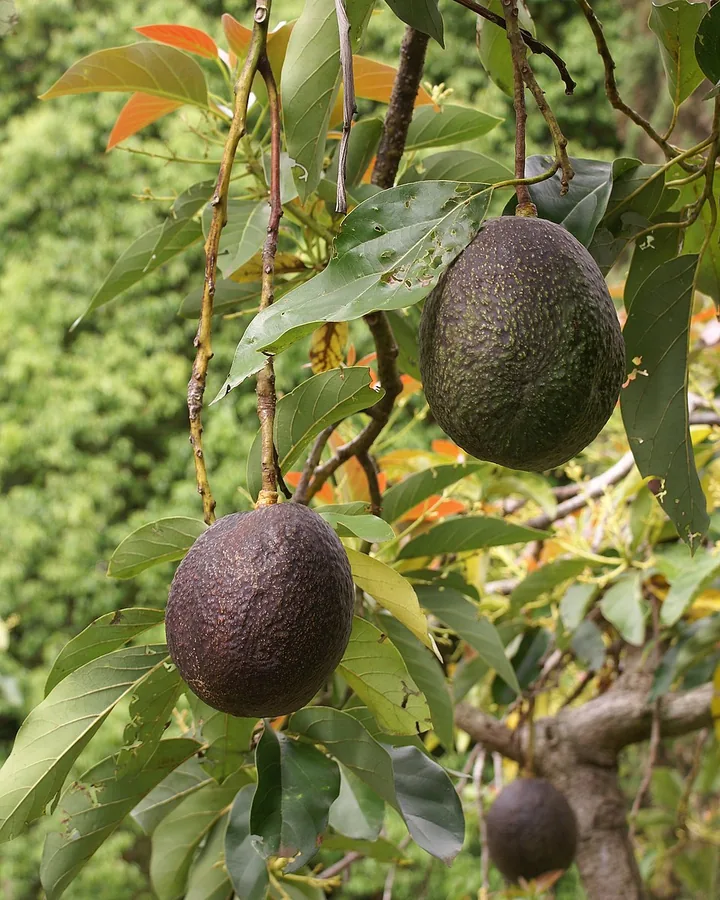
Overview
Persea americana is a large evergreen of the Lauraceae, indigenous to the warm uplands of Mexico and Central America. In open ground it develops a broad crown exceeding 65 feet (20 m), but its shallow root system and brittle wood make adequate space and a sheltered site essential. The economically important organ is the fruit, an oil-rich berry that completes ripening only after harvest rather than on the tree.
Cultivated avocados derive from three botanical races, and that ancestry governs frost tolerance directly. The Mexican race is the most cold-hardy, the West Indian race requires genuinely tropical conditions, and the Guatemalan race is intermediate, so a cultivar's parentage predicts how much cold it will endure. Most named cultivars are interracial hybrids.
Avocado is a long-term planting. Flowers express one of two synchronized patterns, type A and type B, and because the sexes open at offset times, this dichogamy promotes cross-pollination and fruit set. Establish a tree with sound drainage and frost protection, and once it reaches bearing age it can yield for many years.
Care
The short version: full sun and fast-draining soil matter most, because saturated ground starves the roots and kills avocados. Water deeply but let the top half dry between cycles, which keeps the feeder roots oxygenated, protect young trees from frost, and feed across the growing season.
Light
Site avocados in full sun, on the order of six or more hours daily, since photosynthetic capacity drives both growth and fruiting. Partial sun is tolerated, but in real shade the canopy elongates and fruit set falls sharply.
Water
Irrigate deeply but infrequently, allowing the top half of the profile to dry before the next application. Young and fruiting trees demand consistent moisture, yet saturated soil excludes oxygen from the roots and favors the Phytophthora that destroys them, so drainage is non-negotiable.
Soil
Plant into deep, well-drained sandy loam that never remains saturated. A pH of 6.0 to 7.0 keeps nutrients available, and on heavy or poorly drained sites a raised mound lifts the root crown clear of standing water.
Temperature
Avocados perform between roughly 23°F to 95°F (-5°C to 35°C), though the lower limit is race-dependent. Frost-tender races sustain injury well above the threshold for Mexican-race trees, so cultivar choice should follow the local winter minima.
Humidity
Average atmospheric humidity, about 40% to 60%, suits the species, which is not adapted to require high ambient moisture. No supplemental humidity is warranted outdoors.
Feeding
Fertilize monthly through the spring-to-fall period of active growth with a balanced product supplying nitrogen plus micronutrients. Demand for zinc and iron is particularly high, and deficiency of either expresses quickly as foliar symptoms.
Pruning
Avocados require minimal pruning. Remove dead, diseased, or crossing wood and head back lightly after harvest to manage height and form, but avoid heavy cuts, which remove bearing wood and depress yield.
Repotting
Because the species is almost always field-grown, repotting is seldom relevant. A young containerized tree can be potted up every 2 to 3 years until it is set in its permanent position.
Size & spacing
This is a large tree, attaining 30 to 65 feet (9 to 20 m) with a comparable spread. Position it well away from buildings, foundations, and power lines, and allow the brittle, shallow-rooted crown full room to develop.
When to plant
Avocado phenology runs on accumulated warmth, and a hard freeze sets growth back. Plant young trees in spring once frost danger has passed and the soil has warmed enough to drive root activity. Bloom follows from late winter into spring, and the fruit matures on the tree and is harvested across several months according to the cultivar.
Northern hemisphere
Southern hemisphere
Typical months for a temperate climate: start earlier in warm zones, later where spring frosts linger.
- Sow: Seed can be sprouted indoors year-round in warm conditions, but named cultivars are grafted rather than seed-grown.
- Plant: Spring, after danger of frost has passed and soil has warmed.
- Harvest: Flowers late winter to spring; fruit matures on the tree and is harvested over several months depending on cultivar (e.g., Hass roughly summer to winter).
Hardiness
USDA hardiness zones: 9–11
Temperature: down to -7°C
Troubleshooting
Most avocado disorders originate in the root zone or in cold injury, and the canopy registers them first because a compromised root system cannot keep the leaves supplied. Reading those leaf symptoms early lets you intervene before decline becomes irreversible. Match the symptom below, then correct the underlying cause.
Pale, wilting foliage and progressive canopy decline
These symptoms indicate Phytophthora root rot, the principal cause of avocado mortality. Phytophthora cinnamomi destroys the fine feeder roots in saturated soil, so water and nutrient uptake fails and the canopy wilts despite continued irrigation. Correct the drainage first, reduce watering, and incorporate coarse mulch held clear of the trunk.
Fix:
- Improve drainage and stop overwatering
- Apply phosphite (phosphonate) treatments
- Replant or topwork onto tolerant rootstocks using certified disease-free stock
- Maintain coarse wood-chip mulch kept several inches off the trunk and apply gypsum
Blackened, scorched foliage and shoot dieback after cold
This is frost damage, and the West Indian and Guatemalan races sustain it more readily than the hardier Mexican race. Freezing temperatures blacken the tender flush and scorch the leaf margins, and shoots can die back. Protect young trees with wraps and covers through a freeze, and defer pruning until spring growth resumes so you cut only confirmed dead wood.
Fix:
- Protect young trees with covers, trunk wraps, and overhead irrigation during freezes
- Prune frost-damaged wood only after new growth resumes in spring
Brown, necrotic leaf tips and margins
Marginal and tip necrosis reflects salt tip burn, the accumulation of chloride and sodium from saline irrigation water or excess fertilizer salts. The disorder intensifies during the dry season as salts concentrate. Leach the rootzone with a deep, slow irrigation and lower the fertilizer rate.
Fix:
- Leach the soil with deep irrigation
- Reduce fertilizer rates
- Switch to lower-salinity water where possible
Toxicity
The ripe mesocarp is edible, but the rest of the tree is a genuine hazard. Leaves, bark, fruit, and the large seed all contain persin, a compound that is dangerous to horses, livestock, and especially birds, and that can sicken cats and dogs. Exclude grazing animals and pet birds, and remove any fallen fruit from their reach.
Toxic to
Cats · Dogs · Horses · Rabbits · Livestock · Birds
Safe for
People
Cats Mild
A cat that ingests a small amount of avocado generally shows only mild signs, such as vomiting or loose stool from the persin. The principal concerns are the high fat content, which can precipitate pancreatitis, and a swallowed pit large enough to obstruct the digestive tract.
Dogs Mild
Most dogs tolerate a small quantity with little beyond gastric upset. The fatty flesh can induce pancreatitis, and the pit must be kept inaccessible, since an ingested seed can choke a dog or obstruct the bowel.
Horses Severe
Horses are markedly sensitive to persin. The characteristic presentation is edema of the head and neck, frequently with colic, and a substantial dose becomes dangerous. Exclude them from the leaves, bark, and any dropped fruit.
Rabbits Toxic
Persin renders every part of the plant unsafe for rabbits, so none of it belongs in the hutch or run. Keep leaves, bark, and windfall fruit entirely beyond their reach.
Livestock Severe
Goats, sheep, cattle, and donkeys are all severely affected, developing the same head and neck edema and risking cardiac and pulmonary damage. Lactating animals may additionally develop mastitis, so fence stock away from the tree and remove fallen branches.
Birds Severe
Birds are the most susceptible of all and can die from a small exposure. Expect weakness, a depressed and agitated demeanor, ruffled or plucked feathers, and labored breathing preceding cardiac failure. No part of an avocado should ever be offered to a pet bird.
People Flesh safe
The ripe flesh is the portion humans consume and is a wholesome everyday food. The leaves, bark, and skin are not edible, and a young child should be prevented from chewing on the hard pit.
Keep fallen fruit, pits, leaves, and prunings away from pets and livestock; never feed any part of an avocado to pet birds.
Helpline numbers

United States
ASPCA Animal Poison Control: (888) 426-4435 (fee applies)
Poison Control: (800) 222-1222



Canada
Poison Centres: 1-844-764-7669
Varieties
A few cultivars account for nearly the entire avocado trade, distinguished by flower type, skin character, and the cold tolerance inherited from their race.
Hass
A type A cultivar representing about 95 percent of California's commercial crop, with pebbly skin that turns black at ripeness and a pedigree traced to a single patented 1935 tree.
Fuerte
A type B cultivar of Guatemalan and Mexican parentage bearing smooth green skin, the dominant market avocado until Hass displaced it.
Mexicola
A Mexican-race cultivar valued among the most cold-hardy, producing small fruit with thin, dark, edible skin.
How to propagate
Avocado propagates by two routes with very different genetic outcomes: a quick but unpredictable seedling, or a graft that reproduces a named cultivar exactly.
GraftingDemanding
Spring, during warm weather when the bark slips and growth is active · Grafted trees typically bear in 3-4 years
Grafting is the standard method for reproducing every named avocado. In spring, when the bark slips and growth is active, growers cleft- or tip-graft a cultivar scion onto a seedling rootstock, fixing the genotype so the fruit comes true to type and a crop follows in about 3 to 4 years. The technique demands skill, but it is the only reliable way to replicate a cultivar such as Hass.
SeedEasy
Any time in warm conditions · 5-13 years to fruit, if at all
Germinating a pit is simple and succeeds any time conditions stay warm, but the genetics are unpredictable. A seedling is variable and may take 5 to 13 years to fruit, if it fruits at all, which is why seedlings are raised chiefly as rootstock rather than for their own fruit.
Myths
Every avocado is deadly poison to dogs and cats.
In dogs and cats the persin in the flesh ordinarily produces no more than mild gastrointestinal upset. The greater hazards are pancreatitis from the high fat content and a swallowed pit that can choke or obstruct the gut. Birds, horses, and grazing livestock are the species genuinely at risk.
A pit grown in a glass of water gives you fruit just like the parent.
A seedling is genetically variable and may take 5 to 13 years to fruit, if it fruits at all. Named cultivars like Hass are propagated by grafting, which fixes the genotype so the tree fruits true to type and far sooner.
One avocado tree is all you need for a good crop.
Avocados express two flower types, A and B, and interplanting a type A with a type B improves pollination and fruit set because their offset opening times overlap. A solitary tree still bears, but less reliably.