Houseplant · Cycadaceae
Sago Palm
Cycas revoluta
A slow, undemanding cycad of ancient lineage that nonetheless holds a toxin capable of killing a pet.
Bright indirect
Every 7–14 days
48–86°F · 9–30°C
USDA 9–12
Overview
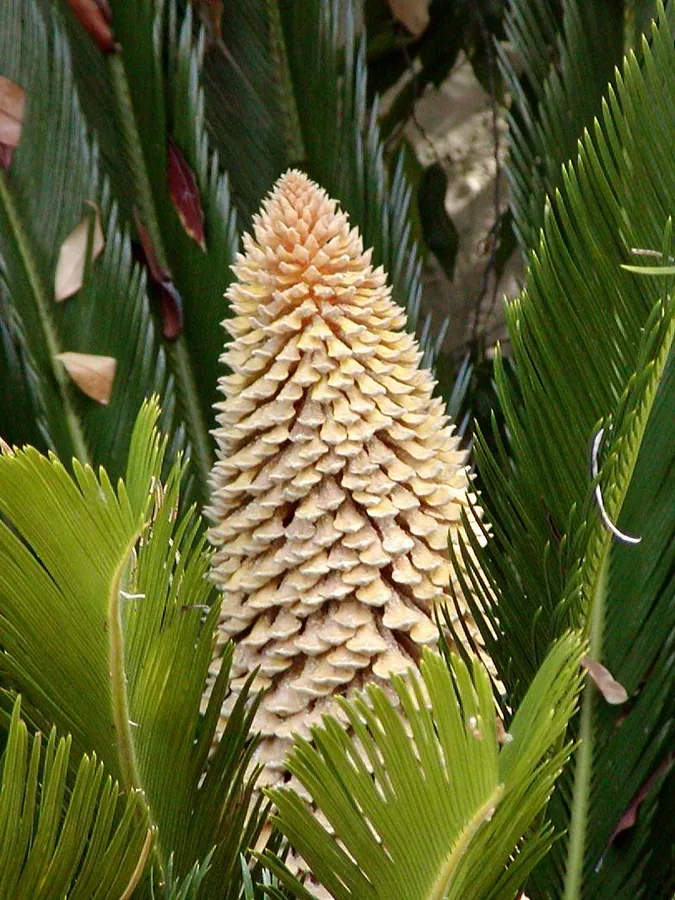
Despite its common name and palm-like silhouette, the sago palm is not a palm. Cycas revoluta is a cycad, a gymnosperm from a lineage that predates the flowering plants and reaches back to the age of the dinosaurs. The stout trunk and rosette of rigid, glossy fronds develop slowly, which is why a specimen holds its architectural form for many years indoors.
Its care requirements follow directly from its origins as a drought-adapted plant. Provide bright light and a coarse, sharply draining medium, then water only as the soil dries, since the roots will not tolerate prolonged saturation. Growth proceeds at a measured rate, generally a single annual flush of fronds, so an established plant demands little intervention.
One consideration outweighs the horticulture. All tissues of Cycas revoluta are severely toxic, with the seeds holding the highest concentration of the active compound, which makes it unsuitable for households with pets or young children inclined to chew foliage. Where that hazard is absent, few houseplants match its longevity or its tolerance of neglect.
Care
The short version: supply bright indirect light, a gritty, free-draining medium, and irrigation only once the upper half of the profile has dried. Fertilize with a palm formulation during the growing season, anticipate slow growth, and keep this toxic plant away from pets and children.
Light
Cycas revoluta performs best under bright, indirect light and will accept direct sun once acclimated. Position it near a bright window indoors. Under insufficient light the fronds emerge weak and elongated as the plant reaches toward the source.
Water
Allow the upper half of the soil to dry before irrigating, which in practice falls around every 7 to 14 days. The species is drought-tolerant once established but highly susceptible to root and crown rot, so saturated soil and impeded drainage are the principal risks. When the interval is uncertain, err toward waiting.
Soil
Use a sandy or loamy medium with free drainage, as rapid water movement through the root zone is essential to prevent rot. Maintain a slightly acidic pH of 5.5 to 6.5, which keeps micronutrients, manganese in particular, available for uptake. Amend with grit where the mix retains water.
Temperature
The plant is comfortable across 48°F to 86°F (9°C to 30°C), a range ordinary interiors satisfy readily. It is not frost-hardy, so any specimen summered outdoors must return inside before temperatures fall.
Humidity
Average indoor humidity is adequate, and no target figure applies. Very dry air favors spider mite populations, so modest local moisture around the foliage reduces the risk of infestation.
Feeding
Fertilize during the growing season, spring through summer, with a complete palm product. Select one supplying manganese and other micronutrients, because manganese deficiency is the specific cause of the frizzled, chlorotic new growth termed frizzle top.
Pruning
Prune minimally. Remove only the fully dead or badly damaged lower fronds, retaining all healthy green foliage, since the plant's slow growth means each removed leaf is replaced only after a long interval.
Repotting
Repot infrequently, on the order of every few years, or when roots have filled the container. The species grows slowly and tolerates being somewhat pot-bound, so excessive repotting disturbs it to little benefit.
Size & spacing
In open ground the plant attains 3 to 10 feet (90 cm to 3 m) in height with a comparable spread. Container culture indoors restricts it considerably, and reaching mature dimensions takes many years.
Troubleshooting
Cycas revoluta is undemanding, so symptoms are worth reading closely when they appear, and they surface either in the fronds or at the base of the trunk. The majority of disorders trace to excess moisture or to a nutrient rendered unavailable at the root. Identify the pattern below and intervene promptly, because a slow-growing cycad also recovers slowly.
Yellowing fronds above a soft base and decayed roots
Yellowing fronds over a soft, mushy base indicate root and crown rot, the consequence of excess irrigation combined with poor drainage that keeps the root zone saturated. Reduce watering and let the medium dry, transition to a gritty, sandy blend, and where the problem is caught early, excise the rotted tissue and repot into fresh, free-draining media. The plant should never stand in water.
Fix:
- Reduce watering and allow the soil to dry
- Improve drainage with a gritty, sandy mix
- Remove rotted tissue and repot into fresh well-drained media if rot is caught early
Newest fronds chlorotic, then browning and frizzled
Yellowing confined to the newest flush while older fronds remain green is diagnostic of manganese deficiency, the disorder called frizzle top. It develops where soil pH has risen above 6.5, which reduces manganese availability at the root. Correct it by watering manganese sulfate, not Epsom salts, into the soil beneath the canopy, and by feeding a complete palm fertilizer to maintain supply.
Fix:
- Apply manganese sulfate (not magnesium sulfate / Epsom salts) under the canopy and water in
- Use a complete palm fertilizer that includes manganese
- Correct excessively high soil pH
Sticky or stippled fronds bearing bumps or webbing
Sticky residue, raised bumps, or white cottony masses indicate scale or mealybugs, whereas fine webbing with pale stippling indicates spider mites, which proliferate in dry indoor air. Remove the pests by wiping or washing, then apply horticultural oil or insecticidal soap. Raising humidity suppresses the mites specifically.
Fix:
- Wipe or wash off pests
- Treat with horticultural oil or insecticidal soap
- Raise humidity to discourage spider mites
Toxicity
This section carries the most weight. Cycas revoluta is a cycad rather than a true palm, and every part contains cycasin, a potent hepatotoxin. Concentration is highest in the seeds, and a single seed can be lethal to a dog or cat. Keep the plant, shed fronds, and all seeds beyond the reach of animals and children, and regard any suspected ingestion as a medical emergency.
Toxic to
Cats · Dogs · Horses · Rabbits · Livestock · Birds · People
Cats Severe
In cats, no part of the plant is safe and the seeds are the most concentrated. Ingestion of even a small amount can produce vomiting, dark hemorrhagic stool, and jaundice as hepatic function declines, and mortality remains high despite treatment.
Dogs Severe
Dogs are attracted to the seeds, of which one or two can be fatal. Clinical signs include vomiting, dark tarry stool, increased thirst, bruising, and the jaundice of liver injury, progressing to fatal hepatic failure within days.
Horses Severe
The cycasin that poisons cats and dogs affects horses with equal severity. Expect vomiting, bloody diarrhea, jaundice, and coagulation disturbances as the liver fails, an outcome that is frequently fatal.
Rabbits Severe
Rabbits possess no tolerance for this toxin. A small quantity of frond or seed is sufficient to cause fatal hepatic damage, so the plant and all trimmings must be kept entirely inaccessible.
Livestock Severe
Cattle, goats, and sheep that consume the fronds or seeds sustain severe liver damage with frequent mortality. Exclude grazing animals from any sago palm growing within reach of pasture or paddock.
Birds Severe
Birds are equally susceptible. The cycasin present in seeds and foliage is as lethal to them as to mammals, so a pet bird should have no access to the plant or its shed seeds.
People Caution
No part of the sago palm is edible, and the seeds in particular can inflict severe liver damage if consumed. Keep children away, handle the seeds carefully, and contact poison control immediately following any ingestion.
Keep the plant, fallen fronds, and especially the seeds well out of reach of pets and children; wash hands after handling and dispose of trimmings and seeds securely.
Helpline numbers

United States
ASPCA Animal Poison Control: (888) 426-4435 (fee applies)
Poison Control: (800) 222-1222



Canada
Poison Centres: 1-844-764-7669
Varieties
The material offered to houseplant growers is effectively limited to the type species, so a single standard form is all that need concern the grower.
Cycas revoluta (king sago)
This is the type species, a thick-trunked cycad bearing stiff, glossy, pinnate fronds that superficially resembles a palm while belonging to an ancient lineage of gymnosperms.
How to propagate
Propagation of Cycas revoluta rewards patience above technique, given its exceptionally slow growth. Two methods are available, one straightforward and one more protracted, and both require careful handling of toxic tissue.
Offsets & pupsEasy
Spring to early summer · Several months to a year or more, as the plant is very slow-growing
The most reliable method is division of the basal offsets, the pups produced around the base of the trunk, lifted and rooted in spring to early summer. Establishment is slow to match the plant, and a single pup may require several months to a year or more to root and grow independently.
SeedModerate
When fresh seed is available from a pollinated female plant · Several months to germinate and well over a year to establish
Seed propagation is slower and depends on both a male and a female plant, as Cycas revoluta is dioecious. Fresh seed germinates over several months and takes well over a year to establish, and because the seeds are highly toxic, they warrant careful handling and storage away from pets and children.
Myths
Because it is called a palm, the sago is no more hazardous than other houseplant palms.
The plant is a cycad, not a palm, and the classification is not a technicality. True palms are harmless, yet every part of Cycas revoluta contains cycasin, and ingestion, above all of the seeds, can produce fatal liver failure in animals and humans. It ranks among the most poisonous plants kept indoors.