Herb · Rutaceae
Rue
Ruta graveolens
Grown in full sun and lean, dry soil, rue stays compact and holds its blue-green form for years.
Full sun
Every 7–14 days
80–120 days
USDA 4–9
Overview
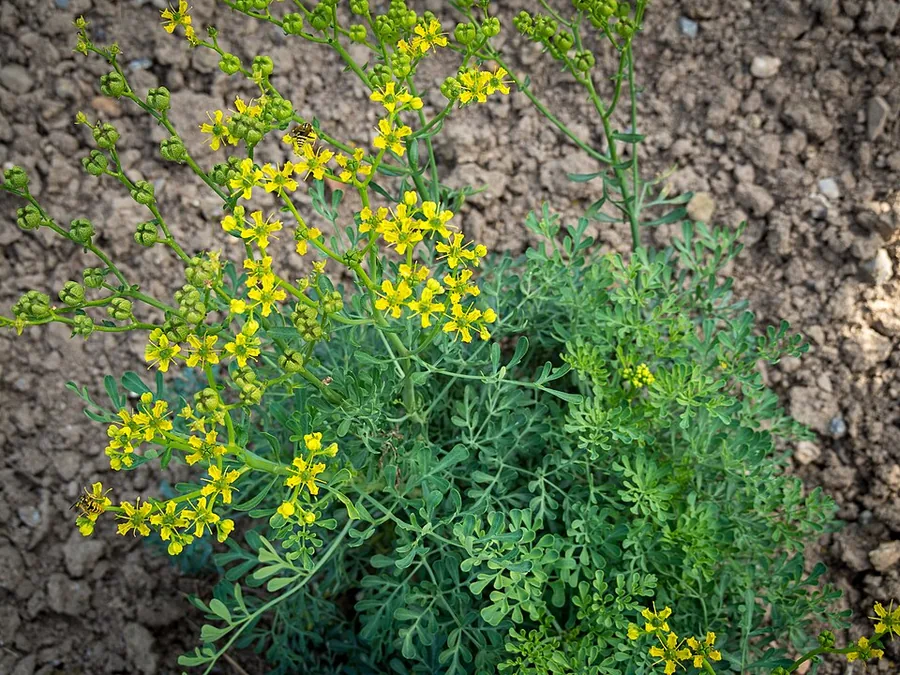
Rue (Ruta graveolens) is a woody-based evergreen herb long kept in physic gardens and apothecaries. It matures as a shrubby perennial of 2 to 3 feet (60 to 90 cm), carrying small mustard-yellow flowers through summer. Its historical culinary and medicinal use has given way to a purely ornamental role, and in the garden it now earns attention as a larval host for swallowtail butterflies.
The traits that make rue undemanding all trace to its dry-country origins. It needs lean, sharply drained soil and full sun, and it withstands both drought and cold to 5°F (-15°C). Because its roots cannot tolerate standing water, rich soil and frequent irrigation work against it, and waterlogging is the most common cause of failure.
The one genuine hazard is chemical. Rue tissue is high in furanocoumarins, phototoxic compounds that react with ultraviolet light, so sap on the skin followed by sun exposure produces painful blistering burns. For that reason it is handled in gloves and long sleeves, sited away from pets and children, and kept out of food use entirely.
Care
The short version: rue performs best in full sun and lean, sharply drained soil, watered deeply but only after the top half of the profile has dried. Prune it hard each spring, fertilize sparingly or not at all, and handle it in gloves because the sap is phototoxic.
Light
Rue is a full-sun plant, and light drives its habit: only in bright conditions does it hold the dense, blue-green mound it is grown for. It tolerates some afternoon shade, but reduced light causes the stems to elongate, so a shaded plant stretches and flops.
Water
Water deeply but only every 7 to 14 days, letting the top half of the soil dry between drinks. Once established rue is drought-tolerant, drawing on a deep root system, and it will not tolerate saturated soil. Persistent moisture around the roots is what triggers rot.
Soil
Rue is adapted to lean, sharply drained soil, sandy or loamy, and drainage matters more than fertility. A pH of 6.0 to 7.8 suits it, spanning slightly acidic to slightly alkaline. Poor soil is an asset here, since low fertility keeps growth compact and structurally sound.
Temperature
Rue tolerates heat to 95°F (35°C) and cold to 5°F (-15°C), a wide range that reflects its hardiness. That cold tolerance is why it overwinters reliably in zones 4 through 9 without protection, returning from its woody base each spring.
Humidity
Low humidity, around 30% to 50%, matches the dry Mediterranean climate rue evolved in. High humidity and stagnant air are the conditions to avoid, because trapped moisture on the foliage encourages the fungal rot the plant is already prone to.
Feeding
Fertilize lightly in spring or omit feeding altogether, because rue is adapted to low-nutrient ground. Excess nitrogen forces soft, rapid extension, and the result is weak, floppy growth that splays open and loses the compact form.
Pruning
Cut rue back hard in early spring to remove the old woody framework and stimulate compact new shoots from the base, then trim again after flowering to hold the shape. Work in gloves and long sleeves on an overcast day, because sap left on skin becomes phototoxic under sunlight and blisters.
Repotting
A container specimen needs potting on only every 2 to 3 years, since rue prefers to be somewhat restrained. Repot when roots circle or emerge from the drainage holes, when water passes through without uptake, or when new growth becomes sparse and stunted.
Size & spacing
At maturity rue forms a rounded subshrub 2 to 3 feet (60 to 90 cm) tall and 18 to 24 inches (45 to 60 cm) wide. Spacing plants at that width keeps air moving through the canopy, which keeps the foliage dry and limits rot.
When to plant
Rue is a cold-hardy perennial that establishes slowly. Seed is started indoors in late winter, transplants go out in spring once frost has passed, and the mustard-yellow flowers follow through summer, roughly June into August, once the plant is settled.
Northern hemisphere
Southern hemisphere
Typical months for a temperate climate: start earlier in warm zones, later where spring frosts linger.
- Sow: 6-8 weeks before last spring frost
- Plant: spring, after danger of frost has passed
- Harvest: Mustard-yellow flowers in summer (roughly June-August); grown ornamentally - do NOT harvest the foliage for eating due to toxicity and phototoxic sap.
Hardiness
USDA hardiness zones: 4–9
Temperature: down to -34°C
Troubleshooting
Once established, rue is largely trouble-free, and the disorders that do appear nearly all come from excess moisture or neglected pruning. The signs below point to a specific cause, so reading them early lets you correct the culture rather than lose the plant. Match the symptom, then address the underlying condition.
Wilting, yellowing, and progressive collapse
Wilting, yellowing, and gradual collapse point to root rot, and in rue it nearly always follows waterlogging. Because the roots need air, heavy clay or repeated watering deprives them of oxygen and they decay from the base up. Withhold water immediately, incorporate grit or sand to improve drainage, and remove any specimen whose roots have already turned brown and mushy.
Fix:
- Reduce watering immediately and allow soil to dry
- Improve drainage by amending with grit or sand, or relocate to a raised/well-drained site
- Remove and discard severely rotted plants
Bare woody stems carrying leaves only at the tips
Leaves confined to the stem tips over a bare, woody base indicate an unpruned, leggy plant: without renewal pruning the base lignifies and sheds its lower foliage. Insufficient light compounds it by drawing the stems out further. Hard pruning in early spring forces compact new shoots from the base, but the plant must then have full sun or it elongates again.
Fix:
- Cut back hard in early spring to encourage compact new shoots
- Ensure the plant receives full sun
Blue-green foliage chewed by banded caterpillars
Green-and-black banded caterpillars stripping the foliage are swallowtail butterfly larvae, for which rue is a recognized larval host. Because the plant is grown partly to support them, most gardeners accept the defoliation as intended. Where the damage is unacceptable, the larvae can be hand-picked and relocated, and broad-spectrum sprays are avoided because they kill the butterflies they attract.
Fix:
- Tolerate the caterpillars where butterflies are desired, as rue is a valued host plant
- Hand-pick and relocate caterpillars if damage is unacceptable
Toxicity
Rue is a plant to grow and observe, not to handle casually or consume. Its furanocoumarin content makes the sap phototoxic, causing severe sun-triggered skin burns, and the foliage is toxic to cats, dogs, horses, and grazing livestock if eaten. No part is edible, so it is managed with gloves and positioned away from pets and children.
Toxic to
Cats · Dogs · Horses · Rabbits · Livestock · Birds · People
Cats Moderate
A cat that ingests rue or contacts the sap develops drooling, vomiting, and diarrhea, followed by lethargy as the toxins take effect. The same compounds irritate the skin, leaving it reddened and sore.
Dogs Moderate
In dogs, chewing the foliage brings on drooling, vomiting, and diarrhea, often with reduced energy, while sap contact produces localized dermatitis where it settled on the skin.
Horses Moderate
Horses that graze rue develop gastrointestinal upset, and the phototoxic sap blisters or inflames the skin, most noticeably on pale, sun-exposed areas such as the muzzle and lower legs.
Rabbits Toxic
Rabbits should be kept away from rue entirely, because the furanocoumarins render the foliage unsafe to eat and can leave a browsing animal with digestive upset and irritated skin.
Livestock Toxic
Grazing livestock that consume rue can suffer digestive upset and photosensitization, in which sun-exposed skin reddens and blisters after the compounds accumulate in the system.
Birds Caution
Birds have little incentive to feed on the bitter foliage, and because the same phototoxic compounds are present, rue is best kept out of reach rather than offered.
People Caution
No part of rue is edible, and the principal risk is dermal: sap on the skin followed by sun exposure produces painful, blistering burns. Gloves and long sleeves are worn whenever the plant is handled or pruned.
Always handle rue with gloves and long sleeves, and avoid contact on sunny days, because sap on skin followed by sunlight causes painful blistering burns (worse than parsley or celery). The plant must NOT be eaten by people or animals and is not used as a modern culinary herb.
Helpline numbers

United States
ASPCA Animal Poison Control: (888) 426-4435 (fee applies)
Poison Control: (800) 222-1222



Canada
Poison Centres: 1-844-764-7669
Varieties
Two named selections circulate in cultivation, both chosen for foliage rather than any difference in use. Each is worth recognizing.
'Jackman's Blue'
A compact selection valued for foliage of an unusually deep blue-green that retains its color throughout the season.
'Variegata'
A form whose leaves are marked and margined with creamy white, producing a softer, mottled appearance.
How to propagate
Rue is propagated readily from seed or from cuttings, though both call for patience, and cuttings call for gloves because of the sap.
SeedModerate
Start indoors 6-8 weeks before last frost, or sow outdoors in spring; germination can be slow · Several weeks to germinate and a full season to establish
Rue is sown indoors 6 to 8 weeks before the last frost or direct-sown in spring. Because the seed needs light to germinate, it is pressed onto the surface rather than covered, and the medium is held evenly moist until emergence. Germination is slow and the plant requires a full season to establish, so the process rewards patience.
Stem cuttingsModerate
Take softwood or semi-ripe cuttings in late spring to summer · 4-8 weeks to root
Softwood or semi-ripe cuttings are taken from late spring through summer and rooted in a gritty, free-draining medium, where they root in 4 to 8 weeks. Gloves are worn throughout, because cut stems release the phototoxic sap that burns skin in sunlight.
Myths
Rue is a safe culinary herb that can be cooked with as freely as other Mediterranean herbs.
Historical kitchens did use it, but current guidance does not classify rue as food. It is toxic when eaten and its sap causes severe photodermatitis, so in modern practice it holds its place as an ornamental and historical herb rather than a culinary one.