Houseplant · Moraceae
Rubber Plant
Ficus elastica
Settle it in bright indirect light and a stable position, and Ficus elastica matures into a glossy, undemanding indoor tree.
Bright indirect
60–80°F · 16–27°C
USDA 9–12
2–10 ft · 0.6–3 m
Overview
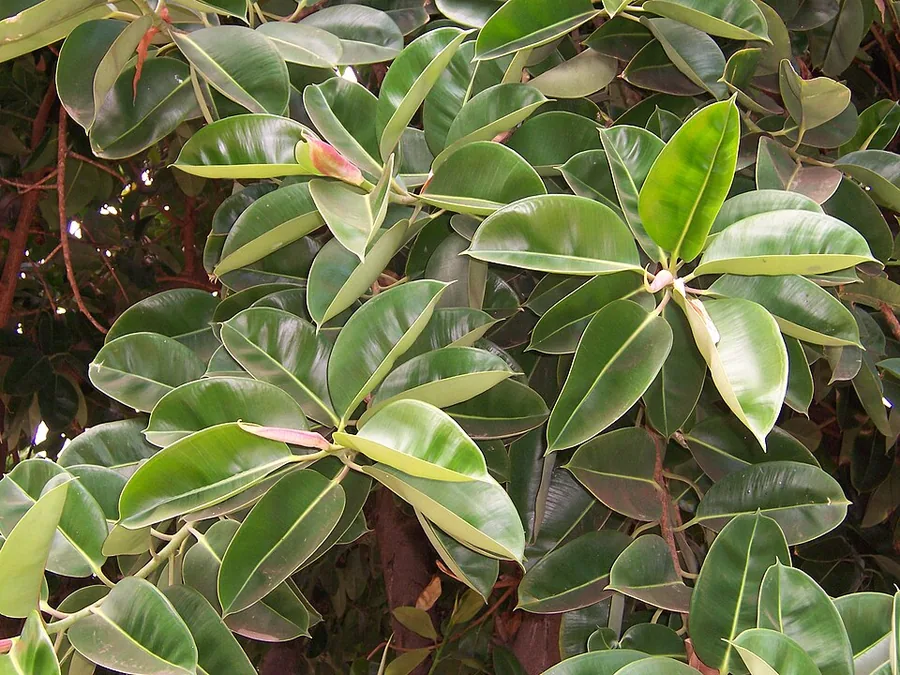
Ficus elastica ranks among the most accommodating of the large indoor trees. A member of the fig family, it originates in the forest belt running from Nepal through southern China and into western Malesia, where it attains tree stature. Confined to a pot it holds at a workable 2 to 10 feet (60 cm to 3 m), the thick, lacquered leaves lending a room genuine weight.
Its forgiving reputation rests on broad tolerance. Performance peaks in bright indirect light, yet it sustains itself under dimmer conditions better than most large foliage subjects and absorbs the occasional lapse in watering. Its chief intolerance is disruption, so a settled position clear of drafts is what keeps the canopy intact.
Cut any tissue and the plant bleeds a milky latex sap from the wound. That exudate is the source of the common name and the reason gloves belong in the routine at pruning time. It can irritate skin and rates as mildly toxic to cats and dogs, so position the plant with the household in view.
Care
The short version: bright indirect light, a warm settled position, and a deep watering withheld until the surface has dried a little. Feed across spring and summer, and glove up each time you cut into it.
Light
Position the plant in bright indirect light beside a window that escapes the harsh afternoon rays, which can scorch the foliage. It persists in partial shade or low light, though the slower light-driven growth there dulls the markings on variegated forms.
Water
Irrigate deeply, then hold off until the soil surface has dried slightly before the next round. Confirm the pot drains and empty whatever gathers in the saucer, because standing water suffocates roots and is the quickest route to rot. Taper the frequency from fall through late winter, when growth idles and uptake falls.
Soil
Use a well drained, soil-based potting mix. The species is indifferent to acidity across 6.0 to 8.0, so a medium that sheds excess water matters far more than chasing a particular reading on the scale.
Temperature
Hold it within its preferred 60°F to 80°F (16°C to 27°C) band, with warmer days easing into cooler nights. Keep it above 55°F (13°C) and away from cold drafts, since a sharp temperature drop is among the leading causes of leaf loss.
Humidity
Ordinary household humidity meets its needs, with no figure to monitor. It favors humid air by nature but withstands the dry heat of a heated winter interior without complaint.
Feeding
Apply a water-soluble houseplant fertilizer every two weeks across spring and summer, matching the supply to the active growth phase. Reduce the rate in lower light and through the cool season, when demand drops well off.
Pruning
Cut back in spring to restrain height, renew tall leggy stems, or steer the plant toward a fuller outline. Unworked, it ascends into a tall, tree-like form, so pruning answers to your intent rather than necessity. Always wear gloves, since the wounds weep irritating latex.
Repotting
Move it on in late winter or early spring once the roots have filled the pot. Step up only one or two sizes at a time into fresh, free-draining mix, and keep the gloves on for this task as well.
Size & spacing
Under cultivation the plant reaches 2 to 10 feet (60 cm to 3 m), climbing fast where light is generous. Allow floor area and overhead clearance to suit, as an unpruned specimen keeps gaining height toward its tree-like form.
Troubleshooting
The bulk of rubber plant complaints resolve to watering missteps or an abrupt change of setting. Interpret the leaves and roots promptly and the remedies stay straightforward. Find the closest match below, then correct course before a small disorder takes hold.
Drooping while the soil remains saturated
A specimen that slumps in wet substrate is exhibiting root rot, the predictable result of oxygen-starved roots. As the tissue blackens and softens it loses the capacity to conduct water, so the canopy wilts even with ample moisture present. Withhold water sharply, excise the decayed roots, and reset the plant into fresh free-draining mix within a container that vents excess water.
Fix:
- Reduce watering
- Repot into a well-drained mix and a pot with drainage holes
- Remove affected roots
Lower leaves yellowing on the plant
When the foliage yellows, suspect a substrate held too wet before anything else. The occasional yellow leaf at the base reflects normal senescence, but once the discoloration advances upward the roots are signaling waterlogged conditions. Scale back the watering interval, confirm the container drains freely, and discard any water pooled in the saucer.
Fix:
- Reduce watering frequency
- Ensure the pot has drainage holes and empty the saucer
- Use a well-drained, soil-based mix
Foliage shedding after relocation or a chill
Ficus elastica responds to abrupt environmental shifts by abscising its leaves, a stress reaction rather than a disease. Insufficient light, a cold draft, parched air, or saturated roots each trigger it, as does repeated repositioning that forces the plant to reacclimate. Settle it in one bright, draft-free location clear of heating vents, hold it above 55°F (13°C), and reassess your watering routine.
Fix:
- Move to a brighter, stable location with bright indirect light
- Keep away from cold drafts and heat sources; keep above 55°F
- Avoid frequently relocating the plant
- Check and correct watering
Sticky residue, fine webbing, or raised bumps
A range of sap-sucking pests colonize Ficus elastica, and each leaves a diagnostic trace. Look for the cottony white masses of mealybugs, the firm shell-like bumps of scale, the stippling and webbing of spider mites, and the tacky honeydew film that coats the leaf surface. Wipe the foliage clean, apply insecticidal soap or horticultural oil, and quarantine the plant from neighbors until the population is cleared.
Fix:
- Wipe or wash insects off the foliage
- Treat with insecticidal soap or horticultural oil
- Isolate the plant until the infestation clears
Toxicity
This is not a houseplant to treat as chew-safe. Its milky latex sap holds ficin and a psoralen, compounds that can inflame the mouth and stomach of cats and dogs and redden human skin on contact. Nothing on the plant is edible, so keep it beyond the reach of pets and young children and handle it gloved.
Toxic to
Cats · Dogs · Horses · Rabbits · Livestock · Birds · People
Cats Mild
After mouthing a leaf, a cat typically salivates and paws at its muzzle as the latex irritates the oral lining, and mild gastric upset with vomiting may follow. Sap reaching the skin can leave the contact site reddened and tender.
Dogs Mild
A dog that bites the foliage commonly drools and shows oral discomfort, with nausea or vomiting arising shortly afterward. The episode stays mild, yet the adhesive sap can still inflame skin where it lands.
Horses Caution
NC State records the species as toxic to horses, and the latex would irritate the mouth and digestive tract in the same way. An indoor fig rarely crosses a horse's path, so simply keep prunings and dropped leaves well out of reach.
Rabbits Caution
The milky exudate carries the same irritants that affect cats and dogs, so a rabbit that samples the leaves risks a sore mouth and digestive distress. Deny it access to the foliage entirely.
Livestock Caution
Stock animals that reach the leaves may develop oral and gastrointestinal irritation from the latex. This is no pasture species, so the genuine hazard lies in discarded trimmings or a potted specimen left within range.
Birds Caution
Companion birds can react to the irritant sap should they chew the leaves, so regard the plant as off-limits and site perches and cages away from the foliage.
People Caution
The milky latex acts as a skin and eye irritant and can provoke contact dermatitis, particularly in those sensitized to natural-rubber latex. Since none of the plant is edible, glove up before pruning or repotting and keep the sap clear of bare skin.
The milky latex sap can irritate skin and eyes and cause contact dermatitis in sensitive people (Ficus latex also cross-reacts with natural-rubber latex allergy); wear gloves when pruning or repotting
Helpline numbers

United States
ASPCA Animal Poison Control: (888) 426-4435 (fee applies)
Poison Control: (800) 222-1222



Canada
Poison Centres: 1-844-764-7669
Varieties
Nearly every rubber plant on offer belongs to one of a few named selections, spanning plain glossy green through deep maroon to bold variegation. The ones below are the most worth recognizing.
Robusta
The cultivar most often offered in trade, valued for its broad, thick, deep green foliage.
Decora
A wide-leaved selection that has served as a houseplant standard for decades.
Rubra
Bears foliage in reddish to deep maroon tones for a darker, more dramatic presence.
Tricolor
A variegated selection marked with green, cream, and a wash of pink.
Doescheri
A further variegated form numbered among the ornamental rubber plants.
How to propagate
Increasing a rubber plant rewards patience, since both standard techniques contend with sluggish rooting and the bleeding sap, but each delivers dependable results once those factors are managed.
Stem cuttingsModerate
Spring to summer during active growth · Several weeks to a couple of months to root
Take stem or tip cuttings during the spring and summer growth flush, when the plant has the metabolic vigor to form roots. The severed ends bleed milky latex, so rinse or blot the cut before potting to keep the wound clean. Expect rooting to proceed slowly, anywhere from several weeks to a couple of months.
Air layeringModerate
Spring to summer · Several weeks to root before separating from the parent
Air layering suits tall or leggy specimens best, since the developing roots draw on the parent for support rather than a fragile detached cutting. Roots form on the stem over several weeks while it stays attached, after which you sever the rooted section to stand on its own.
Myths
The rubber plant is a safe, pet-friendly houseplant.
The ASPCA classifies it as toxic to cats and dogs, and the milky latex can irritate skin and the gut. The active agents are ficin, a proteolytic enzyme, and a psoralen within the sap, so site it beyond the reach of pets and children.
Like many irritating houseplants, the rubber plant's bite comes from calcium oxalate crystals.
Those needle-like crystals account for the sting of philodendron and dieffenbachia, but the mechanism here is unrelated. The irritation arises from the milky latex itself, namely the enzyme ficin and the psoralen ficusin, with no oxalate involvement.
Rubber plants need bright direct sunlight.
Direct exposure, above all the intense afternoon sun, scorches the leaf tissue. The plant performs best under bright indirect light or part shade, and it endures dimmer conditions better than most foliage subjects.