Tree · Moraceae
Mulberry
Morus rubra
Give it full sun and room to spread, and the mulberry returns berries by the bucketful every early summer.
Full sun
Every 7–21 days
USDA 4–9
25–60 ft · 7.6–18.3 m
Overview
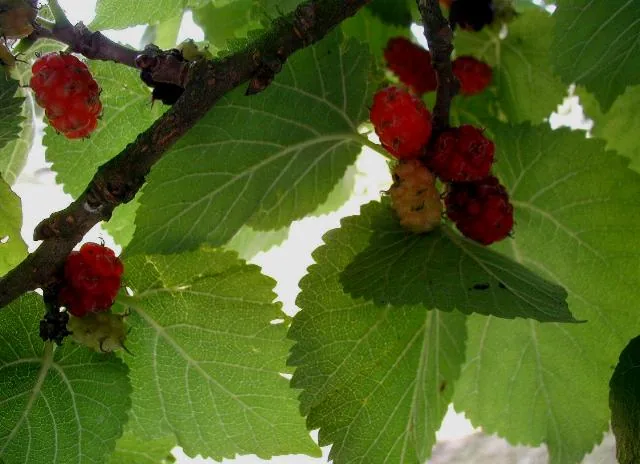
The mulberry is a fast-growing shade tree that repays its keep in fruit. It sits in the fig family, Moraceae, and reaches 25 to 60 feet (7.5 to 18 m) tall with a broad, spreading crown. Red mulberry is native to the eastern US while the white and black species originate in Asia, and all three ripen sweet, blackberry-like fruit in early summer.
The traits that make a mulberry undemanding also account for its reputation as a handful. It withstands cold to -29°F (-34°C), tolerates drought once established, and fruits so heavily that birds disperse seedlings across the neighborhood. Because the fallen fruit stains pavement a deep purple, placement carries as much weight as cultivation.
Sited correctly, a mulberry needs little intervention. Provide sun, deep soil, and clearance from patios and paths, and it persists for decades. Note, however, that white mulberry has become invasive across much of the US, so the native red mulberry or a named cultivar is the sounder choice.
Care
The short version: deep, well-drained soil, full sun, and generous clearance suit it best. Irrigate through the establishment years, confine pruning to midwinter dormancy, and locate it clear of any surface the fruit could stain.
Light
The heaviest crops come in full sun, though the tree tolerates partial sun or light shade. More light drives more fruit and holds the canopy open, so it dries quickly after rain, which denies mildew the still, humid air it needs.
Water
Water a young tree deeply about once a week through establishment, while its root system is still shallow. A mature mulberry is quite drought tolerant and requires irrigation only during an extended dry spell.
Soil
It performs best in deep, well-drained loam high in organic matter. It accepts clay or sand but declines in thin, poor ground, and it grows across a broad pH span of 5.5 to 7.5.
Temperature
The species is markedly hardy, enduring cold to -29°F (-34°C) and heat to 104°F (40°C). That thermal range corresponds to USDA zones 4 through 9.
Humidity
Ambient outdoor humidity of roughly 30% to 70% is adequate and needs no management. Canopy airflow matters more than any figure, since moving air keeps the foliage dry and less prone to fungus.
Feeding
A mature mulberry rarely needs feeding and often fruits better unfed. Where a young tree grows poorly, a light balanced fertilizer or compost in early spring suffices, because excess nitrogen forces weak, structurally poor growth.
Pruning
Prune only in full dormancy in late winter, since cuts made while the tree is active bleed sap heavily. Remove dead, crossing, or crowded branches, shape young trees, and hold cuts under about 2 inches across so the wounds close cleanly.
Repotting
As a landscape tree grown in the ground, a mulberry is not repotted. Transplant a young or container-grown specimen only while it is dormant, and read circling roots or stalled spring growth as the cue to move a potted one.
Size & spacing
Allow for a large tree, 25 to 60 feet (7.5 to 18 m) tall with a crown spreading 35 to 40 feet (10.5 to 12 m) wide. Provide that much open ground, well clear of buildings, paths, and other plantings.
When to plant
The mulberry follows a temperate seasonal cycle. Plant a young tree in spring once frost has passed, or set it out in fall during dormancy, when transplant stress is lowest. Flowering occurs in April and May, and fruit ripens through May and June, extending into summer on some types.
Northern hemisphere
Southern hemisphere
Typical months for a temperate climate: start earlier in warm zones, later where spring frosts linger.
- Plant: Spring after the last frost, or in fall while the tree is dormant
- Harvest: Blooms April-May; fruit ripens roughly May-June (into summer for some types)
Hardiness
USDA hardiness zones: 4–9
Temperature: down to -34°C
Troubleshooting
A mulberry is durable, so most of its problems are mess and pests rather than serious disease. Inspect the trunk for borers, the leaves for mildew, and the ground for staining and volunteer seedlings. Match the sign below, then intervene while the task is still small.
Branch dieback with frass and tiny boreholes at the trunk base
Dieback of this kind traces to a borer larva feeding in galleries beneath the bark, which severs the vascular tissue the branch depends on and starves it of water. The round exit holes, the oozing, and the powdery frass mark where the larva has worked. Prune out and burn the colonized limbs, then sustain vigor with consistent water and mulch, because a healthy tree lays down callus and resin fast enough to wall off new larvae. Keep mowers and trimmers off the trunk, since the beetle oviposits into fresh bark wounds.
Fix:
- Prune out and destroy infested limbs
- Keep the tree vigorous with proper water and mulch
- Avoid bark wounds that invite egg-laying
Pale powdery bloom coating the foliage by late summer
The coating is powdery mildew, a surface fungus whose mycelium sits on the leaf rather than inside it, which is why it rubs off under a wiping finger and shows on both faces. On a mature tree it is largely cosmetic and costs little. Thin the crowded growth so air moves through and the surfaces dry faster, since the spores need still, humid air to germinate, and rake off the fallen leaves that would otherwise overwinter the fungus. Full sun and dry foliage remove the conditions it needs.
Fix:
- Improve air circulation by thinning crowded growth
- Rake and remove fallen infected leaves
Purple staining underfoot with seedlings emerging widely
The heavy fruiting that makes a mulberry valuable is the same trait behind the mess: the abundant berries stain the ground where they fall, and birds carry the seed well beyond the canopy, which is why volunteers appear at a distance. Remove the volunteer seedlings while young, when the root is shallow and pulls cleanly, and clear fallen fruit before it sets. Because the problem is inherent to a fruiting tree, the durable control is siting well back from patios, driveways, and walkways, reserving a fruitless cultivar for situations where pollen-allergy rules permit it.
Fix:
- Hand-pull volunteer seedlings while young
- Site away from patios, driveways, and walkways
- Choose a fruitless cultivar only where allergy bans do not apply
Toxicity
The ripe fruit is a sweet, edible crop that is safe for people and pets, which is the tree's chief attraction. The remainder warrants care. Unripe green berries and the milky sap of the leaves and stems irritate skin and disturb the stomach, so keep grazing animals and curious children away from the green tissue.
Safe for
People · Cats · Dogs · Horses · Rabbits · Livestock · Birds
Cats Mild
Ripe berries carry no toxic principle for a cat. The irritant lies in the milky sap and the green unripe fruit, which can provoke salivation or a short bout of vomiting, so limiting the chewing keeps the response minor.
Dogs Mild
The ripe fruit poses no problem for a dog. Ingesting the unripe berries or chewing the sap-laden leaves, however, can produce soft stools or mild vomiting, a self-limiting gastrointestinal upset that resolves without treatment.
Horses Mild
Ripe windfalls are tolerated in moderation. Browsing on sap-rich leaves or green fruit can loosen the gut and suppress appetite for a day or so, the same mild irritant effect seen across species.
Rabbits Mild
Small portions of ripe fruit are a safe treat, but the rabbit's fermentation-dependent gut is easily disrupted, so unripe berries and sappy leaves can bring on soft stools. Introduce it sparingly and monitor for digestive upset.
Livestock Mild
Cattle, goats, and sheep consume fallen mulberries without harm. A large intake of green fruit or sap-laden foliage can cause transient diarrhea, and in real quantity the unripe berries can act as a mild intoxicant.
Birds Mild
Birds consume ripe mulberries without harm and are the tree's chief seed dispersers, which explains its wide spread. Only the green, unripe berries carry any risk of unsettling the gut.
People Ripe fruit safe
The ripe berry is a sweet, edible fruit taken fresh or baked. Avoid the unripe green berries and the milky sap, which irritates skin and, ingested in quantity, disturbs the stomach and can even induce hallucinations.
Ripe berries are safe, but unripe green or white berries and the milky sap of leaves and stems can cause mild gastrointestinal upset, and the sap is a mild skin and GI irritant.
Varieties
Three species and a few hybrids account for most of what reaches the trade. Distinguishing them lets you select the right tree and avoid the invasive one.
Morus rubra (red mulberry)
This eastern US native is identified by its dull, non-glossy foliage and its dark red-to-purple fruit.
Morus alba (white mulberry)
Introduced from Asia for sericulture, this glossy-leaved species has become invasive across much of the US, where it hybridizes with the native red mulberry.
Morus nigra (black mulberry)
It yields the largest and richest-flavored fruit of the three species while showing the least cold hardiness.
Illinois Everbearing
A productive M. alba by M. rubra hybrid, this cultivar extends fruiting across a long, heavy season.
Companions
A mulberry works best as a decoy for hungry birds and worst as a neighbor to anything that needs sun or clean ground beneath it.
Plant near
Cherries and blueberries: Birds strongly prefer mulberries, so a mulberry can act as a decoy that draws them away from other fruit crops.
Clover or other low groundcover: A living groundcover suppresses weed seedlings and adds organic matter under the canopy.
Keep apart
Vegetable and flower beds: Dense shade, greedy shallow roots, and staining fruit drop make underplanting and nearby beds difficult.
How to propagate
A mulberry propagates by cutting, graft, or seed, and the appropriate method depends on whether you want a genetic copy of a named tree or simply additional trees.
Stem cuttingsEasy
Hardwood cuttings in late winter; softwood cuttings in early summer · About 4-8 weeks to root
Two windows work for cuttings: dormant hardwood in late winter and softwood in early summer, with most striking roots in about 4 to 8 weeks. White mulberry roots readily by this route, whereas red and black mulberry are notably slower and less reliable to establish.
GraftingModerate
Late winter to early spring (whip or bark graft) · One growing season
Grafting is the standard means of propagating a named fruiting cultivar or a species that resists rooting, uniting the scion with vigorous seedling rootstock. Perform the whip or bark graft from late winter into early spring, and the union consolidates over a single growing season.
SeedModerate
Sow after 1-3 months of cold stratification · Several years to first fruit
Break dormancy with 1 to 3 months of cold stratification before sowing, then expect a long juvenile phase, since a seedling requires several years to reach first fruit. The progeny segregate and vary, and white mulberry in particular self-seeds aggressively wherever birds deposit the fruit.
Myths
A fruitless male mulberry provides a clean, problem-free shade tree.
Selecting for fruitlessness substitutes one liability for another. The male trees, typically Morus alba, release large volumes of allergenic pollen, which is why some cities such as Albuquerque restrict or ban them outright on air-quality grounds.
All tissues of the mulberry are toxic.
The claim is unfounded. The ASPCA classifies mulberry as non-toxic, and the ripe fruit is edible. Only the unripe berries and the milky sap present a hazard, and that amounts to a mild, self-limiting gastrointestinal upset.