Houseplant · Moraceae
Creeping Fig
Ficus pumila
A vigorous, fast climber that clings by self-attaching rootlets and asks chiefly for bright shade and steady humidity.
Bright indirect
Every 5–10 days
61–75°F · 16–24°C
USDA 8–11
Overview
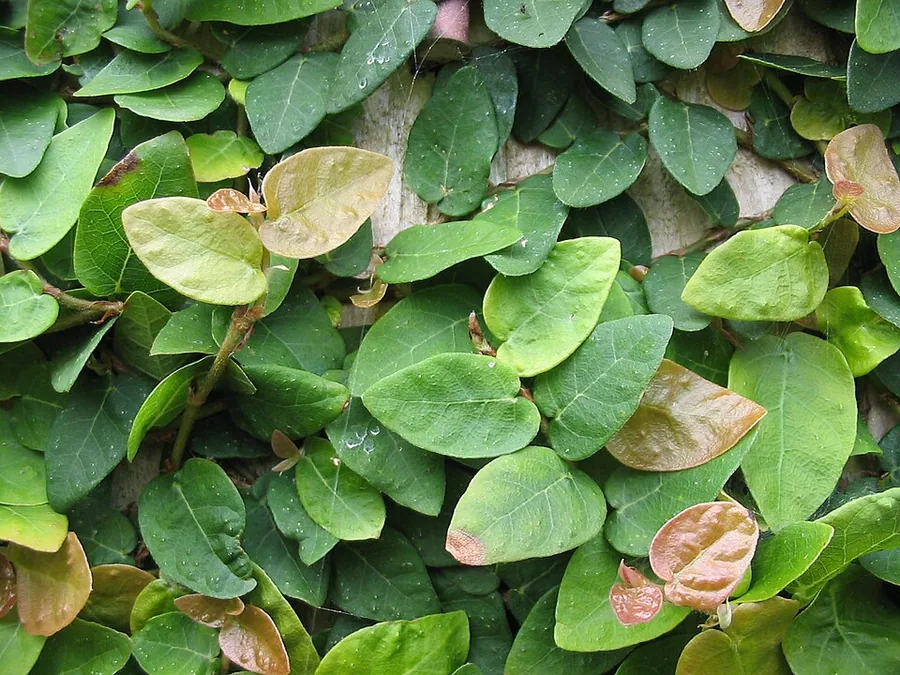
Ficus pumila is a small-leaved evergreen vine in the family Moraceae, native to East Asia and cultivated worldwide as a houseplant. The juvenile phase that most growers encounter is fine-textured and dense, its heart-shaped leaves scarcely larger than a thumbnail set along thin, wiry stems. Provided a pole, frame, or wall, it ascends by adhesive aerial rootlets that anchor it to nearly any surface without external support.
Under interior conditions it remains a compact, fast-growing climber or trailer well suited to a hanging pot, a moss pole, or a terrarium. The vigor that makes it undemanding also drives rapid extension, so periodic trimming is needed to keep it within bounds. Its tolerance of light levels well below what most figs require accounts in large part for its easy classification.
Two points deserve attention before acquisition. The milky sap is a skin irritant and is unsafe for pets, so gloves and an out-of-reach position are prudent. Outdoors in mild climates the species can become invasive and damage walls, which is the practical case for confining it to a container.
Care
The short version: bright indirect light, a soil-based mix held evenly moist but never saturated, warm interior temperatures, and high humidity, with trimming whenever extension outpaces the available space.
Light
Site creeping fig in bright indirect light for optimal growth. It withstands medium light, part shade, and even full shade more readily than most figs, so a position set back from a window remains workable. Exclude harsh direct sun, which scorches the small leaves.
Water
Through the growing season, water to keep the mix moist but never soggy, allowing the top inch or so to dry before rewatering, an interval that commonly falls every 5 to 10 days. Reduce watering from fall into late winter as growth slows and water demand drops. Because waterlogging suffocates the roots faster than anything else, drainage outweighs adherence to a fixed schedule.
Soil
Grow it in a soil-based potting mix high in organic matter that nonetheless drains freely. The roots require accessible moisture without standing water, so a medium that retains some moisture while shedding the surplus meets that demand precisely.
Temperature
Maintain the warm range it favors, approximately 61°F to 75°F (16°C to 24°C). Stable interior warmth suits the species, so the main task is excluding cold drafts and chilled window glass through winter.
Humidity
This fig requires high humidity and signals deficiency through crisp, dropping leaves in dry rooms. Group it with other plants, stand it on a pebble tray, or operate a humidifier, particularly while heating systems run and depress indoor moisture.
Feeding
Apply a balanced general-purpose houseplant fertilizer monthly across spring and summer during active growth. Suspend feeding once growth slows in fall and winter, when the plant cannot use the supplied nutrients.
Pruning
Anticipate routine pruning, since this is a vigorous vine of rapid growth. Remove wayward or leggy stems at any time to maintain form and dimension, and cut back any extension straying where it is not wanted. Trimming here is standard maintenance rather than corrective intervention.
Repotting
Advance it one pot size every 1 to 2 years in spring as it fills the container. Roots circling the pot or emerging from the drainage holes, water passing straight through, and arrested growth all indicate the time has come. Increase the pot by a single size so the fresh mix does not remain saturated around a small root mass.
Size & spacing
Trained on support indoors it can attain 8 to 15 feet (2.4 to 4.5 m) in time, with a spread near 3 to 6 feet (91 to 183 cm). Routine pruning holds most specimens well below that, and the container itself restrains overall extent.
Troubleshooting
Creeping fig is forgiving, yet it registers errors in air moisture or watering quickly because its thin leaves have little reserve. Most faults present on the foliage, so reading the leaves lets you correct conditions before marginal browning advances to bare stems.
Marginal browning followed by leaf abscission
Creeping fig abscises its small leaves when the root zone dries past its tolerance or the surrounding air loses moisture, since this thin-leaved species transpires faster than its limited roots can replace. The foliage crisps, curls, and drops, and the lower leaves usually go first as the plant sheds what it can no longer support. Hold the mix evenly moist across the growing season and raise the humidity with a pebble tray, a humidifier, or grouped plants to slow that water loss.
Fix:
- Water regularly during the growing season to keep the mix evenly moist but not soggy
- Raise humidity by grouping plants, using a pebble tray, or a humidifier
Stippled foliage with fine webbing from mites
Hot, dry conditions accelerate spider mite reproduction, and creeping fig is among their preferred hosts, so dry indoor air sets up the infestation. The mites feed on the leaf undersides, draining cell contents until the foliage reads dull and stippled, with faint webbing and minute moving dots betraying their presence. Rinse the leaves to dislodge them, lift the humidity to suppress their increase, and treat with insecticidal soap or horticultural oil, repeating until the population collapses.
Fix:
- Rinse foliage and increase humidity
- Treat with insecticidal soap or horticultural oil, repeating as needed
Toxicity
Keep this species out of reach of pets and small children. The stems and leaves carry a milky sap containing ficin and furocoumarins that irritates the mouth and gut and stings exposed skin. No part is intended for consumption, and gloves are warranted whenever you prune or train it.
Toxic to
Cats · Dogs · Horses · Rabbits · Livestock · Birds · People
Cats Mild
A cat that chews the foliage releases the milky latex into its mouth, and the proteolytic enzyme in that sap irritates the oral tissue and the gut lining. Drooling and vomiting follow, and direct contact can leave the skin reddened and sore.
Dogs Mild
Dogs respond to the latex as cats do, presenting an irritated mouth, gastric upset, and occasional vomiting once they have bitten into it. The same sap reddens the skin on contact.
Horses Mild
Horses are not spared the latex either; browsing the foliage irritates the mouth and digestive tract through the identical enzyme mechanism.
Rabbits Caution
No safety data exist for rabbits with this fig, and the documented irritancy of the sap argues against any exposure. Site the plant beyond their reach and exclude it from the diet.
Livestock Caution
Grazing stock rarely seek it out, yet the latex that irritates other mammals would in all likelihood affect them on the same basis. Keep it clear of feeding areas as a precaution.
Birds Caution
Documentation on creeping fig and birds is sparse, so the defensible position is to classify it as unsafe rather than assume otherwise and keep pet birds away from the foliage and sap.
People Caution
In humans the latex acts as a skin irritant capable of provoking contact dermatitis, which is why gloves are warranted during pruning or training. No part is edible, and the sap should be kept off bare skin and clear of the eyes.
Wear gloves when handling or pruning, as the milky latex can cause skin (contact) dermatitis.
Helpline numbers

United States
ASPCA Animal Poison Control: (888) 426-4435 (fee applies)
Poison Control: (800) 222-1222



Canada
Poison Centres: 1-844-764-7669
Varieties
Commerce supplies mainly the plain species, but several cultivars are distinguished by leaf form or coloration. The following are the ones most often met in cultivation.
'Minima'
A slow, mat-forming dwarf whose small quilted leaves suit the confined scale of a terrarium and drape cleanly over the rim of a pot.
'Variegata'
Distinguished by wiry stems bearing small heart-shaped leaves margined with a broad zone of creamy white.
'Quercifolia'
Identified by tiny lobed leaves resembling miniature oak foliage, a form well matched to containers and terrariums.
'Curly'
Recognized by curled, crinkled leaves, each bearing a variegated stripe along the midline.
How to propagate
Few houseplants propagate more readily. The juvenile stems root almost on contact, so new plants follow easily from cuttings or from layering a stem left attached to the parent.
Stem cuttingsEasy
Spring through summer during active growth · A few weeks to root
Collect cuttings from juvenile growth in spring or summer, when active growth supplies the hormones and reserves that drive rooting. This stage is so primed to root that a rooting hormone is unnecessary, and a cutting establishes within a few weeks.
LayeringEasy
Spring through summer · Several weeks to root where stems touch the medium
Creeping fig layers naturally, because its trailing stems initiate aerial rootlets at every point of contact with a surface. Pin a stem against moist medium in spring or summer and those contact points root along the stem over several weeks, yielding a new plant to sever from the parent.
Myths
Creeping fig gives you edible figs like the common fig tree.
It does set fruit, but only mature outdoor specimens produce the pear-shaped figs, and those are insipid and not worth harvesting. Under indoor conditions the plant rarely reaches the flowering, let alone fruiting, stage. This is a foliage species, not a fruiting one.