Houseplant · Moraceae
Ficus Audrey
Ficus benghalensis
Provide bright indirect light and even, measured watering, and this banyan fig grows into one reliable, handsome houseplant.
Bright indirect
65–80°F · 18–27°C
USDA 10–12
100 ft · 30.5 m
Overview
Ficus Audrey is the cultivated houseplant expression of Ficus benghalensis, the banyan fig recognized as the national tree of India. Under indoor conditions it retains a compact upright habit, a pale, almost chalky trunk, and soft green leaves with pronounced venation. Among the ornamental figs it reads as an easy species, more tolerant of lapses and less reactive than the fiddle-leaf fig grown alongside it.
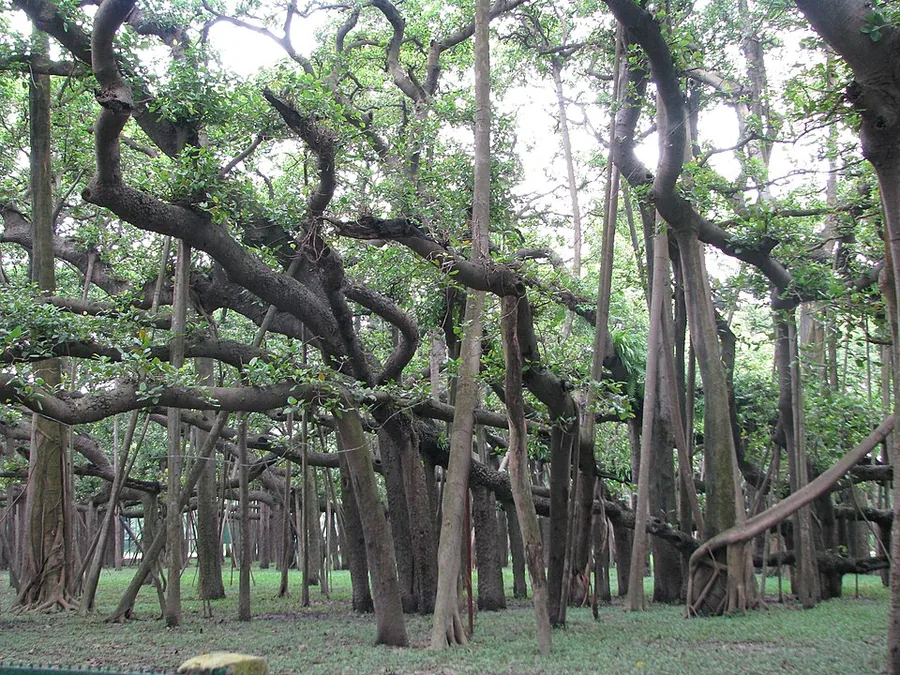
The same species, grown unchecked in a frost-free climate, attains tree dimensions. It germinates as an epiphyte on a host tree, then deploys aerial roots that thicken into secondary trunks until one individual reads as a small grove. A container restricts that program entirely. Confined to a pot it holds near 1 to 2 feet (30 to 60 cm) and forms no aerial roots.
Consistency is the operative requirement. Bright indirect light, irrigation timed to the drying of the soil surface, and a fixed position rather than frequent relocation sustain it. Maintain that regime and it produces steady new foliage; let the watering drift and it responds with stress, expressed most often as leaf abscission.
Care
The short version: provide bright indirect light, irrigate only once the top 2 to 3 inches (5 to 7.6 cm) of soil have dried, hold the air on the humid side, and keep the plant in one fixed position rather than relocating it.
Light
Place it in bright, indirect light beside a window where direct rays do not strike the lamina. It accepts some direct sun and a degree of shade, but inadequate light produces sparse, etiolated growth and leaf loss.
Water
Irrigate only when the top 2 to 3 inches (5 to 7.6 cm) of soil read dry, then allow free drainage and discard whatever collects in the saucer. Reduce frequency through winter as growth slows. Waterlogged roots are the most direct path to losing the plant.
Soil
Grow it in a well-drained potting mix, preferably amended with perlite so water passes through readily. It is indifferent across a pH of 6.0 to 8.0, which makes drainage the decisive variable rather than soil chemistry.
Temperature
Standard room temperatures suit it, in the range of 65°F to 80°F (18°C to 27°C). Keep it away from cold drafts and from the hot, dry discharge of heating and AC vents, since both induce leaf drop.
Humidity
It performs best where the air stays humid, around 50% to 80%. Dry indoor air, most acute in winter, cracks the leaf margins through excess transpiration, so cluster plants or run a humidifier where rooms run dry.
Feeding
Apply a liquid houseplant fertilizer monthly across spring and summer, then suspend feeding through winter dormancy. Pale new growth signals nitrogen demand.
Pruning
It tolerates pruning, so cut to shape or restrain size whenever required. The complication is the irritant milky latex that flows from each cut, so wear gloves and keep the sap clear of skin and eyes.
Repotting
Pot it on in late winter or early spring, without urgency, since it tolerates a degree of root confinement. Roots emerging from the drainage holes, circling the rootball, or water passing straight through indicate the time has come.
Size & spacing
As a houseplant Audrey holds near 1 to 2 feet (30 to 60 cm) tall, well short of the roughly 100-foot (30 m) tree the species reaches in habitat. Allow enough clearance for air to circulate around the canopy and to keep it off neighboring plants.
Troubleshooting
Most Ficus Audrey disorders originate in watering or an abrupt change in conditions, and the foliage registers them first. Interpreting the early signs lets you correct the cause before isolated leaf loss escalates to bare stems. Match the presentation below to its likely driver, then intervene while the response still helps.
Wilting, yellowing, and soft decaying roots
This is root rot, the result of roots held in saturated soil where oxygen runs out and tissue dies. Lift the plant and inspect for brown, mushy roots that give off a sour odor. Excise the rotted roots, repot into a fast-draining medium, and from then on let the surface dry before watering and empty the saucer, since standing water reproduces the original anaerobic conditions.
Fix:
- Reduce watering
- Repot into a well-drained mix and trim away rotted roots
- Ensure the pot drains freely and empty saucers
Leaves abscising in a sudden flush
Figs shed foliage when conditions shift faster than the plant can adjust, whether the trigger is a saturated rootzone, a cold draft, or relocation. Overwatering ranks first among the causes, so assess soil moisture before anything else and withhold water until the top few centimeters dry. Hold the plant in one bright, draft-free position, since stable light and temperature let it re-leaf rather than keep dropping.
Fix:
- Stabilize conditions: keep in bright indirect light, away from heating/AC vents and cold drafts
- Water only when the top few cm of soil dry; never leave the pot in standing water
- Resume light feeding in the growing season if foliage is pale (nitrogen)
Stippling, honeydew, or raised bumps signaling pests
Stippling, a sticky film, or raised bumps on the stems indicate a pest infestation, commonly spider mites, scale, or mealybugs, with fungus gnats breeding in persistently damp soil. Washing the foliage and rinsing dislodges much of the population, after which insecticidal soap or horticultural oil applied per label disrupts the survivors across repeat cycles. Allowing the soil surface to dry interrupts the fungus gnat life cycle, which depends on moist medium.
Fix:
- Wash foliage and rinse off pests
- Treat with insecticidal soap or horticultural oil per label
- Let the soil surface dry to discourage fungus gnats
Brown and yellow lesions developing on the leaves
Leaf spotting reflects the moisture and airflow at the leaf surface. Where stagnant air and standing surface moisture persist, soft spreading lesions form and spread, while pale brown dry patches indicate the plant drew down on water. Improving air movement and keeping the foliage dry removes the conditions both spots depend on, and even watering covers the deficit cause.
Fix:
- Improve air circulation and avoid wetting foliage
- Water consistently and discard excess water
Leaf margins cracking and crisping
Low ambient humidity drives this, pronounced in winter when heating dries the indoor air and raises transpirational loss past what the leaves replace. Clustering plants, running a humidifier, or standing the pot on a pebble tray lifts local humidity toward 50% to 80%. Distance from heating vents matters because their hot dry output desiccates foliage faster than any other indoor source.
Fix:
- Raise humidity (group plants, use a humidifier or pebble tray)
- Keep away from heating vents
Contact dermatitis from cut-stem sap
The milky latex sap holds ficin, a proteolytic enzyme, along with psoralen, and contact with broken tissue inflames the skin. Because the latex flows only from wounds, irritation reliably follows pruning or a snapped stem. Washing the contact area with soap and water removes the residue, and gloves worn during any cutting prevent exposure in the first place.
Fix:
- Wash skin with soap and water after contact
- Wear gloves when pruning or taking cuttings
Toxicity
This is neither an edible plant nor one to leave within a chewing animal's reach. The leaves and the milky sap contain ficin and psoralen, compounds that irritate the mouth, digestive tract, and skin in cats, dogs, and people alike. Severity registers as low rather than dangerous, but no tissue is safe to ingest, so keep it clear of pets and children and wear gloves when pruning.
Toxic to
Cats · Dogs · Horses · Rabbits · Livestock · Birds · People
Cats Mild
A cat ingesting leaf tissue or sap shows drooling and sometimes vomiting as the ficin and psoralen irritate the oral and gastric lining. The effect stays mild, and signs resolve once the animal stops contacting the plant.
Dogs Mild
A dog that bites a stem or leaf develops drooling and gastric upset, with vomiting in some cases. The latex can also redden the perioral skin where it makes contact.
Horses Mild
In horses the sap irritates the mouth and digestive tract, producing salivation and gastrointestinal upset. Latex on the skin can leave the muzzle inflamed at the point of contact.
Rabbits Caution
The ficin and psoralen that affect cats and dogs apply equally to rabbits, making the foliage an unsuitable browse. Position the plant out of reach to remove any chance of ingestion.
Livestock Caution
Grazing animals reaching the foliage incur the same oral and gastric irritation the sap causes across mammals. Exclude the plant from any area stock can access.
Birds Caution
No portion of the plant is safe to consume, and the irritant latex makes exposure of an inquisitive bird to the leaves and cut stems inadvisable.
People Caution
No part of the plant is edible, and the latex sap can irritate skin on contact, so gloves are warranted during pruning. Prevent children from chewing the leaves, which can inflame the mouth.
The milky latex sap can irritate skin; wear gloves when pruning or taking cuttings
Helpline numbers

United States
ASPCA Animal Poison Control: (888) 426-4435 (fee applies)
Poison Control: (800) 222-1222



Canada
Poison Centres: 1-844-764-7669
Varieties
Ficus Audrey reaches the trade under a single principal name, though a closely allied selection appears in cultivation. The two below are worth distinguishing.
'Audrey'
This is the compact houseplant clone marketed as Ficus Audrey, maintaining 1 to 2 feet (30 to 60 cm) with a pale, whitish trunk and prominently veined green leaves, and it is undemanding in cultivation.
Chandelier Happiness
An upright selection of greater stature, attaining roughly 2 to 4 feet, with oval foliage in a medium green.
How to propagate
Propagating an established Audrey is feasible, if slower than rooting an obliging trailer. Both methods sever stems that exude irritant latex, so gloves are a prerequisite throughout.
Air layeringModerate
Any season (genus-level, Clemson); NC State also lists air layering for F. benghalensis · Unknown
Air layering gives the higher success rate, and figs root by this method in any season. The technique wounds a stem section and encases it in moist moss until adventitious roots form, after which the rooted portion is severed from the parent. The wound exudes irritant latex throughout, so gloves are required for the duration.
Stem cuttingsModerate
Best taken in summer (genus-level, Clemson); NC State lists stem cuttings for the species · Unknown
Stem cuttings offer a second route, taken in summer when active growth favors rooting. A healthy stem is cut and potted to initiate roots. The cut surface releases milky latex that irritates the skin, which makes gloves necessary while handling the material.
Myths
Ficus Audrey is widely regarded as an entirely non-toxic fig, harmless to both cats and dogs.
The record contradicts that. The ASPCA classifies the genus Ficus as toxic to cats, dogs, and horses on account of its ficin and psoralen, and NC State documents this species as poisonous to cats, dogs, and people through its leaves and sap. Keep it out of reach of pets and children, and regard any chewed leaf as grounds to consult the vet.
In common with numerous cultivated houseplants, the irritant principle is taken to be calcium oxalate.
The mechanism differs. Irritation traces to the milky latex sap, which contains the proteolytic enzyme ficin together with psoralen, and not the calcium oxalate crystals responsible for irritation in genera such as pothos and dieffenbachia.
This is presumed to be merely a compact tabletop specimen, with the great aerial-rooted banyans representing an unrelated species.
It is the same taxon, Ficus benghalensis, the national tree of India. Cultivated indoors as Audrey it holds around 1 to 2 feet and produces no aerial roots, yet in habitat it functions as a strangling fig, germinating as an epiphyte, ascending to roughly 100 feet, and dropping prop roots that lignify into trunks.
Sources
- Plants of the World Online, Royal Botanic Gardens Kew
- NC State Extension Gardener Plant Toolbox
- ASPCA Animal Poison Control ('Fig')
- UF/IFAS Center for Aquatic and Invasive Plants, University of Florida
- Clemson Cooperative Extension HGIC (Weeping Ficus)
- Missouri Botanical Garden Plant Finder (Ficus benjamina)