Herb · Lamiaceae
Rosemary
Salvia rosmarinus
Rooted in lean, fast-draining soil under full sun, this Mediterranean subshrub rewards restraint with years of aromatic growth.
Full sun
Every 7–14 days
USDA 7–11
2–6 ft · 0.6–1.8 m
Overview
Rosemary, botanically Salvia rosmarinus, is a woody evergreen subshrub shaped by the dry, sun-baked hillsides of the Mediterranean. It belongs to the mint family, yet its needs run opposite to those of its moisture-loving relatives. The plant is adapted to scarcity, so lean soil and strong sun serve it far better than rich ground and shade.
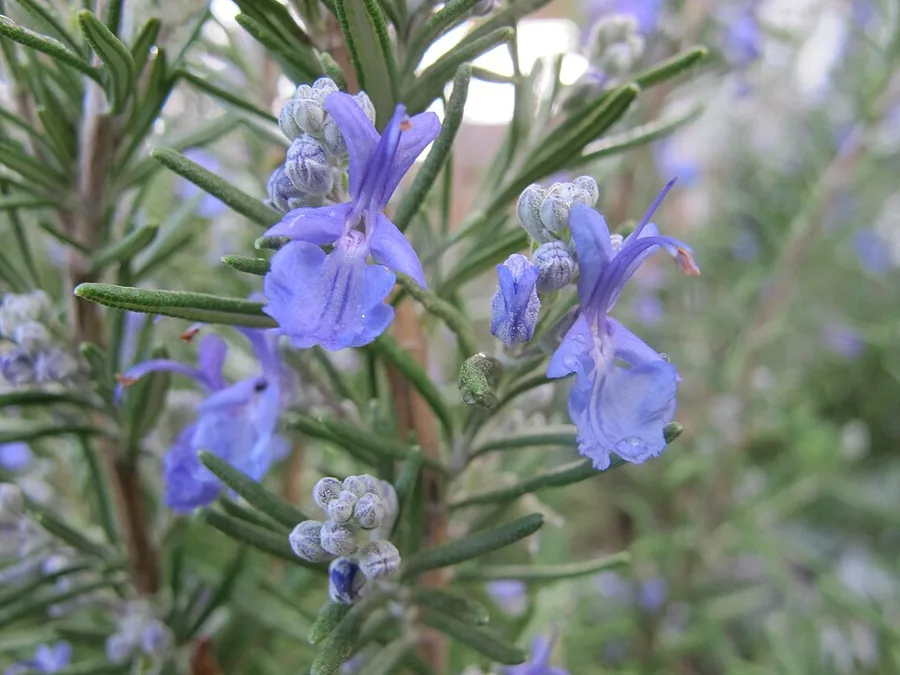
As a perennial, an established plant persists for years, laying down gnarled woody stems clothed in narrow, needle-like leaves. Flowering comes in late winter and spring, when small blue blooms, occasionally pink or white, open on the stems. Its hardiness spans zones 7 through 11, within which it can remain outdoors permanently; beyond that range, container culture and winter shelter substitute for a mild climate.
One physiological fact governs its care above all others: rosemary evolved to resent standing moisture, so overwatering, not drought, is the leading cause of decline and death. Soggy soil suffocates the roots, whereas dry spells the plant is built to withstand. Grow it lean, water it sparingly, and it demands little more.
Care
The short version: rosemary needs full sun and sharp drainage because it evolved in dry, exposed ground, and it should be watered only after the soil has dried well down. Feed sparingly, keep the air moving to suppress mildew, and hold it on the dry side year-round.
Light
Rosemary requires full sun, ideally 6 to 8 hours daily, because its compact, aromatic growth depends on high light. Under part shade the stems stretch and thin and the essential-oil content, and therefore the flavor, declines. Indoors, the brightest available window is the minimum standard.
Water
Watering is the decisive variable, since the plant resents saturated soil. Allow the top half of the soil to dry before watering again, on the order of every 7 to 14 days, and reduce that frequency further once the plant is established. Persistently wet roots are the single greatest threat, so err toward waiting.
Soil
Provide light, sandy, sharply drained soil, which mirrors the rocky ground the species evolved on. It tolerates poor and stony sites but rots in heavy clay, so incorporate grit or sand where drainage is slow. A pH of 6.5 to 7.0, near neutral, is optimal.
Temperature
The plant withstands a broad range, roughly 10°F to 86°F (-12°C to 30°C), though cold tolerance is cultivar-dependent. A hard freeze can kill tender selections outright, so in cold zones a hardy cultivar or overwintering under cover is the reliable approach.
Humidity
Rosemary favors low humidity, near 30% to 50%, consistent with its arid origins. Damp, stagnant air promotes powdery mildew on the foliage, which makes free air movement more valuable to the plant than any added moisture.
Feeding
As a light feeder, rosemary performs best with minimal nutrition, and excess feeding actively reduces the concentration of aromatic oils that give it flavor. A single modest application of balanced fertilizer or compost in spring meets its needs. Heavier feeding forces soft, sappy growth at the expense of fragrance.
Pruning
Trim lightly after flowering and harvest sprigs through the season to maintain a bushy habit. The critical constraint is to avoid cutting into old leafless wood, which lacks dormant buds in quantity and regenerates slowly, if at all. Confine cuts to leafy growth.
Repotting
Repot container specimens every 1 to 2 years, or when roots circle the pot, water passes through almost immediately, or new growth stalls, all signs the plant has become rootbound. A gritty, fast-draining medium in a pot with functional drainage holes preserves the dry root zone the plant requires.
Size & spacing
24–71 in (60–180 cm) tall
When to plant
Rosemary follows a slow developmental clock, and its seed germinates poorly, which is why transplants are the practical route once frost has passed in spring. Where winters stay mild, sprigs can be cut throughout the year. Flowering, marked by small blue blooms, runs from late winter into spring.
Northern hemisphere
Southern hemisphere
Typical months for a temperate climate: start earlier in warm zones, later where spring frosts linger.
- Sow: 10-12 weeks before last spring frost (germination is slow and erratic)
- Plant: after danger of frost has passed in spring
- Harvest: Small blue (occasionally pink or white) flowers in late winter to spring; leafy sprigs can be harvested year-round in mild climates.
Hardiness
USDA hardiness zones: 7–11
Temperature: down to -18°C
Troubleshooting
The great majority of rosemary disorders reduce to two conditions the plant is poorly equipped to handle: excess moisture at the roots and stagnant air around the foliage. Both announce themselves early, and reading those signs allows intervention before decline sets in. Identify the symptom below, then correct the underlying condition rather than the symptom alone.
Wilting and yellowing that persist in wet soil
Collapse in saturated soil signals root rot, the consequence of overwatering or poor drainage rather than a lack of water. The affected roots turn soft and brown and give off a sour odor as the tissue breaks down. Withhold water, repot into a gritty, fast-draining medium, and secure a few healthy cuttings against the chance the plant fails.
Fix:
- Stop watering and allow soil to dry
- Repot into fast-draining gritty mix and trim rotted roots
- Take healthy stem cuttings as a backup if the plant is failing
Fine webbing and a stippled, dull surface on the leaves
Webbing and pale stippling indicate spider mites, which colonize indoor and stressed plants most readily in dry winter air. The mites cluster on the leaf undersides, where they feed and spin the fine threads. Dislodge them with a firm rinse, treat with insecticidal soap or horticultural oil, and improve airflow to reduce the stress that favors them.
Fix:
- Rinse foliage with a strong stream of water
- Apply insecticidal soap or horticultural oil
- Increase airflow and reduce plant stress
Brittle, brown, leafless stems following cold
Bare, brittle wood after cold weather reflects winterkill, most severe on non-hardy cultivars grown in marginal zones beyond their tolerance. A bark scratch distinguishes the two states: living wood shows green beneath, dead wood is dry and brown. Cut back to living tissue in spring, and the plant will regenerate from the stems that survived.
Fix:
- Prune out dead wood back to living tissue in spring
- Allow plant to regrow from healthy stems
A dusty white bloom coating the foliage
The white powder is powdery mildew, a fungal infection that establishes where air stagnates and humidity climbs. It appears most on crowded indoor plants held in still winter air, conditions that suit the pathogen. Widen the spacing, lower the humidity, and remove the most heavily colonized foliage to check its spread.
Fix:
- Improve air circulation and spacing
- Reduce humidity and avoid overhead watering
- Remove and discard affected foliage
Toxicity
For households with pets or young children, the safety profile is straightforward: rosemary is non-toxic. The ASPCA classes it as safe for cats, dogs, and horses, and the culinary herb is equally safe for people to eat. The one exception is the concentrated essential oil, a distinct product that should not be ingested.
Safe for
People · Cats · Dogs · Horses · Rabbits · Livestock · Birds
Cats None
Rosemary is non-toxic to cats and appears on the ASPCA's safe list. An exploratory bite is harmless, and the strong aromatic oils deter most cats from eating more.
Dogs None
Dogs tolerate the leaves without harm, and rosemary extract is used in some pet foods as a natural preservative. Only an unusually large quantity is likely to cause a mild, self-limiting digestive upset.
Horses Safe
Horses can graze rosemary without risk. The pungent, aromatic foliage is unpalatable to them, so intake rarely exceeds a taste.
Rabbits Safe
Small amounts of fresh rosemary suit rabbits within a varied diet. Hay and leafy greens should still form the dietary staple, with the herb as an occasional supplement.
Livestock Safe
Goats, sheep, and cattle can browse rosemary safely. Its pungent foliage generally limits how much stock will consume regardless.
Birds Safe
Rosemary presents no hazard to backyard poultry or pet birds. A sprig placed in the enclosure is harmless, though it is usually left untouched.
People Safe
Rosemary is a standard culinary herb, safe for both adults and children to eat and cook with. The concentrated essential oil is the sole exception, being a separate product that is not intended for ingestion.
Highly concentrated rosemary essential oil is a separate product that can irritate skin or be harmful if ingested in quantity, but the culinary herb and growing plant are non-toxic.
Varieties
Cultivated rosemary ranges from prostrate, trailing forms to erect shrubs, and cultivar choice becomes significant chiefly where cold hardiness or culinary quality is the deciding factor.
Arp
Among the most cold-hardy selections available, tolerating winters colder than the species typically endures.
Hill Hardy
An upright, cold-tolerant cultivar that persists in marginal northern zones where standard rosemary fails to overwinter.
Tuscan Blue
A vigorous, erect grower bearing deep blue flowers, valued equally for the kitchen and for training into low hedges.
Prostratus
A low, trailing groundcover form suited to spilling over walls and containers, though its cold tolerance falls short of the upright cultivars.
How to propagate
Stem cuttingsEasy
Spring to summer from softwood or semi-ripe growth · 4-8 weeks to root
Vegetative propagation from cuttings is the most reliable method and the one most growers adopt. Working in spring or summer, take 8 to 15 cm sections of softwood or semi-ripe growth, strip the lower leaves, and insert them in a gritty, free-draining medium, where root initiation follows over 4 to 8 weeks.
SeedDemanding
Indoors 10-12 weeks before last frost · Several weeks to germinate, then a full season to establish
Seed propagation is demanding and rarely the efficient choice. Sow indoors 10 to 12 weeks before the last frost and expect slow, erratic germination and a low strike rate, with weeks required to sprout and a full season before seedlings establish. That inefficiency is why cuttings remain the standard.
Myths
Rosemary needs frequent watering to stay healthy.
Once established, rosemary is markedly drought-tolerant and needs very little water. Saturated soil, not drought, accounts for most losses, because the roots evolved in free-draining ground and suffocate when kept wet.
The rosemary plant is toxic to pets because rosemary oil can be harmful.
The ASPCA classifies the growing plant and culinary herb as non-toxic to cats, dogs, and horses. Only the concentrated essential oil, a separate and far more potent product, carries a meaningful irritation risk, and animals do not encounter it by browsing the plant.