Houseplant · Begoniaceae
Rex Begonia
Begonia Rex Cultorum Group
Prized for foliage patterned like paint, the rex begonia demands bright, indirect light and steady air movement to stay disease-free.
Bright indirect
66–73°F · 19–23°C
USDA 10–11
12–18 in · 30–46 cm
Overview
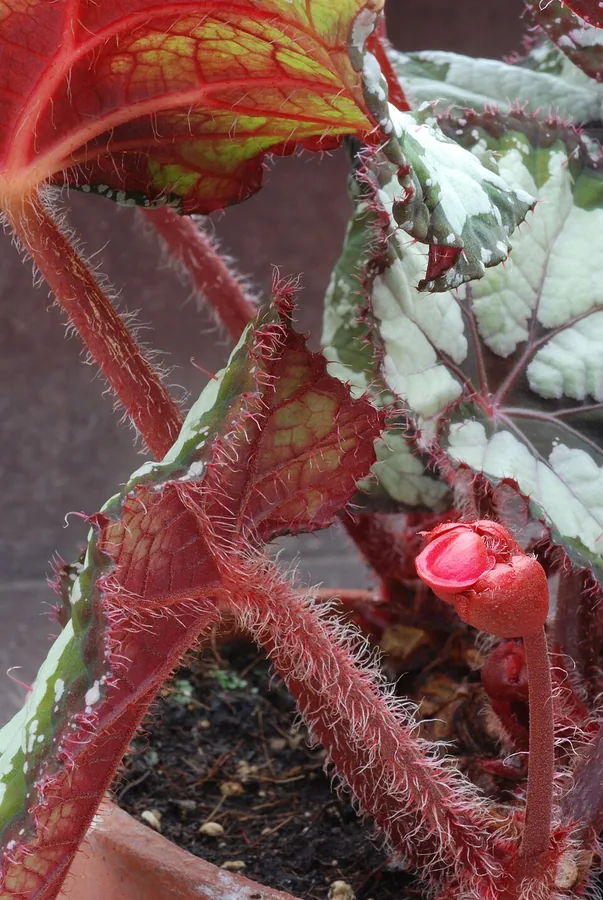
The rex begonia is a foliage plant, cultivated for leaf display rather than bloom. Its laminae layer silver, plum, rose, and deep green, often spiraled or blistered, while the flowers stay small and pink-white, of little ornamental weight. It sits within the Rex Cultorum Group, a large body of hybrids derived from a wild species of the eastern Himalayan foothills.
Growth arises from a creeping rhizome rather than an upright stem, which keeps the plant low and spreading at 12 to 18 inches (30 to 46 cm) in height and a similar spread. That habit is the reason a shallow pot serves it better than a deep one, matching the horizontal root system.
Its demanding reputation follows from a narrow set of preferences: steady warmth, high humidity, and continuous air movement. Fall short on any of them and the plant declines, because the same warm, moist conditions it needs also favor the fungi that attack it once the air stays still. Manage moisture and airflow together and the foliage rewards the effort; neglect either and rot follows quickly.
Care
The short version: bright, indirect light, an evenly moist but porous mix that drains freely, warmth held near 66°F to 73°F (19°C to 23°C), and high humidity supplied through the surrounding air rather than by wetting foliage, which would invite fungal disease.
Light
Provide bright, indirect light, and exclude hot, direct sun, which scorches the thin, pigmented leaves. The plant tolerates partial to full shade, but coloration weakens as light drops, since the pigments develop best under brighter indirect exposure. A fluorescent fixture substitutes where daylight is insufficient.
Water
Hold the soil evenly moist with slight surface drying between waterings, and never let it stand saturated. Deliver water at the soil line or from below rather than overhead, because wetting the foliage promotes leaf rot and fungal infection. Reduce the volume through winter dormancy, when uptake falls.
Soil
Use a porous, well-drained mix high in organic matter, such as a light soilless or African-violet medium, so excess water clears quickly. A slightly acidic pH of 5.5 to 6.5 suits nutrient uptake, and a shallow container matches the horizontal rhizome.
Temperature
Maintain warmth between 66°F and 73°F (19°C to 23°C); growth slows once nights fall much below that range. Protect it from cold drafts and abrupt temperature swings, which stress the tissue.
Humidity
This species requires high humidity, roughly 50% to 75%, above typical indoor winter levels. Raise ambient moisture with a pebble tray or by spraying the surrounding air, not the leaves, because standing moisture on foliage is the primary trigger for powdery mildew and botrytis.
Feeding
During active growth from spring through early fall, apply a balanced liquid fertilizer at half strength every couple of weeks at alternate waterings, matching feeding to the period of active uptake. Withhold fertilizer through fall and winter dormancy, when the plant is not growing.
Pruning
Pruning demand is low. Remove dead or diseased leaves promptly, both to keep the canopy open for airflow and to strip out the tissue on which fungi establish. Pinching the growing tips induces branching for a denser habit.
Repotting
Repot in spring when the plant becomes pot-bound, moving to a shallow pot suited to the creeping rhizome. Roots circling the root ball indicate the pot is exhausted and the plant is ready to move up.
Size & spacing
At maturity the plant remains compact, reaching 12 to 18 inches (30 to 46 cm) tall with an equivalent spread. Allow open space around it so air circulates through the foliage and the leaf surfaces stay dry, which limits fungal disease.
Troubleshooting
Most disorders in this species reduce to two variables, soil moisture and air. Waterlogged media and damp, static air drive the rots and mildews, while inadequate light degrades the leaf coloration. Identify the pattern below and intervene early, since fungal problems spread through the canopy fast.
A collapsing plant with a blackened, softened base
A persistently soggy medium produces crown and root rot. Once the rhizome softens and darkens, withhold water and let the mix dry. Repot into fresh, porous media in a shallow pot, cut away all rotted tissue, and resume watering conservatively to avoid a recurrence.
Fix:
- Stop watering and allow the mix to dry
- Repot into fresh porous, well-draining mix and a shallow pot, trimming away rotted tissue
- Resume careful watering, avoiding waterlogged soil
Powdery white coating that resists rubbing off
The coating is powdery mildew, a fungus that establishes where air is still and humidity is high. Remove the colonized leaves and open the canopy so air circulates around the plant. Keep the foliage dry, since surface moisture is what lets the fungus advance.
Fix:
- Remove and discard affected leaves
- Improve air circulation around the plant
- Avoid wetting foliage; spray the surrounding air rather than the leaves to raise humidity
Grey fuzzy mold over collapsing, water-soaked tissue
This is botrytis, the grey mold that colonizes leaves held wet in stagnant, humid air. Excise and destroy the infected tissue rather than composting it, since the spores persist. Water at the soil and increase airflow so the canopy dries between waterings.
Fix:
- Remove and destroy affected plant parts
- Increase air circulation and lower ambient moisture on foliage
- Stop misting/wetting leaves; water at the soil
Cottony masses, fine webbing, or stippled new growth
Three sap-feeders account for these signs. Cottony white masses in the leaf axils indicate mealybugs, fine webbing over stippled tissue indicates spider mites, and a flush of tiny insects on disturbance indicates whiteflies. Treat mealybugs with rubbing alcohol, isolate the plant, and repeat treatment, raising humidity to suppress mites.
Fix:
- Dab mealybugs with rubbing alcohol on a cotton swab
- Isolate the plant to prevent spread
- Treat repeatedly until pests are gone, raising humidity to discourage spider mites
Bleached leaf color with elongated, drawn-out growth
Loss of leaf pattern combined with stretched stems signals insufficient light, as the plant elongates toward the source. Relocate it to a brighter position with ample indirect light, avoiding hot direct sun. Where daylight is limited, a fluorescent fixture restores adequate intensity.
Fix:
- Move to a brighter spot with plenty of bright, indirect light (avoid direct, hot sun)
- Supplement with fluorescent lighting if natural light is limited
Growth halts and leaves drop through winter
A rex begonia that stops and sheds leaves in the colder months is entering winter dormancy, triggered by shorter days and lower temperatures. The rhizome remains firm even as the canopy thins. Reduce watering, suspend feeding until spring, and resume routine care when active growth returns.
Fix:
- Reduce watering and keep the soil barely moist
- Stop fertilizing until new spring growth appears
- Resume normal care when active growth resumes in spring
Toxicity
Treat the rex begonia as toxic. All tissues contain soluble calcium oxalate, concentrated most heavily in the underground rhizome. Because the oxalate is soluble, it can be absorbed systemically, which is why grazing animals risk kidney injury while cats and dogs that chew the foliage mainly drool and vomit; the sap can also irritate skin. Keep it away from pets, livestock, and small children.
Toxic to
Cats · Dogs · Horses · Rabbits · Livestock · Birds · People
Cats Moderate
A cat that ingests leaf tissue typically salivates and vomits as the calcium oxalate irritates the oral cavity and digestive tract. Because the rhizome holds the highest concentration, a cat that excavates the base receives a larger dose.
Dogs Moderate
In dogs, chewing the foliage produces salivation, pawing at the mouth, and gastric upset. Ingestion of the rhizome is the greater concern, as the toxin is most concentrated in that underground tissue.
Horses Severe
Grazing animals are affected most severely. The soluble oxalates enter the circulation and burden the kidneys, so a horse that browses the plant may become considerably sicker than the small quantity consumed would suggest.
Rabbits Toxic
Rabbits feed low and continuously, which makes the same kidney-stressing oxalates a genuine hazard for them. Position the plant well beyond their reach and never provide any part as forage.
Livestock Toxic
Goats, sheep, and cattle share the systemic oxalate risk documented in horses, presenting oral irritation followed by potential renal involvement after grazing. Exclude them from the plant entirely.
Birds Caution
The oxalates that affect mammals make the plant unsuitable around pet birds as well. Regard any pecking at the foliage as a hazard and keep birds away from it.
People Caution
No part of the plant is edible, and the sap can produce itching or dermatitis in sensitive individuals on contact. Wash the hands after pruning and prevent small children from placing leaves in the mouth.
NC State and UConn note the sap contains calcium oxalate and can cause skin irritation/contact dermatitis in some people when handling
Helpline numbers

United States
ASPCA Animal Poison Control: (888) 426-4435 (fee applies)
Poison Control: (800) 222-1222



Canada
Poison Centres: 1-844-764-7669
Varieties
The Rex Cultorum Group holds a great many named hybrids, all selected for foliage. The record documents one by name.
Begonia rex-cultorum 'Super Curl'
A documented cultivar within the extensively hybridized Rex Cultorum Group, cultivated as the group generally is for ornamental patterned foliage rather than bloom.
How to propagate
The rex begonia propagates readily because its leaf veins are capable of forming adventitious plantlets. Attempt it in spring and summer, during active growth, when wound tissue regenerates fastest.
Leaf cuttingsModerate
Spring to summer · Plantlets form in 1-3 months
Leaf cuttings exploit the plant's capacity to form plantlets at wounded veins, and are best taken in spring or summer during active growth. Sever the major veins on the underside and lay the entire leaf flat on moist medium, or divide it into wedges that each retain a principal vein. New plantlets emerge from the cuts over the following one to three months.
DivisionEasy
At repotting in spring · Several weeks
Division at spring repotting is the simplest method. Separate the rhizome into sections, each retaining its own roots and foliage, and pot them individually. Established growth follows within a few weeks.
Stem cuttingsModerate
Spring to summer · Several weeks
Stem cuttings taken during the spring and summer growing season also succeed. Root a cutting in moist medium and it establishes within a few weeks.
Myths
Rex begonias are cultivated chiefly for their flowers.
The value of this plant lies in the foliage, not the flowers. The leaves carry the pattern and color that define the group, whereas the blooms remain small, pinkish-white, and of little interest. A rex begonia is a foliage plant first and last.
The calcium oxalate in begonia is the same benign mouth-irritant present in aroids.
The two oxalates differ in form and consequence. Aroids contain insoluble oxalate crystals that irritate the mouth locally and then pass, but the ASPCA classifies the begonia toxin as soluble calcium oxalate, which is absorbed into the body. That solubility is what raises the risk of kidney failure in grazing animals.
Misting the leaves is the best way to meet a rex begonia's humidity needs.
Ambient humidity is what the plant needs, not wet leaves. Standing moisture on the foliage favors the powdery mildew and botrytis that trouble the species, so raise humidity in the surrounding air with a pebble tray or by spraying the space around it. The leaf surfaces should stay dry.
Sources
- ASPCA Animal Poison Control
- NC State Extension Gardener Plant Toolbox
- Clemson Cooperative Extension HGIC
- Missouri Botanical Garden Plant Finder
- University of Connecticut Home & Garden Education Center
- Pet Poison Helpline
- University of Illinois Extension
- Plants of the World Online, Royal Botanic Gardens Kew