Houseplant · Begoniaceae
Polka Dot Begonia
Begonia maculata
Provide bright indirect light, careful watering, and humid air, and the polka dot begonia responds with spotted, silver-flecked leaves.
Bright indirect
USDA 10–11
2–3 ft · 0.6–0.9 m
Overview
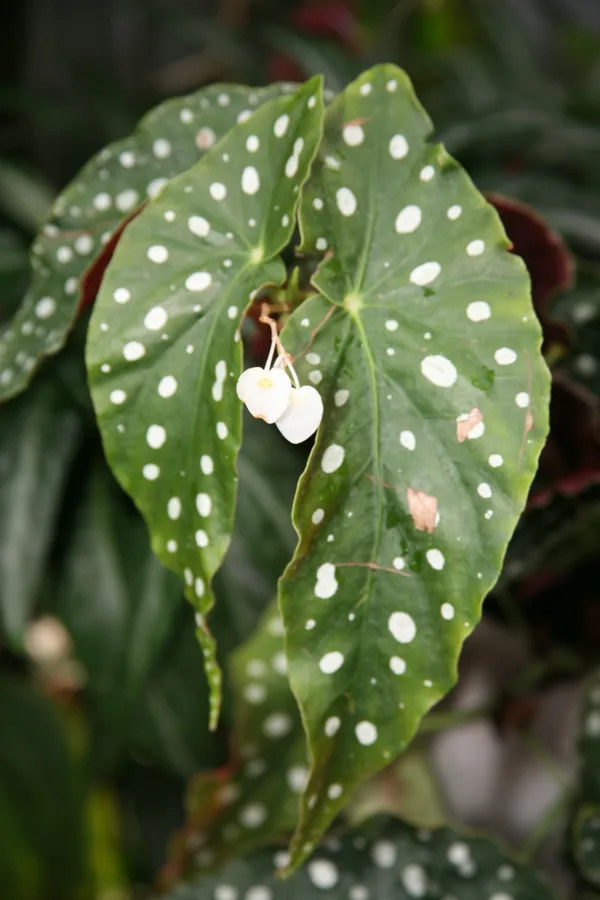
The polka dot begonia takes its name from its most conspicuous feature. Long, angel-wing leaves bear silvery-white spots on the upper surface and a deep crimson-red underside, borne on upright, bamboo-like canes. It sits within the cane-stemmed begonias and originates in the forests of southeast Brazil, a lineage that explains much of its cultural preference.
Under indoor conditions it holds to a manageable stature, reaching roughly 2 to 3 feet (61 to 91 cm) in height across several seasons. Pendulous clusters of pale pink to white flowers open in the warmer months, though the foliage remains the principal draw for most growers. Its reputation is moderate rather than demanding: undemanding in most respects, yet decided in a few.
Those few reduce to water and air. The plant will not tolerate saturated soil and rots readily under it, while still requiring the high humidity characteristic of its native understory. Reconciling the two, steady moisture together with air moving across the leaves, produces fuller, more colored growth from one season to the next.
Care
The short version: bright indirect light, water only once the top of the soil dries, and humid air kept in gentle motion. Feed lightly across the growing season and pinch the tips to maintain a compact, branched habit.
Light
Site it in bright, indirect light beside a window where direct sun never strikes the leaves. It persists in medium light or partial shade, but the spotting fades and the canes elongate as it reaches for the source. Direct midday sun scorches the foliage outright.
Water
Water moderately during active growth, then let the top of the soil dry before rewatering, because the roots need periodic air. This begonia rots easily, so the governing rule is never to leave it in saturated soil or standing water. Reduce watering in winter as growth slows.
Soil
Grow it in a light, well-drained mix rich in organic matter, one that retains some moisture yet drains freely. A slightly acidic pH of 5.5 to 6.5 suits it. Drainage is the decisive factor, since it governs whether the roots stay aerated.
Temperature
Hold it warm and never below 55°F (13°C), the point past which cold begins to stress the tissue. Cold drafts and chilled windowsills prompt leaf drop, so shift it from doors and vents in winter.
Humidity
The plant requires high humidity, above what most homes provide, so a humidifier or pebble tray supplements it. Because still, humid air favors powdery mildew, that moisture must be matched with steady airflow across the leaves.
Feeding
Feed across the growing season, spring into summer, with a balanced liquid fertilizer at alternate waterings, roughly every two weeks. Withhold feed in autumn and winter, when the plant is dormant and cannot use it.
Pruning
Pinch the growing tips to release the lower buds and hold the plant full rather than leggy. Regular pinching also restrains its size and prevents the lower canes from bared.
Repotting
Repot every one to two years, or earlier once roots emerge from the drainage holes and water runs straight through. During the work, keep the dug-up roots and tubers away from pets, as those tissues carry the highest toxin load.
Size & spacing
Indoors it attains about 2 to 3 feet (61 to 91 cm) in height with a spread of 1 to 2 feet (30 to 60 cm). Allowing space and airflow on all sides limits the standing humidity that favors mildew.
Troubleshooting
Nearly every disorder in a polka dot begonia resolves to a problem of water or air. Reading the leaves and stems at the first sign lets you correct the cause before it advances. Match the symptom below, then intervene while the plant retains the capacity to recover.
Flaccid foliage above softened, discolored basal stem tissue
A soft, blackened stem base above soil that stays saturated indicates root and stem rot, the most serious disorder this species faces, caused when waterlogged soil suffocates the roots and lets pathogens take hold. Because a plant can wilt even while wet once the roots have failed, the response is surgical: unpot it, excise all rotted root and stem tissue back to firm growth, and replant in fresh, fast-draining mix. Watering only after the surface dries thereafter keeps the medium aerated and prevents recurrence.
Fix:
- Remove the plant and cut away rotted roots and stems
- Repot into fresh, well-drained mix
- Water only after the top of the soil dries
Powdery white fungal bloom developing on the foliage
The dusty white film is powdery mildew, a fungal infection that establishes where humid air stagnates against the leaf surface. Because the spores germinate in still, moist conditions, moving air disrupts that microclimate and is the single most effective control. Improving circulation, removing colonized leaves, and keeping the foliage dry all deny the fungus the standing humidity it depends on, which matters because this begonia requires high humidity yet is predisposed to mildew when that humidity is not paired with airflow.
Fix:
- Improve air circulation around the plant
- Remove and discard affected leaves
- Avoid wetting the foliage when watering
Leaves yellowing and falling off
Yellowing followed by leaf drop most often signals overwatering, because saturated soil starves the roots of oxygen and the plant sheds foliage it can no longer support. Cold is the second driver, since exposure below 55°F (13°C) or a persistent draft stresses the tissue enough to trigger abscission. Allowing the top of the soil to dry before rewatering restores root function, and holding the plant above that temperature threshold, away from cold air, with a freely draining pot removes both causes.
Fix:
- Let the top of the soil dry before watering again
- Move away from cold drafts and keep above 55°F (13°C)
- Ensure the pot drains freely
Cotton-like masses, honeydew stickiness, or silken webbing on foliage
Several sap-sucking pests colonize this begonia, and each announces itself through a distinct symptom that guides identification. White cottony masses indicate mealybugs, clouds of small white flies indicate whiteflies, fine webbing with stippled leaves points to spider mites, and silvery scarring reflects thrips feeding. Because these insects spread by contact and flight, isolating the plant contains the outbreak, while washing off visible individuals lowers the population before insecticidal soap or horticultural oil finishes the survivors over repeated applications.
Fix:
- Isolate the affected plant
- Wipe off or wash off visible pests
- Treat with insecticidal soap or horticultural oil and repeat as needed
Elongated internodes leaving the lower canes defoliated
Leggy canes form when light falls short of what the plant needs, so it elongates internodes to reach toward the source, and the effect compounds when the tips are never pinched. Raising the light level removes the trigger, while pinching the tips breaks apical dominance and releases the lower buds into side branches. Cutting a long cane back to a node forces those dormant buds to break, which is why the plant returns fuller and more branched.
Fix:
- Move to brighter indirect light
- Pinch the growing tips to force branching
- Prune back leggy canes to a node to encourage bushier regrowth
Toxicity
Position this plant away from pets and grazing animals. All tissue contains calcium oxalate crystals, and the underground tubers and roots hold the highest concentration, so a chewed leaf irritates the mouth while an exposed root does considerably more. No part is edible, which also warrants keeping it clear of small children.
Toxic to
Cats · Dogs · Horses · Rabbits · Livestock · Birds · People
Cats Moderate
The calcium oxalate crystals in the tissue release on chewing, so a cat that bites any part shows drooling, pawing at the mouth, and vomiting. Concentration is highest in the tubers, which makes repotting debris the more hazardous material to leave within reach.
Dogs Moderate
A dog exhibits the same oral response, drooling and stomach upset, after ingesting leaf or stem tissue. Digging to and chewing the roots exposes it to the more concentrated tuber tissue and a correspondingly stronger dose.
Horses Moderate
In horses and other grazing animals the identical oxalates produce mouth irritation and gastrointestinal upset. Larger or repeated intake carries the added risk of kidney strain.
Rabbits Caution
The same oxalate crystals that affect cats and dogs would irritate a rabbit's mouth and digestive tract by the same mechanism, so the entire plant should be considered unsuitable to offer.
Livestock Caution
Grazing stock face the risk documented for horses, since the toxic principle does not vary between species. Cattle, goats, and sheep should be kept from both the foliage and any excavated roots.
Birds Caution
No nutritional case supports letting a pet bird feed on the leaves, and the irritant crystals argue against it. The plant is best positioned away from a bird's access.
People Caution
No part of this begonia is intended for consumption, and ingestion produces oral burning and stinging from the crystals. It warrants placement out of reach of small children inclined to taste plants.
Most toxic part is underground; keep the plant and any repotting debris (tubers/roots) away from pets and grazing animals
Helpline numbers

United States
ASPCA Animal Poison Control: (888) 426-4435 (fee applies)
Poison Control: (800) 222-1222



Canada
Poison Centres: 1-844-764-7669
Varieties
Nearly every plant traded as polka dot begonia descends from one well-documented cultivar. It is the one worth recognizing by name.
Begonia maculata 'Wightii'
A vigorous, free-flowering cane-stem cultivar identified by long, narrow green leaves that carry silvery-white spots above deep crimson-red undersides.
How to propagate
Polka dot begonias propagate readily and require no specialized equipment. A cutting taken during active growth forms roots on its own with minimal intervention.
Stem cuttingsEasy
Spring to summer · Roots in a few weeks (often in water)
Stem and tip cuttings are the most reliable method, because active cambial tissue readily forms adventitious roots. Take them in spring or summer when the plant is in active growth, then hold them in water or insert them into moist mix, where they root within a few weeks.
Leaf cuttingsModerate
Spring to summer · Several weeks
A single leaf can regenerate a whole plant, though it demands more time because the tissue must first initiate both roots and a new plantlet. Set the leaf cutting in spring or summer and allow it several weeks to develop that plantlet before potting on.
Myths
Begonia toxicity is trivial for animals, as the hazard is limited to the leaves.
Begonia is genuinely toxic to cats, dogs, and horses by way of calcium oxalate crystals, and the leaves represent the milder tissue. The greater hazard lies underground in the tubers and roots, where the crystals concentrate, which is precisely what a digging animal or an incautious repotting brings within reach.