Ornamental · Begoniaceae
Wax Begonia
Begonia semperflorens
With moist soil, dappled light, and open spacing, the wax begonia flowers without pause from spring to frost.
Partial shade
Every 2–4 days
50–75°F · 10–24°C
USDA 9–11
Overview
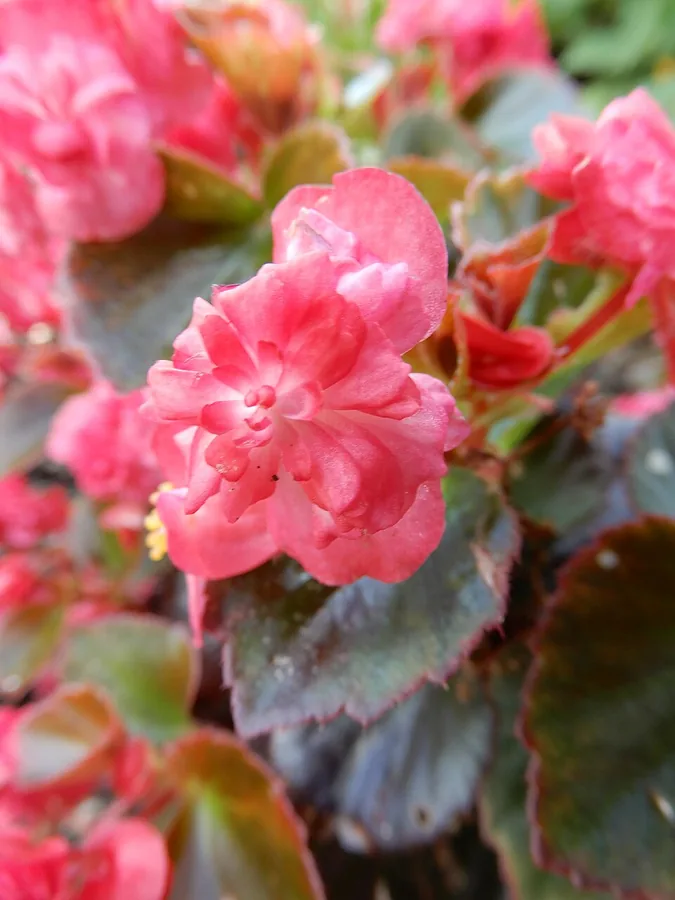
The common name points to the thick, waxy leaves, glossy enough to look polished, in green or deep bronze. Among flowering bedding plants it is one of the least demanding, which explains its wide use in summer beds, borders, and window boxes. The small pink, red, or white flowers open in succession from spring until the first hard frost.
In cultivation it functions as a warm-season annual. Botanically it is a tender perennial, hardy year-round only in the mildest zones, so in most climates it is set out each spring and discarded at frost. Growth stays compact and low, seldom exceeding a foot, and performs equally well massed in a bed or grown in a container.
Its real value is tolerance of shade that defeats most flowering annuals. Bronze-leaved selections accept more direct sun and green-leaved ones require afternoon shade, and because the flowers are self-cleaning, neither needs deadheading. Hold the soil evenly moist and well drained, and the plant largely maintains itself.
Care
The short version: provide dappled light or morning sun with afternoon shade, hold the soil evenly moist but never saturated, feed monthly through the season, and allow 6 to 12 inches between plants so air can move.
Light
The species performs best in partial shade or morning sun with afternoon shade, but tolerates a broad light range. Bronze-leaved types withstand full sun best because their pigmented foliage resists scorch, whereas green-leaved forms burn in direct midday sun and need shade through the hottest hours.
Water
Hold the soil evenly moist but well drained, irrigating every 2 to 4 days as the surface dries. Water at the base in early morning, since foliage left wet under hot sun scorches and standing moisture on leaves favors fungal infection. The thick waxy leaves store enough water to carry the plant through a brief dry spell.
Soil
Grow it in moist, well-drained soil rich in organic matter, with a slightly acidic pH of 5.5 to 6.5. Drainage is the decisive factor, because saturated soil deprives the roots of oxygen and leads directly to rot.
Temperature
The plant favors mild conditions, roughly 50°F to 75°F (10°C to 24°C). Growth stalls in heat and the top dies back at the first frost, which is why it is treated as an annual outside the mildest zones.
Humidity
Ambient outdoor humidity meets its needs, so there is no target to reach. Air movement matters far more than moisture level, since crowded, humid, stagnant plantings are precisely the conditions under which powdery mildew and gray mold establish.
Feeding
Apply a balanced fertilizer formulated for flowering bedding plants monthly through the growing season. Light, regular feeding sustains continuous bloom without forcing the soft, weak growth that heavier feeding produces.
Pruning
Pinch or shear leggy stems to keep the plant compact and to stimulate branching at the cut points. Because the flowers are self-cleaning, the routine deadheading many annuals require is unnecessary.
Size & spacing
Mature plants reach 6 to 12 inches (15 to 30 cm) in height and a similar spread. Set them 6 to 12 inches (15 to 30 cm) apart so air circulates between plants and denies fungal disease the still, humid microclimate it needs.
When to plant
Being frost-tender, the wax begonia tolerates no freezing. Sow the dust-fine seed indoors in late winter, transplant only after the last frost and once night temperatures hold above 50°F (10°C), and the plant then flowers continuously from early summer until frost ends the season.
Northern hemisphere
Southern hemisphere
Typical months for a temperate climate: start earlier in warm zones, later where spring frosts linger.
- Sow: About 8 to 12 weeks before the last spring frost; do not cover the tiny seed.
- Plant: After all danger of frost has passed and night temperatures stay above 50°F.
- Harvest: Blooms continuously from spring or early summer until frost.
Hardiness
USDA hardiness zones: 9–11
Temperature: down to -7°C
Troubleshooting
Nearly every disorder in this species traces to excess moisture, whether held on the foliage or standing around the roots, because the same wet, still conditions favor fungal infection and rot. Identified early, most cases respond to wider spacing and adjusted watering. Match the symptom below, then act before it spreads.
Wilting despite wet soil, with blackened stems at the crown
A plant that collapses in wet soil is showing stem or Pythium root rot, which develops where drainage fails and the roots stay oxygen-starved. The crown and roots turn soft, dark, and decayed, and affected plants do not recover. Remove the worst, correct the drainage, and reduce watering so the pathogen loses the saturated conditions it needs.
Fix:
- Remove severely affected plants
- Improve soil drainage
- Reduce watering frequency
White powdery dust across the leaves and stems
The dusty coating is powdery mildew, a fungus that colonizes foliage when the air is humid and poorly circulated. It rubs off in the early stages but soon spreads through crowded plantings. Spacing plants 6 to 12 inches apart, removing the worst leaves, and watering at the base in the morning all keep the foliage dry and slow it.
Fix:
- Improve spacing and air circulation
- Remove affected foliage
- Water at the base in the morning rather than overhead
Gray fuzz on the flowers that then rot and collapse
This is botrytis blight, or gray mold, which develops in cool, damp, still air where spores settle on aging tissue. The infected parts turn tan to brown and become coated in gray spores. Removing the infected tissue, opening the planting for airflow, and keeping water off the leaves together deny the fungus the moisture it depends on.
Fix:
- Remove and discard infected plant parts
- Increase air circulation
- Avoid overhead watering
Cottony clusters or slender insects with stippled, distorted growth
Cottony white masses indicate mealybugs, while slender crawling insects are usually thrips, and both feed by sucking sap from stems and leaf undersides. Thrips cause the more serious harm because they transmit viruses such as INSV and TSWV as they feed. Rinsing off light infestations, treating survivors with insecticidal soap, and removing heavily infested growth together bring the population down.
Fix:
- Spray off light infestations with water
- Treat with insecticidal soap
- Remove heavily infested plant parts
Toxicity
The plant is not one to let animals chew. Every part contains calcium oxalate crystals, concentrated most heavily in the roots, and chewing releases them to irritate the mouth mechanically, producing burning, drooling, and soreness. Keep it from cats, dogs, horses, and grazing animals, and note that no part is edible for people.
Toxic to
Cats · Dogs · Horses · Rabbits · Livestock · Birds · People
Cats Toxic
A cat that chews the foliage or roots takes in sharp oxalate crystals that irritate the mouth on contact, producing pronounced drooling, pawing at the mouth, and vomiting. The roots carry the highest crystal load and cause the most severe burning.
Dogs Toxic
Dogs that dig up and chew the roots ingest the greatest crystal load and are most affected. Intense oral burning, heavy salivation, repeated vomiting, and difficulty swallowing follow soon after ingestion.
Horses Toxic
In horses the same oxalate crystals irritate the mouth and gut, causing drooling, oral pain, and colic-like discomfort. A grazing animal that consumes a large quantity is at the greatest risk.
Rabbits Toxic
The oxalate crystals irritate a rabbit's mouth and digestive tract as they do in other species, so the plant should be kept out of reach and never offered as forage.
Livestock Toxic
Cattle, goats, and sheep grazing on begonia can ingest enough oxalate to cause oral irritation, drooling, and digestive upset, with the largest quantities presenting the real hazard.
Birds Caution
Documented data on birds is limited, but the crystals that irritate other species would affect a curious bird's mouth as well, so the plant is best treated as off limits.
People Caution
No part of the wax begonia is edible; a bite irritates the mouth, and contact with the sap can inflame sensitive skin. Wash after pruning and keep the plant away from small children.
Toxicity is oral and gastrointestinal irritation rather than systemic in pets; grazing animals eating large amounts are at greater risk.
Helpline numbers

United States
ASPCA Animal Poison Control: (888) 426-4435 (fee applies)
Poison Control: (800) 222-1222



Canada
Poison Centres: 1-844-764-7669
Varieties
The species reaches the market chiefly as named series rather than individual cultivars, sorted by leaf color and by the amount of sun each tolerates. The following are encountered most often.
Cocktail Series
A compact, bronze-leaved series including 'Whiskey', 'Vodka', and 'Gin', selected for greater tolerance of full sun than typical wax begonias.
Ambassador Series
A green-leaved series bred for heat tolerance that performs best given morning sun and shade through the hot afternoon.
Doublet Series
A series distinguished by full, double, rose-like flowers in place of the single blooms typical of the species.
How to propagate
Stem cuttingsEasy
Spring or fall, including from overwintered plants · Roots typically form in about 2 to 4 weeks
Stem cuttings are the most reliable method and can be taken in spring or fall, including from plants overwintered indoors. Remove a healthy stem, or detach a single leaf, and insert it in a moist, well-drained medium. Roots develop in about 2 to 4 weeks, yielding a plant genetically identical to its parent.
SeedModerate
Indoors about 8 to 12 weeks before the last frost · Several weeks from sowing to transplant size
Seed is the slower and more exacting route. Sow indoors 8 to 12 weeks before the last frost, surface-sow the dust-fine seed without covering it, and supply gentle bottom heat to speed germination. Several weeks pass before seedlings reach transplant size, and they are never sown directly outdoors.
Myths
Wax begonias require full shade and tolerate no sun.
Once established, the species handles a wide light range. Bronze-leaved cultivars grow and flower well in full sun, their pigmented foliage resisting scorch, while only the green-leaved forms genuinely need afternoon shade.
A small taste of begonia poses no risk to a pet.
All tissue holds calcium oxalate crystals, with the greatest concentration in the roots. Even a single bite releases enough to burn the mouth and trigger drooling and vomiting in cats, dogs, and horses, so the plant should stay out of reach of curious animals.