Shrub · Pittosporaceae
Japanese Pittosporum
Pittosporum tobira
An evergreen shrub that withstands sun, shade, drought, and hard shearing and still carries an orange-blossom scent each spring.
Full sun
Every 7–14 days
USDA 8–10
8–13 ft · 2.4–4 m
Overview
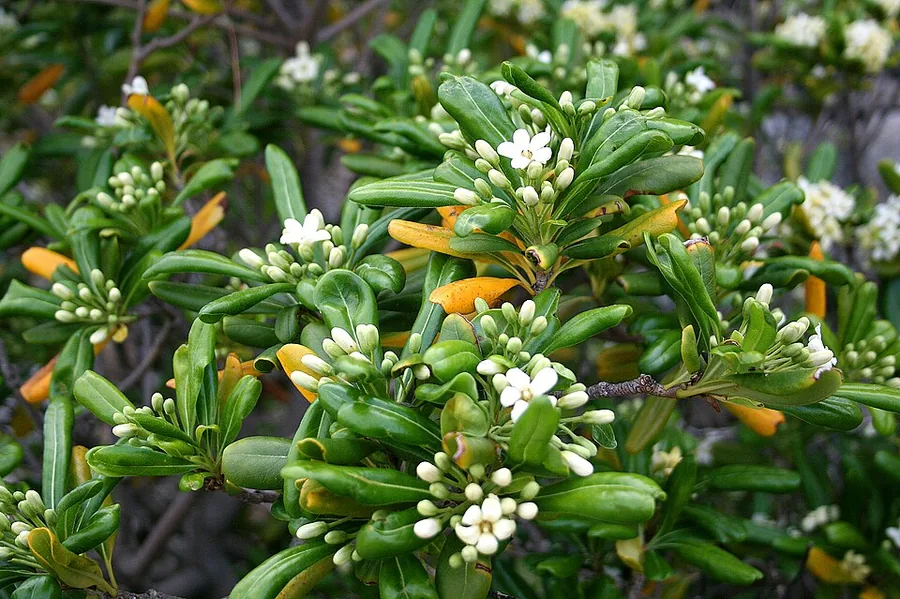
Japanese pittosporum is a dependable structural shrub for mild-climate gardens. Its fast growth produces a dense, rounded evergreen framework of glossy leathery leaves, and in late spring it sets small creamy flowers whose orange-blossom fragrance gives rise to the common name mock orange. That name reflects scent alone, since the species is unrelated to the true mock orange.
The plant's value lies in a broad tolerance for stress. Once its root system is established it withstands drought, heat, and salt spray, performs from full sun through deep shade, and adapts to most soils provided water drains freely. Its capacity for hard shearing lets it serve equally as a clipped hedge, a natural mound, or a trained standard.
Unchecked, it develops into a large shrub reaching 8 to 13 feet (2.4 to 4 m) with a still greater spread, which suits it to screening and backdrop plantings. Dwarf selections supply lower forms for borders and foundations. The single physiological limit is drainage, because saturated soil causes the fatal root rot that accounts for most losses of this otherwise durable species.
Care
The short version: it grows from full sun to shade, needs deep but infrequent watering once established, and accepts any soil that drains freely; shear it after flowering and keep the root zone out of standing water to avoid rot.
Light
Pittosporum accepts the full spectrum from full sun to full shade. Flowering and canopy density peak under sun, because higher light drives more photosynthesis and floral bud formation, yet the shrub still persists in shaded positions where many species would open up and thin.
Water
Water deeply but infrequently, allowing the top half of the profile to dry between applications so the root zone alternates wet and aerated. Established plants are genuinely drought tolerant, and the greater hazard is the reverse, since soggy, poorly drained soil excludes oxygen and induces fatal root rot quickly.
Soil
Almost any well-drained soil is suitable, including clay, sand, or loam, across a pH from 6.0 to 7.5. Drainage is the non-negotiable factor, because standing water at the roots is the condition that kills this plant.
Temperature
It tolerates a wide thermal range, from about 10°F to 100°F (-12°C to 38°C), which keeps foliage evergreen through mild winters and leaves it unstressed by summer heat.
Humidity
Ambient outdoor humidity is adequate and no target figure applies. Air movement is the more consequential factor, since still, damp conditions around crowded foliage prolong leaf wetness and favor leaf spot and sooty mold.
Feeding
A single spring application of a balanced general-purpose shrub fertilizer meets its needs. On high-pH soils, reduced availability can cause micronutrient shortfalls such as magnesium, so correct these where interveinal yellowing appears on the leaves.
Pruning
Prune immediately after the spring flowers fade, because the next season's buds form on old growth and a later cut removes them. The species tolerates hard shearing without dieback, which is what allows its use as a clipped hedge or a trained small tree.
Repotting
Repot container specimens into a fresh, larger pot every 2 to 3 years. The cues are roots circling the surface or emerging from the drainage holes, water passing straight through, and growth stalling as the medium is exhausted.
Size & spacing
Left unpruned it attains 8 to 13 feet (2.4 to 4 m) in height with a spread of 4 to 18 feet (1.2 to 5.5 m), so allow generous spacing when using it for screening or hedging. Dwarf cultivars remain far more compact for confined sites.
When to plant
As an evergreen for warmer regions, pittosporum is hardy roughly in zones 8 to 10. Establish new plants in spring or fall, while temperatures remain mild and root growth is active, and expect the scented flowers in late spring, around April and May.
Northern hemisphere
Southern hemisphere
Typical months for a temperate climate: start earlier in warm zones, later where spring frosts linger.
- Plant: spring or fall in mild climates
- Harvest: late spring (April-May)
Hardiness
USDA hardiness zones: 8–10
Temperature: down to -12°C
Troubleshooting
Pittosporum is durable, and nearly all of its disorders trace to one of two causes: sap-feeding pests that deposit honeydew, or roots held in saturated soil. Match the early symptoms below to what the plant shows, and intervene before the underlying cause advances.
Whole plant wilting and yellowing despite watering
A simultaneous slide into wilting, yellowing, and decline in waterlogged soil signals root rot. Pittosporum has no tolerance for wet feet, and saturated soil starves the roots of oxygen until pathogens invade and darken them, at which point recovery is unlikely. Halt watering and correct the drainage so the root zone can drain and breathe. Remove any specimen already too far gone, since the rot spreads through remaining tissue.
Fix:
- Improve drainage and stop overwatering immediately
- Remove and discard severely affected plants, as root rot is often lethal
- Replant healthy stock in a well-drained site where water does not accumulate
Black sooty film over sticky leaves and stems
The black crust is sooty mold, a fungus that colonizes the sugary honeydew rather than the plant tissue itself. That honeydew is excreted by aphids, cottony cushion scale, or mealybugs feeding higher on the shrub, so the mold is a symptom of the infestation and not the primary problem. Smother the insects with horticultural oil, which blocks their spiracles, and the film loses its food source and washes away.
Fix:
- Spray plants thoroughly with horticultural oil to smother scale, mealybugs, and aphids
- Repeat applications as directed and wash off sooty mold once pests are controlled
- Hose off light aphid populations with a strong stream of water
Spots and blotches scattered across the leaves
Discrete lesions on the foliage indicate fungal or bacterial leaf spot, which establishes where leaves stay wet long enough for spores to germinate. Crowding and overhead watering extend that leaf wetness, so thinning the canopy speeds drying and base watering keeps the foliage dry. Strip the worst-marked leaves to reduce inoculum. The disorder is cosmetic and does not threaten the shrub's health.
Fix:
- Improve air circulation by thinning and proper spacing
- Avoid overhead watering and keep foliage dry
- Remove and dispose of badly spotted leaves
Toxicity
Pittosporum is not classified among the seriously poisonous plants, though it is not edible. Its leaves, stems, and seeds contain saponins, compounds that irritate the digestive lining, so an animal that chews them may drool and become queasy. Since no part is grown for consumption, exclude it from curious mouths.
Toxic to
Cats · Dogs · Horses · Rabbits · Livestock · Birds · People
Cats Mild
The saponins in the foliage irritate a cat's digestive lining, so a leaf-chewing cat may drool, vomit, or refuse food for a period. Because the compound only irritates rather than poisons, the upset resolves on its own once the plant is out of reach.
Dogs Mild
Saponin exposure from chewed foliage or seed pods produces drooling and gastric upset in dogs. A small nibble seldom escalates, but a large volume overwhelms the gut and drives a day of vomiting.
Horses Caution
Horses rarely select the shrub, yet the same saponins irritate the equine gut if a bored animal browses it. Siting the plant away from paddocks removes the exposure route.
Rabbits Caution
The foliage is not appropriate rabbit forage, since its saponins irritate a rabbit's sensitive digestive tract. Excluding it from the diet avoids the resulting gut upset.
Livestock Caution
Cattle, goats, and sheep normally avoid it, but a hungry animal stripping the leaves ingests enough saponin to trigger the same digestive irritation. Fencing it off from grazing land breaks that contact.
Birds Caution
Wild birds process the sticky seeds without harm, whereas the saponins in the foliage make it an unsuitable food for pet birds. Withholding it prevents the irritation.
People Caution
No part of the plant is cultivated for consumption, and swallowing leaves or seeds delivers enough saponin to leave a person queasy. Supervising small children keeps plant parts out of their mouths.
No part of the plant is meant to be eaten; the saponins make even a curious nibble unpleasant, though it is not life-threatening in small amounts.
Helpline numbers

United States
ASPCA Animal Poison Control: (888) 426-4435 (fee applies)
Poison Control: (800) 222-1222



Canada
Poison Centres: 1-844-764-7669
Varieties
A small number of named selections are grown far more widely than the species, chiefly variegated foliage and compact dwarfs. The following are the ones a grower will meet most often.
Variegata
Reduced chlorophyll along the leaf margin gives its gray-green foliage an uneven creamy-white edge that reads distinctly brighter than the plain species.
Wheeler's Dwarf
A compact mounding selection that stabilizes at about 2 to 3 feet (60 to 90 cm), demands almost no pruning, and suits low borders and foundation plantings.
Cream de Mint
A dense dwarf cultivar carrying neat mint-green leaves margined in creamy white.
How to propagate
Pittosporum propagates readily, and cuttings are the standard choice because they root dependably and preserve the parent cultivar's traits.
Stem cuttingsEasy
Mid-July to September · Several weeks to a few months to root
Vegetative propagation from cuttings is the reliable method and preserves cultivar identity. Collect semi-hardwood cuttings from mid-July through September, when the current season's wood has partly firmed, treat the base with rooting hormone, and insert them into a 50/50 peat-and-perlite medium held under high humidity to limit moisture loss while roots form. Rooting proceeds readily, over several weeks to a few months.
SeedModerate
When ripe seed is available · Slow; weeks to germinate and longer to reach planting size
Seed propagation is feasible from ripe seed but works on a longer timescale, requiring weeks to germinate and considerably longer to reach planting size. Because seedlings segregate genetically, they will not reproduce a named cultivar true, which is why cuttings remain preferable for selected forms.
Myths
Japanese pittosporum is the same plant as true mock orange.
The connection is nomenclatural, not botanical. Pittosporum tobira acquired the common name mock orange because its flowers emit an orange-blossom fragrance, yet it is classified in the family Pittosporaceae and bears no relation to the true mock orange, Philadelphus. Convergent floral scent, not shared ancestry, links the two, which belong to entirely separate families.