Ornamental · Poaceae
Perennial Ryegrass
Lolium perenne
It emerges within days of sowing, delivering fast, fine-bladed, hard-wearing turf that greens a lawn in a fortnight.
Full sun
Every 2–7 days
14–21 days
USDA 3–7
Overview
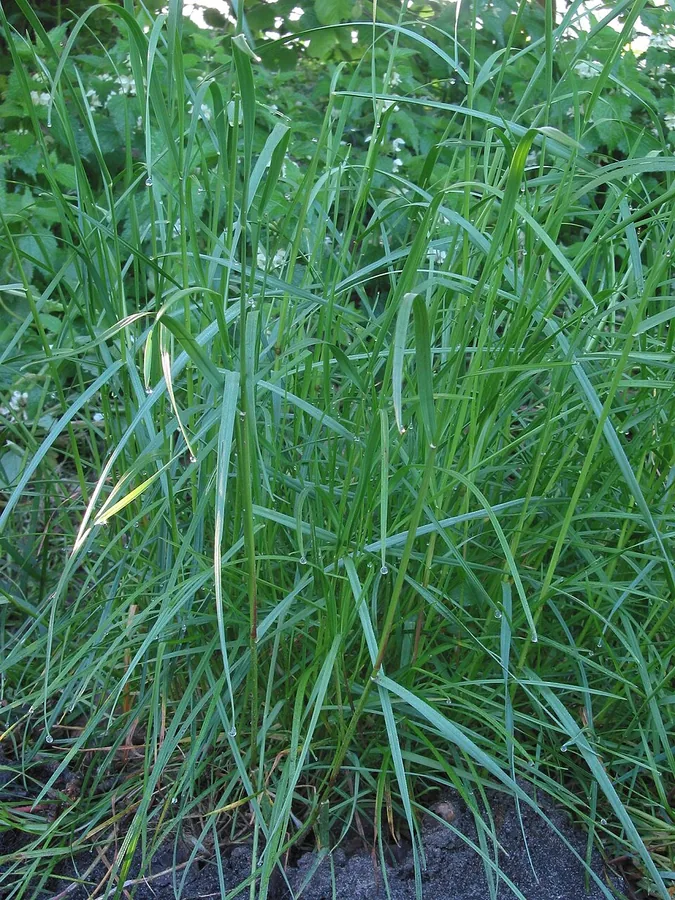
Perennial ryegrass is a cool-season turfgrass valued chiefly for its rapid establishment. Seedlings emerge in 3 to 7 days, faster than any other common lawn grass, a trait that explains its heavy use in seed blends and in patch repair where quick cover matters. Its leaf blades are fine to medium and a glossy dark green, and the mature stand tolerates heavy wear, which is why it appears on sports fields and high-traffic family lawns.
Its growth habit is the key to how it behaves in the lawn. As a bunch grass it produces neither rhizomes nor stolons, so each plant enlarges only in place and a worn opening cannot be recolonized by lateral spread. That anatomy is precisely why it is so often sown with Kentucky bluegrass, whose rhizomes migrate into gaps that the ryegrass, for all its speed and toughness, cannot repair on its own.
Physiologically it is adapted to cool conditions and steady moisture, holding green from a low of -20°F (-29°C) to summer heat near 95°F (35°C), but declining under sustained drought. In the South the same cool-season habit makes it a winter overseed, sown over dormant warm-season turf to maintain a green canopy until the base grass resumes growth in spring.
Care
The short version: it performs best in full sun with steady moisture and regular mowing to about 1.5 to 2.5 inches (4 to 6 cm). Fertilize in spring and fall, keep nitrogen low through summer heat, and reseed thin spots, since the bunch habit prevents self-repair.
Light
Perennial ryegrass performs best in full sun and tolerates some partial shade. Higher light drives denser, more wear-resistant turf through greater photosynthesis, whereas deep shade limits carbohydrate supply and leaves the stand thin and weak.
Water
Hold a new seedbed consistently moist to sustain the germination that occurs in 3 to 7 days, watering lightly and often until emergence. Established turf requires moderate to high water and declines rapidly in drought, so avoid prolonged drying of the root zone.
Soil
Grow it in fertile, moist, well-drained soil. A pH of 6.0 to 7.0 supports nutrient availability, and a profile that drains freely yet retains moisture keeps the root system supplied without waterlogging.
Temperature
Its cool-season physiology spans roughly -20°F (-29°C) in winter to about 95°F (35°C) in summer. Growth peaks in the cool of spring and fall, when temperatures favor its metabolism, and slows under the heat stress of high summer.
Humidity
Ambient outdoor humidity is adequate, so no target value applies. The operative risk is prolonged leaf wetness, because extended surface moisture on warm blades supplies the conditions gray leaf spot needs to infect.
Feeding
Apply a balanced turf fertilizer in spring and fall, timed to the periods of strongest growth. Keep nitrogen low in late spring and summer, since a heat-season flush of soft, succulent tissue is more readily colonized by gray leaf spot.
Pruning
Mow on a regular schedule to about 1.5 to 2.5 inches (4 to 6 cm). Where gray leaf spot is active, bag and remove clippings to carry fungal inoculum off the lawn rather than redistributing it.
Repotting
none
Size & spacing
Mown blades stand only about 2 inches (5 cm) tall, and each clump spreads to roughly 6 to 12 inches (15 to 30 cm). Because the bunch habit provides no lateral spread, seed thickly and evenly so adjacent clumps coalesce into a continuous stand.
When to plant
As a cool-season grass, perennial ryegrass establishes best under mild rather than hot conditions. Sow or overseed in early fall, or in spring in cool regions, and in the South drill it over dormant warm-season turf in fall to hold a green canopy through the winter.
Northern hemisphere
Southern hemisphere
Typical months for a temperate climate: start earlier in warm zones, later where spring frosts linger.
- Plant: Seed or overseed in early fall (or spring) in cool-season regions; standard winter overseed for dormant warm-season lawns in the South.
- Harvest: Establishes uniform turf within about 2 weeks under ideal conditions.
Hardiness
USDA hardiness zones: 3–7
Temperature: down to -40°C
Troubleshooting
Most perennial ryegrass problems present as patches, and the prevailing weather is the strongest clue to the cause. Hot, humid conditions indicate one pathogen, cool and damp another, and a worn opening points to the grass's own bunch habit rather than disease. Match the pattern below and intervene before a patch enlarges.
Greasy gray patches that collapse a stand within days
The pathogen is gray leaf spot, a fungus that exploits perennial ryegrass most aggressively in hot, humid weather because sustained leaf wetness gives its spores the hours of surface moisture they need to infect. Lesions expand into patches 4 to 12 inches (10 to 30 cm) across, the blades mat into a gray-fuzzy layer of sporulation, and a susceptible stand can collapse within a few days. Management targets the moisture and inoculum that drive it: bag the clippings to carry spores off site, irrigate before sunrise so blades dry quickly, and apply a preventive fungicide on a 14 to 21 day interval through the high-risk window.
Fix:
- Collect clippings when symptoms appear
- Apply preventive fungicide on a 14-21 day interval during high-risk periods
Bare patches that do not regenerate without intervention
The cause is anatomical: perennial ryegrass is a bunch grass that lacks rhizomes and stolons, the horizontal stems that let other turfgrasses creep laterally into an opening. Without those spreading structures, an individual crown can only enlarge in place, so a gap thinned by traffic or weather has no mechanism to close itself. Recovery therefore depends on adding new plants, either by overseeding the void with fresh ryegrass seed or by blending in Kentucky bluegrass, whose rhizomes migrate into the gap and knit it shut.
Fix:
- Overseed bare areas directly with fresh ryegrass seed
- Blend with Kentucky bluegrass so the bluegrass spreads to fill gaps
Pink patches bearing red thread-like strands at the tips
The diagnostic sign of red thread is the reddish sclerotial strand extending from the blade tip, produced by a fungus that favors the cool, humid, wet weather of spring and fall. Its appearance is usually a fertility signal rather than a health crisis, because the disease advances mainly where soil nitrogen is low and the grass cannot outgrow the infection. The corrective is to restore fertility: a balanced feed drives fresh leaf growth that outpaces the fungus, while mowing off infected tips removes inoculum and reducing evening irrigation shortens the leaf-wetness period the pathogen depends on.
Fix:
- Apply adequate nitrogen to push recovery growth
- Mow to remove infected tips and reduce leaf wetness
Toxicity
Lawn ryegrass is non-toxic. As a common turf and pasture grass it contains no poisonous parts, so cats, dogs, rabbits, birds, and children are unaffected by it. The single qualification is agronomic rather than toxicological: pasture stands carrying a fungal endophyte can induce ryegrass staggers in horses and livestock, a forage-management concern that does not arise in a mown home lawn.
Safe for
People · Cats · Dogs · Horses · Rabbits · Livestock · Birds
Cats None
Non-toxic to cats. The blade tissue carries nothing harmful, so the incidental grazing many cats do on lawn grass produces no reaction.
Dogs None
Non-toxic to dogs. Because lawn ryegrass is classed as safe, contact, rolling, and casual grazing carry no risk of poisoning.
Horses None
The plant tissue is not itself poisonous to a grazing horse. The recognized hazard is indirect: a pasture stand colonized by a fungal endophyte can induce ryegrass staggers, whose muscle tremors and ataxic, uncoordinated gait surface when the animal is excited.
Rabbits None
Safe as a grazing green for rabbits. Fresh lawn ryegrass integrates into their normal forage with no toxic component.
Livestock None
A widely cultivated, non-toxic forage. The one qualification is endophyte-infected pasture, in which the toxins lolitrem B and ergovaline can produce staggering, incoordination, and heat stress, and the risk concentrates on heavily grazed stands in late summer and fall.
Birds None
Presents no toxic hazard to birds. They consume the seed and clippings without effect, since the plant holds nothing injurious to them.
People None
A common lawn and pasture grass with no toxic parts. Children may play on the turf without any exposure of concern.
Safe as a pet and family lawn; however, turf-type and forage ryegrass can carry a fungal endophyte (Epichloe festucae var. lolii) producing lolitrem B and ergovaline that cause tremors, incoordination, and heat stress in grazing horses and livestock, especially on overgrazed stands in late summer and fall.
Helpline numbers

United States
ASPCA Animal Poison Control: (888) 426-4435 (fee applies)

United Kingdom
Animal PoisonLine: 01202 509000 (fee applies)

Australia
Animal Poisons Helpline: 1300 869 738
Varieties
Several forms of perennial ryegrass are sold, and their labels are easily confused. The distinctions below are the ones worth recognizing.
Turf-type cultivars
Bred for dense, wear-tolerant lawns, these improved selections combine a fine-to-medium leaf texture with a glossy dark green color.
Winter overseeding ryegrass
This class is drilled over dormant warm-season turf across the South, sustaining a green canopy through the winter months.
Distinct from annual/Italian ryegrass
Perennial ryegrass is finer-textured and persistent, whereas the separate species annual ryegrass (Lolium multiflorum) is coarser and short-lived.
Companions
Perennial ryegrass pairs best with a spreading grass that can do the one thing it can't, which is fill its own gaps.
Plant near
Kentucky bluegrass: Spreads by rhizomes to fill the gaps that bunch-type ryegrass cannot self-repair.
How to propagate
Perennial ryegrass is propagated almost exclusively by seed, since it forms no runners capable of rooting. Its advantage is establishment speed, which few turfgrasses match.
SeedEasy
Early fall (or spring) in cool regions; fall for southern winter overseeding. · Germinates in 3-7 days, the fastest of common lawn grasses; uniform turf in about 2 weeks.
Seed is effectively the only method, because the plant produces no runners that could root and establish new crowns. Sow in early fall or spring in cool regions, or in fall for southern winter overseeding. Germination follows in 3 to 7 days, the quickest among common lawn grasses, and a uniform stand closes in about 2 weeks. Since the clumping habit prevents any lateral thickening, thin stands must be reseeded to build density.
Myths
Perennial ryegrass and annual ryegrass are the same plant.
They are distinct species. Perennial ryegrass (Lolium perenne) is a fine-textured, persistent turfgrass, while annual ryegrass (Lolium multiflorum) is a coarser, short-lived grass used for quick temporary cover or winter overseeding. Verify the species name printed on the bag before purchase.