Ornamental · Poaceae
Kentucky Bluegrass
Poa pratensis
Given full sun and steady water, Kentucky bluegrass knits into a dense, self-healing sod.
Full sun
Every 3–7 days
14–30 days
USDA 3–7
Overview
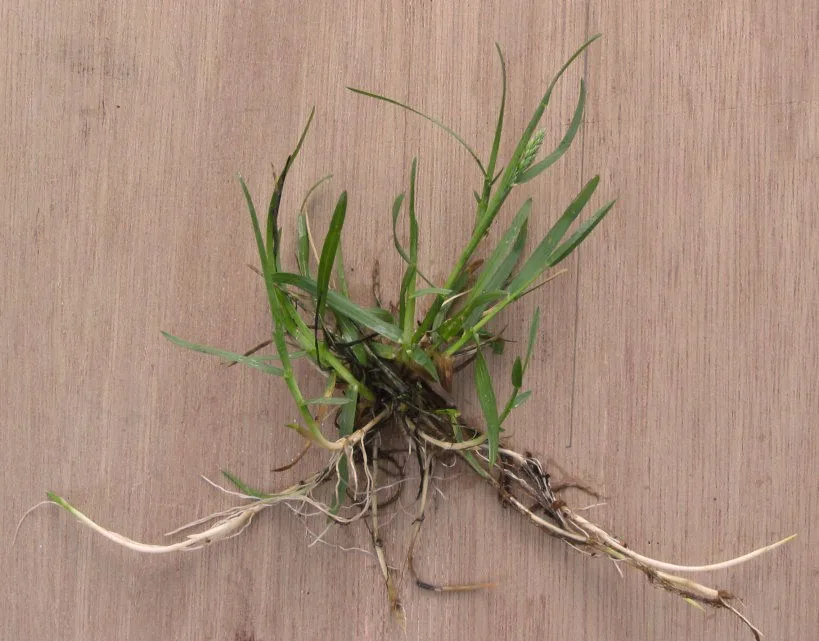
Kentucky bluegrass, Poa pratensis, is the cool-season turfgrass most people have in mind when they think of a classic northern lawn. It builds a fine, dense turf in a deep green shading toward blue, and it propagates laterally by underground rhizomes that let a stand recolonize scuffs and bare ground on its own. Despite the common name the species is not native to North America; it originated in Europe and northern Asia and was introduced by early colonists, after which it became the standard for cool-region lawns.
The horticultural signature of the grass is that self-repairing habit. Unlike bunch grasses, which remain in discrete clumps, the rhizomatous growth of bluegrass spreads sideways and re-knits worn turf, which accounts for its durability on lawns and playing fields under real foot traffic. The counterweight is establishment time, because it is slow from seed and commonly takes a full season or two to reach full density.
Its requirements are sun and adequate cool-season moisture. In hot, dry summers the turf browns and enters dormancy, appearing dead while the crowns remain alive below the canopy, then resumes growth once rainfall and cooler nights return. Supplied with the light and water the species needs, it yields one of the most durable and best-looking turfs available in northern regions.
Care
The short version: full sun, a steady 1 to 1.5 inches of water a week, mowing to about 2.5 to 3.5 inches, fertile well-drained soil, and a feed in spring and fall.
Light
The species requires full sun and extends only to part shade at the margin. In genuine shade it thins and weakens and becomes prone to powdery mildew, so shaded ground is better assigned to a fine fescue.
Water
During active growth it needs about 1 to 1.5 inches (2.5 to 4 cm) of water weekly, applied deeply rather than as light daily amounts, since deep irrigation supports the crown. In hot, dry conditions it browns and goes dormant, but the crowns persist and the stand recovers when cool, moist weather returns.
Soil
It performs best in fertile, well-drained loam at a pH of 6.0 to 7.0. Heavy, poorly drained soil retains moisture that favors disease, so drainage matters more than high fertility.
Temperature
As a cool-season grass it operates across roughly -29°F to 75°F (-34°C to 24°C). It withstands severe northern winters and greens up early, but growth slows as high-summer heat exceeds its optimum.
Humidity
Ambient outdoor humidity is adequate, so no target level applies. What matters is air movement, because still, humid microclimates favor dollar spot and mildew.
Feeding
Apply a nitrogen-rich lawn fertilizer in spring and again in fall, timed to periods of active growth. Withhold heavy nitrogen in summer, when it stresses dormant turf and promotes disease.
Pruning
Mow to about 2.5 to 3.5 inches (6 to 9 cm), raising the height to 3.5 inches or higher during summer heat to reduce stress. Because the vigorous rhizomes accumulate thatch, periodic dethatching is part of routine maintenance.
Repotting
none
Size & spacing
Mowed turf stands only about 2 to 4 inches (6 to 9 cm) tall, while each plant spreads 6 to 18 inches (15 to 46 cm) by rhizome. That lateral spread is what allows a stand to close into continuous sod and reoccupy its own bare areas.
When to plant
Establishment succeeds best once summer heat abates, because moderate temperatures and returning rainfall support root development. Seed or lay sod in late summer to early fall so the young stand settles in before winter; spring is the secondary window. Left unmown, the grass raises blue-green flower heads in late spring to early summer.
Northern hemisphere
Southern hemisphere
Typical months for a temperate climate: start earlier in warm zones, later where spring frosts linger.
- Plant: Seed (10 to 14 lb per acre, no deeper than 1/4 in) or lay sod in late summer to early fall when temperatures moderate and rains return; spring seeding is the second-best option.
- Harvest: Grown as mowed turf and normally kept from flowering; if left unmowed it produces blue-green flower heads in late spring to early summer. Establishes as a dense sod over one to two seasons via rhizomes.
Hardiness
USDA hardiness zones: 3–7
Temperature: down to -40°C
Troubleshooting
Most problems in bluegrass present as browning, thinning, or bare patches, and the underlying cause commonly traces to weather or to mowing and fertility practice. The key diagnostic skill is separating summer dormancy from disease and grub injury, then intervening before a thin area is lost. Match the sign below and act while correction still restores the stand.
Purple-brown leaf lesions advancing to crown and root rot
This is the leaf spot and melting-out complex, driven by Drechslera and Bipolaris fungi that gain ground in cool, wet spring weather, and made worse by close mowing and heavy early nitrogen. The leaf phase presents as dark purplish-brown spots with tan centers; the melting-out phase then advances into the crowns and roots, rotting them and thinning the stand into open patches. Because stress and leaf wetness fuel the progression, raising the mowing height, easing spring nitrogen, and improving drainage and airflow all slow it.
Fix:
- Raise the mowing height to reduce stress on the crowns.
- Avoid heavy quick-release nitrogen in spring.
- Improve drainage and air movement and apply a labeled fungicide if needed.
Loose dead patches over severed root systems
Turf that rolls back like carpet has lost its anchoring roots to feeding below the surface. The primary agents are white grubs, the C-shaped larvae of Japanese beetles, chafers, and June beetles, with billbug larvae tunneling stems and crowns as a secondary cause. Skunks, birds, and raccoons digging in the lawn are a useful indirect sign, since they are foraging for those grubs. Inspecting the root zone confirms population levels, after which a labeled grub insecticide watered in at the correct timing, plus sustained irrigation so the stand can outgrow minor loss, resolves it.
Fix:
- Confirm grub numbers by inspecting the root zone and treat when populations are high.
- Apply a labeled grub-control insecticide at the proper timing and water it in.
- Keep turf well watered to help it outgrow minor damage.
Straw-brown, stalled turf in midsummer heat and drought
The straw color is summer dormancy, a survival response rather than mortality. Under heat and drought a cool-season grass such as this one halts top growth and diverts resources to the crown, which stays alive below the canopy. To hold color, supply 1 to 1.5 inches (2.5 to 4 cm) of water weekly; to allow dormancy, water lightly every 2 to 3 weeks so the crowns keep enough moisture to green up once cooler, wetter conditions return.
Fix:
- Apply about 1 to 1.5 in of water per week to keep the lawn from going dormant, or let it go dormant and water lightly every 2 to 3 weeks to keep crowns alive.
- Avoid heavy traffic on dormant turf.
- Resume normal care when temperatures cool in fall.
Sparse, weak turf where light is limited
As a full-sun species, Kentucky bluegrass has little tolerance for shade, so stands thin quickly where light falls short. That is why the decline concentrates under tree canopies and on the north side of buildings while the sunlit areas remain dense. Low light paired with poor air movement also favors powdery mildew, whose white surface coating you will find on the blades in those pockets. Raising light by thinning the overhead canopy, or overseeding with a more shade-tolerant grass like fine fescue, addresses the root cause.
Fix:
- Prune or thin overhead trees to let in more light.
- Overseed shaded spots with more shade-tolerant grasses such as fine fescues.
- Raise mowing height and reduce nitrogen and irrigation in shade.
Silver-dollar tan spots 2 to 5 inches across, coalescing
These coin-sized patches are dollar spot, caused by the fungus Clarireedia jacksonii, which advances in warm, humid weather and is aggravated by low nitrogen. On the individual blade you will find light-tan lesions bordered in reddish brown, and on dew-covered mornings a white cobwebby mycelium may be visible. Because nitrogen deficiency drives the disease, holding fertility steady and moderate, irrigating early so foliage dries by midday, and applying a labeled fungicide only when damage spreads together check it.
Fix:
- Maintain moderate to adequate nitrogen fertility to promote recovery.
- Water deeply in the early morning so foliage dries quickly; remove dew by mowing early.
- Apply a labeled fungicide (alternating modes of action) if damage is severe.
Spongy turf over a thick surface mat of dead material
The same vigorous rhizome growth that makes this grass sod-forming also produces thatch, a brown mat of dead stems and rhizomes that accumulates between the green canopy and the soil. Once it exceeds about 1/2 inches (5 cm), the turf feels spongy underfoot and the barrier holds moisture and pathogens that raise disease and drought stress. Core aeration or power raking in early fall physically opens the mat, while lighter water and nitrogen slow the rate at which it rebuilds.
Fix:
- Core aerate and/or dethatch (power rake) in early fall.
- Avoid excessive nitrogen and overwatering that speed thatch buildup.
Toxicity
For animal-keeping households the verdict is reassuring: Kentucky bluegrass is not poisonous. It is a non-toxic lawn and forage grass, safe for cats, dogs, and grazing livestock, and it does not appear on the ASPCA's toxic-plant lists. The single qualification is the pollen released by an unmown, flowering stand, which can provoke hay fever in susceptible people and pets.
Safe for
People · Cats · Dogs · Horses · Rabbits · Livestock · Birds
Cats Safe
The species poses no toxic risk to cats. Where a cat vomits after eating a large mouthful, the cause is mechanical stomach irritation from the fibrous blades rather than any poison.
Dogs Safe
Dogs may chew or lie on the turf with no toxic consequence. The one variable to note is grass pollen, which can provoke itchy, watery hay-fever signs in a sensitive individual.
Horses Safe
Regarded as a valued pasture species, it is grazed by horses freely and without adverse effect.
Rabbits Safe
The fresh blades are safe forage for rabbits. Any new forage should be introduced gradually, since an abrupt dietary change disturbs a rabbit's gut regardless of how benign the plant is.
Livestock Safe
Cattle, goats, and sheep perform well on it, consistent with its standing among the most palatable forage grasses.
Birds Safe
Both songbirds and poultry consume the seed and tender shoots without harm.
People Safe
The grass is harmless to handle and to walk on. Individuals prone to hay fever may react to the airborne pollen released when an unmown lawn flowers, but that response is allergic, not toxic.
The grass itself is not poisonous. Grass pollen can trigger hay-fever allergies in sensitive people, and dogs or cats that nibble large amounts of grass may occasionally vomit, but this is not a sign of poisoning.
Varieties
Most lawns are planted to improved turf-type cultivars rather than wild bluegrass. The following names are the ones worth knowing when selecting seed or sod.
'Midnight'
A widely grown improved turf-type cultivar valued for its very dark blue-green color and a low, dense, compact habit that tolerates close mowing well.
Kentucky bluegrass blends
Formulations of several improved cultivars, frequently combined with quick-establishing perennial ryegrass, that broaden disease resistance across the stand and offset the species' otherwise slow establishment.
Hybrid (Texas × Kentucky) bluegrasses
Interspecific crosses with Texas bluegrass that retain color and sustain summer growth through heat and drought far better than pure Kentucky bluegrass.
How to propagate
A bluegrass stand is established by one of two methods: from seed, which is inexpensive but slow, or from sod and plugs, which cover quickly and then spread on their own.
SeedModerate
Late summer to early fall (or spring) · Germinates in about 14 to 30 days and forms a full sod over one to two seasons
Seed in late summer to early fall, with spring as the secondary window, at roughly 10 to 14 pounds per acre placed no deeper than 1/4 inch. Germination is unhurried at 14 to 30 days, and one to two full seasons are required before the stand knits into dense sod, which is why quick perennial ryegrass is often included in the mix to cover the ground during that establishment interval.
DivisionEasy
Spring or early fall · A few weeks once roots and rhizomes re-knit
Sod pieces or plugs laid in spring or early fall root in within a few weeks. Thereafter the plant advances on its own through underground rhizomes that colonize bare ground, and this lateral spread is the mechanism behind the turf's strong self-repairing character.
Myths
Kentucky bluegrass is genuinely blue and native to Kentucky.
The foliage ranges from green to blue-green and is never truly blue; the common name derives from the blue-green flower heads an unmown stand raises in early summer. Nor is the species North American in origin. It arrived from Europe, northern Asia, and the North African mountains with European colonists, which is why it is neither blue nor a Kentucky native.