Houseplant · Crassulaceae
Panda Plant
Kalanchoe tomentosa
A fuzzy, silver-green succulent adapted to bright light, dry soil, and lean, hands-off culture.
Bright indirect
Every 10–21 days
50–75°F · 10–24°C
USDA 9–11
Overview
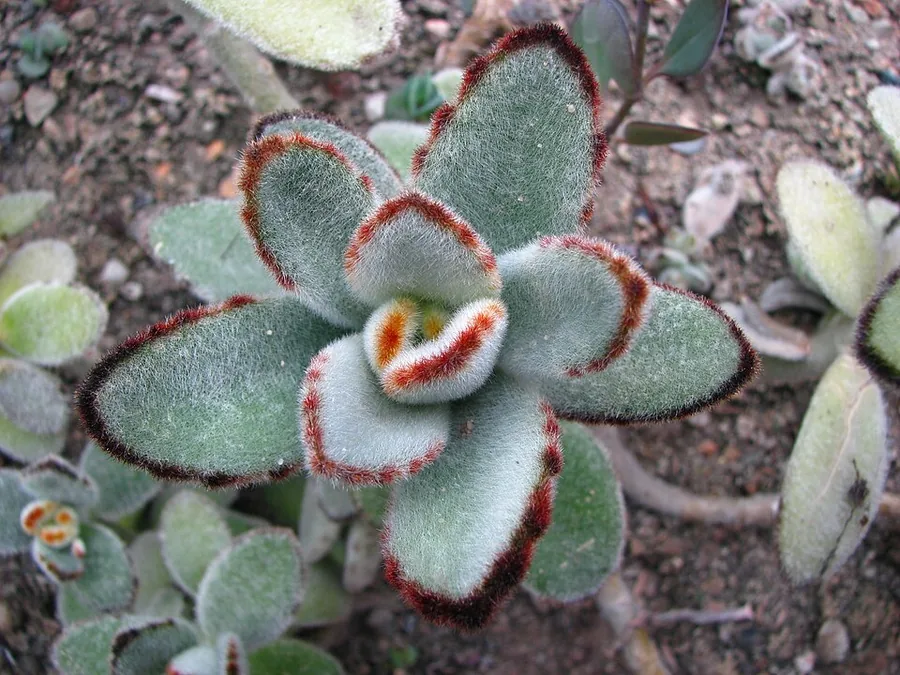
The panda plant takes its name from the dense silvery trichomes that clothe its leaves, edged with rust-brown felted margins reminiscent of a paw print. A slow-growing succulent native to Madagascar, it evolved to store water within those thickened leaves and endure prolonged drought. Under indoor culture it remains compact, reaching only 12 to 18 inches (30 to 45 cm) across many seasons.
The trait that makes it forgiving is also the one that undoes careless growers. Its water-storing physiology means it tolerates neglect far better than attention, and most failures stem from irrigation the plant never needed. Provide bright light and a fast-draining gritty medium, and its own reserves handle the rest.
One caution governs placement: the entire plant is toxic to animals. The foliage contains bufadienolides, cardiac glycosides that make it unsuitable for households with inquisitive pets. Site it where cats, dogs, and other animals cannot reach it.
Care
The short version: supply bright light, a gritty fast-draining medium, and water only once the soil has dried out completely. Hold it warm, feed lightly through the growing season, and avoid the overattention that undoes most specimens.
Light
Provide bright indirect light, preferably a position that receives some direct sun through the glass. It withstands full sun once acclimated, but insufficient light drives the stems to elongate and thins the protective indumentum.
Water
Allow the medium to dry out completely between irrigations, which generally falls near every 10 to 21 days and even less in winter as growth slows. Apply water at the soil line and keep it off the felted leaves, where retained moisture causes spotting. Overwatering accounts for more losses in this species than any other factor.
Soil
Grow it in a gritty cactus or succulent mix that drains freely and never remains saturated. A slightly acidic pH of 6.0 to 6.5 suits it, and a container with drainage holes is essential, not optional.
Temperature
Maintain it within 50°F to 75°F (10°C to 24°C), ordinary room temperature for most of the year. It has no frost tolerance, so move it clear of cold glazing through winter.
Humidity
It requires low humidity, so typical dry indoor air suits it well. Do not mist it or place it in a steamy bathroom, since sustained moisture on the felted leaves promotes rot.
Feeding
Feed sparingly from spring through summer during active growth, roughly once a month. Apply a diluted balanced or low-nitrogen succulent fertilizer, and suspend feeding entirely through winter dormancy.
Pruning
Pruning is minimal. Pinch or cut back elongated, etiolated stems to induce branching and a fuller habit, and remove damaged leaves with a clean blade. Let the cut ends callus before they contact soil.
Repotting
Repot only every 2 to 3 years, or sooner if roots emerge from the drainage holes and the plant grows top-heavy. Do it in spring, advancing a single pot size into fresh gritty mix.
Size & spacing
Expect a compact specimen of 12 to 18 inches (30 to 45 cm) in height and 8 to 12 inches (20 to 30 cm) across. Growth is slow, so a single plant holds its form and dimensions for years on a windowsill.
Troubleshooting
Nearly every disorder in this species reduces to a fault in water or light. Diagnose from the leaves and stems early, because the underlying cause is usually straightforward to correct. Match the symptom below and intervene before rot or etiolation advances.
Soft, darkening basal tissue signals stem rot
Soft, blackening tissue at the base is rot, and the pathway is clear: soil that holds water too long, or moisture caught in the fuzzy crown, deprives the roots of oxygen and lets decay set in. Once cells collapse they will not recover, so excise all affected tissue with a clean blade. Root firm leaves as cuttings, replant the survivors in fresh gritty mix, and let it dry hard between waterings to restore aeration.
Fix:
- Stop watering immediately and allow the soil to dry
- Cut away all soft, rotted tissue with a clean blade
- Take healthy leaf or stem cuttings to propagate if the base is lost
- Repot remaining healthy growth into fresh gritty, fast-draining mix
Elongated stems and wide leaf spacing from low light
Elongated stems and widening gaps between leaves are etiolation, the plant's response to a light shortfall. Deprived of adequate intensity, it extends its stems and leans them toward the window in search of more. Relocate it to brighter conditions, raising the light over a week or two so the tissue adapts without scorching, then cut back the drawn growth and root the pieces.
Fix:
- Move to a brighter spot with bright indirect or some direct sun
- Acclimate gradually to stronger light to avoid scorch
- Prune leggy stems and propagate the cuttings
Dry brown lesions on the most exposed leaf faces
Dry brown lesions on the sun-facing leaves are sunscald, the outcome of light rising faster than the tissue can adjust. Foliage moved abruptly from shade into strong sun has no time to build its protective response, so it burns. Return it to bright indirect light and then raise the intensity in stages over one to two weeks to let it acclimate.
Fix:
- Move the plant to bright indirect light
- Introduce stronger sun gradually over one to two weeks
Toxicity
Regard this as a plant to keep out of reach. Its leaves, stems, and flowers all contain bufadienolide cardiac glycosides, which provoke drooling and vomiting and, in a large dose, can disturb cardiac rhythm. It is hazardous to cats, dogs, horses, and other animals, and no part of it is safe for human consumption.
Toxic to
Cats · Dogs · Horses · Rabbits · Livestock · Birds · People
Cats Toxic
Ingestion typically produces drooling, vomiting, and diarrhea within a few hours as the gut reacts. Cats are the most frequent chewers, and a larger dose of the cardiac glycosides acts directly on cardiac muscle to disrupt rhythm, so a lethargic or unsteady cat warrants a call to the vet.
Dogs Toxic
A dog that chews the fuzzy foliage commonly drools, vomits, and passes loose stool from gastrointestinal irritation. The graver risk comes when a large mouthful delivers enough bufadienolides to the heart to slow or destabilize the rhythm, so seek veterinary care if a dog weakens or collapses.
Horses Toxic
Every Kalanchoe is hazardous to horses. The cardiac glycosides both irritate the digestive tract and act on the heart, producing colic, depression, and an irregular pulse. Site the plant well beyond the reach of any grazing horse.
Rabbits Toxic
A rabbit should have no access to it. The same heart-active compounds that affect cats and dogs pose the same danger to a small grazer, and body size means a modest amount delivers a proportionally high dose.
Livestock Toxic
Cattle, goats, and sheep are all susceptible to Kalanchoe poisoning, with the toxin driving digestive upset and serious cardiac disturbance. Grazing stock that reach a stand of it face genuine risk.
Birds Toxic
Birds are not exempt. The bufadienolides act on the avian heart by the same mechanism, so pet birds should be kept entirely away from the foliage.
People Caution
No part of the panda plant is edible, so treat it as off limits and keep it clear of small children. The fine leaf trichomes can also irritate sensitive skin, so wash your hands after handling it.
The fine leaf hairs (trichomes) may irritate sensitive skin in some people; wash hands after handling.
Helpline numbers

United States
ASPCA Animal Poison Control: (888) 426-4435 (fee applies)
Poison Control: (800) 222-1222



Canada
Poison Centres: 1-844-764-7669
Varieties
Several named cultivars accompany the common species, distinguished chiefly by leaf coloration and the pattern of markings along the margins.
Kalanchoe tomentosa 'Chocolate Soldier'
Its leaf margins bear darker brown to rust-colored felted teeth that read as a chocolate trim across the whole plant.
Kalanchoe tomentosa 'Golden Girl'
It carries larger leaves with a golden to silvery cast and softer, lighter markings along the margins.
Kalanchoe tomentosa 'Nigra'
It is marked by dark, almost black-brown leaf tips that contrast sharply with the silvery indumentum.
How to propagate
The panda plant propagates readily, and a single leaf or stem tip suffices to raise an entire new plant.
Leaf cuttingsEasy
Spring to summer during active growth · 4 to 8 weeks to root and form plantlets
Leaf cuttings propagate most reliably, and they take best in spring or summer when the plant is metabolically active. Twist off an intact healthy leaf, allow the cut end to callus for a day or two so the wound seals against pathogens, then set it on or just into gritty mix and water sparingly. Roots and small plantlets emerge over 4 to 8 weeks, so allow the process its full course.
Stem cuttingsEasy
Spring to summer · 3 to 6 weeks to root
Stem cuttings both propagate the plant and remedy etiolated growth, and they root best in spring or summer during active growth. Sever a stem tip, let the wound callus, insert it into dry gritty mix, and water lightly only after rooting begins, which occurs over roughly 3 to 6 weeks. The parent commonly responds by branching below the cut.
Myths
Fuzzy succulents like the panda plant love regular misting and high humidity.
As a dry-air succulent, the panda plant stores its own water within those densely felted leaves, so it draws nothing useful from ambient moisture. Misted water lodges among the trichomes rather than evaporating, and that retained film promotes spotting and rot. Forgo misting and manage moisture through the soil instead.