Herb · Lamiaceae
Oregano
Origanum vulgare
Give it sun, lean soil, and a dry root run, and oregano largely tends itself.
Full sun
Every 7–10 days
80–90 days
USDA 5–10
Overview
Oregano is a hardy perennial in the mint family, native to the warm, rocky slopes of the Mediterranean. That origin defines its requirements: adapted to intense sun and thin, quick-draining ground, it performs best where it receives heat, strong light, and fast drainage. The mild stress of lean conditions concentrates the essential oils, which is why a harder site yields more pungent leaves.
The plant serves two purposes at once. Its foliage supplies the warm, peppery character central to Italian and Greek cooking, and if allowed to flower, the small white or pink blooms attract bees and other pollinators. Left uncut, it develops into a low, spreading, bushy mat that persists across seasons.
Cultural demands are minimal. Once its root system is established the plant tolerates drought, requires no rich feeding, and is seldom troubled by pests. Its two genuine limits are waterlogged roots and deep shade, so siting it in full sun over free-draining soil satisfies nearly every requirement.
Care
The short version: full sun, lean and sharply drained soil, and a deep irrigation only after the top half has dried. Feed sparingly if at all, pinch frequently to hold a bushy form, and the plant persists for years.
Light
Oregano requires full sun, ideally 6 or more hours daily, because that light drives the synthesis of the essential oils that give the leaves their pungency. It tolerates light partial shade, but reduced light produces a looser habit and correspondingly weaker flavor.
Water
Once established the plant is drought tolerant and physiologically suited to dry rather than wet conditions. Irrigate deeply, then withhold water until the top half of the soil has dried, which typically falls every 7 to 10 days. Saturated soil excludes oxygen from the roots and is the principal cause of rot.
Soil
Provide well-drained sandy or loamy soil and avoid rich amendments, since the lean conditions that mildly stress the plant intensify leaf flavor. A pH between 6.0 to 7.5 is suitable. Rapid drainage is the single most important soil property.
Temperature
Oregano operates across a broad range of roughly 30°F to 84°F (-1°C to 29°C), and within its hardiness zones the established root system resumes growth after winter. Hard frost kills the top growth, but the crown regenerates in spring.
Humidity
The plant favors low humidity, around 30% to 50%, consistent with its arid Mediterranean origin. Damp, stagnant air promotes mildew and pest colonization, so adequate spacing and air movement are protective.
Feeding
Oregano is a light feeder adapted to poor soil, so fertilization should be restrained. A single light application of a balanced fertilizer such as 5-10-5 in spring suffices; excess nitrogen forces soft growth and dilutes leaf flavor.
Pruning
Pinch and harvest regularly, cutting just above a leaf node so the buds below break and hold the plant bushy rather than leggy. Remove woody, bare stems, and take off flower buds before they open to retain the highest leaf flavor.
Repotting
Container oregano needs potting on only every 2 to 3 years, indicated when roots circle or emerge from the drainage holes, leaf size declines, or the medium dries almost immediately after watering. Repot into a gritty, free-draining mix.
Size & spacing
A mature specimen reaches about 12 to 24 inches (30 to 60 cm) in height with a comparable spread. Allow each plant 12 to 24 inches (30 to 60 cm) so air circulates through the canopy and the foliage dries quickly.
When to plant
Oregano is a cold-hardy perennial rated for zones 5 through 10, but juvenile plants need warmth to establish. Sow seed indoors 6 to 8 weeks before the last frost, transplant after the danger of frost has passed, and harvest through summer, cutting just before the flowers open when essential oil content in the leaves is highest.
Northern hemisphere
Southern hemisphere
Typical months for a temperate climate: start earlier in warm zones, later where spring frosts linger.
- Sow: 6-8 weeks before last spring frost
- Plant: spring after danger of frost has passed
- Harvest: Small white to pink flowers in summer; harvest leaves before flowering for best flavor.
Hardiness
USDA hardiness zones: 5–10
Temperature: down to -29°C
Troubleshooting
Oregano is largely trouble-free, and the disorders it does develop nearly always originate in excess moisture or insufficient light. Reading the early symptoms on the leaves, stems, or roots usually points to a straightforward correction. Match the observed sign below and intervene before it progresses.
Wilting plant with dark, mushy roots
Wilting in soil that remains moist is the classic sign of root rot, in which overwatering or poor drainage deprives the roots of oxygen and they begin to die back. Confirm it by lifting the plant: healthy roots are firm and white, while affected ones turn dark and soft. Excise the rotted tissue, replant into gritty, fast-draining soil that admits air to the root zone, and reduce watering sharply.
Fix:
- Remove affected plant material
- Replant in well-drained soil or amend with grit
- Reduce watering frequency
Elongated, woodening stems going bare and thin on foliage
Stems that grow leggy and woody at the base with long internodes reflect a plant reaching for light it is not getting and going too long without cutting; surplus nitrogen compounds the problem by driving soft, extended growth. Pruning back to just above a leaf node breaks apical dominance and releases the buds below into bushy regrowth. Relocate the plant to full sun and withhold fertilizer to hold that habit.
Fix:
- Cut back stems above a leaf node to encourage bushy regrowth
- Move to a full-sun location
- Reduce fertilizer
Stippled, washed-out foliage and delicate webs on leaf undersides
A stippled, sandy discoloration paired with fine webbing is the signature of spider mites, which build to damaging numbers in the hot, dry conditions and low airflow of a sheltered spot or indoor position. Soft-bodied clusters on the newest growth instead indicate aphids drawing sap. Dislodge both with a forceful water spray, follow with insecticidal soap on what remains, and raise air circulation to keep the population from rebuilding.
Fix:
- Rinse foliage with a strong spray of water
- Apply insecticidal soap to affected leaves
- Increase air circulation and reduce dustiness
Leaf pungency declining once the plant begins to set buds
As oregano shifts into flowering it redirects resources toward reproduction, and the essential oil concentration in the leaves falls, so the foliage loses its flavor. Removing the flower buds before they open keeps that energy in the leaves. For peak pungency, cut the leaves just as the plant approaches bloom.
Fix:
- Pinch off flower buds before they open
- Harvest leaves just before flowering
Toxicity
For people, oregano is a safe culinary herb with no restriction on kitchen use. For companion animals the assessment differs: the ASPCA classifies it as toxic to cats and dogs, because the essential oils act as gastrointestinal irritants that can cause mild vomiting or diarrhea at sufficient intake. The concentrated oregano oil represents the greater hazard, so it should be kept away from all animals.
Toxic to
Cats · Dogs · Horses · Rabbits · Livestock · Birds
Safe for
People
Cats Mild
An incidental nibble seldom registers, but sustained grazing delivers enough of the irritant oils to provoke drooling, vomiting, or loose stools. The concentrated essential oil carries a far higher dose, so it is the priority to secure.
Dogs Mild
Consuming the plant in quantity introduces enough gastrointestinal irritant to cause an upset stomach, vomiting, and diarrhea. A trace from a plate is negligible, whereas the bottled oil is concentrated and warrants keeping out of reach.
Horses Caution
The same aromatic oils documented as irritants in cats and dogs may disturb equine digestion, which argues for excluding it from the diet. A brief taste taken at pasture is unlikely to produce measurable effects.
Rabbits Caution
The sensitive hindgut of a rabbit is readily disrupted by pungent aromatic herbs such as oregano. Restrict it to trace amounts, if offered at all, and monitor for soft stools or reduced appetite as early indicators.
Livestock Caution
Grazing stock typically avoid the strongly aromatic foliage by selection, and an incidental mouthful poses little risk. Ingesting a large quantity could produce mild gastrointestinal upset consistent with the irritant oils.
Birds Caution
The small body mass of a pet bird makes it disproportionately sensitive to concentrated plant oils, so the essential oil in particular must be kept away. Modest amounts of fresh leaf are generally tolerated.
People Safe
As a standard culinary herb, oregano is safe for people to consume fresh or dried at any amount used in cooking. Only the concentrated essential oil requires care, as it is potent and formulated for dilution.
Normal culinary amounts of fresh or dried leaf are generally not a concern; concentrated oregano essential oil is the bigger hazard to pets.
Helpline numbers

United States
ASPCA Animal Poison Control: (888) 426-4435 (fee applies)

United Kingdom
Animal PoisonLine: 01202 509000 (fee applies)

Australia
Animal Poisons Helpline: 1300 869 738
Varieties
The herb sold as oregano resolves into two subspecies distinguished chiefly by flavor. These are the two worth separating before selection.
Greek oregano (Origanum vulgare subsp. hirtum)
This white-flowered, pungent subspecies is the source of the strong flavor most cooks associate with the herb.
Common oregano / wild marjoram (Origanum vulgare subsp. vulgare)
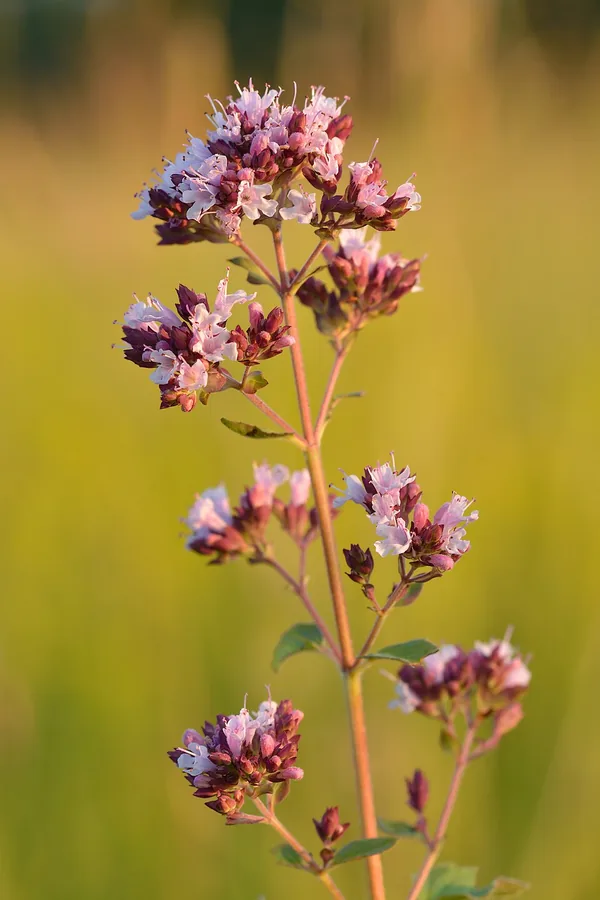
The pink-flowered subspecies is an ornamental, bee-friendly plant, though its leaves are milder and often too weak for culinary use.
How to propagate
Oregano propagates readily, but the method determines flavor outcome. Vegetative techniques on a selected plant reproduce it exactly, whereas seed introduces variability.
DivisionEasy
Early spring or fall · 2 to 4 weeks
Division reproduces a selected plant faithfully because it is a vegetative method that preserves the parent's flavor. Working in early spring or fall, lift an established clump and separate it into rooted sections, then replant each. The divisions re-establish within 2 to 4 weeks.
Stem cuttingsEasy
Late spring to summer · 2 to 4 weeks
From late spring through summer, take soft, non-flowering shoots from a plant of proven flavor, since actively growing tissue roots most readily. Set the cuttings in a moist, well-drained medium and they root in 2 to 4 weeks. As with division, the result is genetically identical to the parent.
SeedModerate
Start indoors 6-8 weeks before last frost · 2 to 3 weeks to germinate
Seed sown indoors 6 to 8 weeks before the last frost germinates in roughly 2 to 3 weeks. Because seed introduces genetic variation, the resulting plants are inconsistent and often bland, which is why division or cuttings are the sounder choice where predictable flavor is required.
Myths
Since oregano is an everyday cooking herb, pets can eat it without any risk.
Edibility for humans does not extend to companion animals. The ASPCA classifies oregano as toxic to cats and dogs, because the essential oils act as gastrointestinal irritants and can produce mild vomiting and diarrhea once a pet ingests an appreciable amount. The concentrated oil delivers the highest dose and poses the real hazard, so it must be stored out of reach.
A packet of oregano seed always yields plants with the pungent flavor cooks expect.
Seed-raised common oregano segregates for flavor and frequently emerges bland and inconsistent, lacking the pungency wanted for the kitchen. Because vegetative propagation preserves the parent genotype, dividing or taking cuttings from a plant of known quality reliably reproduces strong flavor.