Tree · Rutaceae
Orange
Citrus × sinensis
Give it full sun, warmth, and well-drained soil, and a sweet orange tree rewards you with fruit for decades.
Full sun
Every 7–14 days
55–100°F · 13–38°C
USDA 9–11
Overview
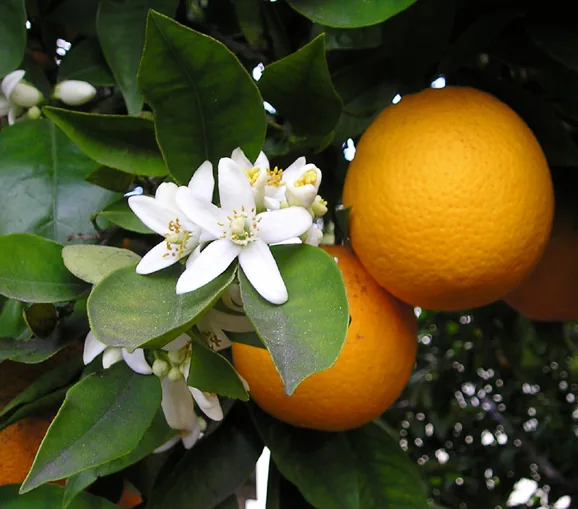
Citrus sinensis, the sweet orange, is the most widely cultivated citrus on earth, an evergreen tree bearing glossy foliage, fragrant white flowers, and fruit that matures through the cool season. It sits within the rue family, Rutaceae, alongside lemons and limes, and its productivity depends on mild winters, which places it in USDA zones 9 to 11. Where hard frost is likely, container culture supplies the mobility to overwinter the tree under cover.
An orange is a durable perennial rather than a seasonal planting. It grows at a moderate rate and reaches 20 to 30 feet (6 to 9 m) in open ground, then bears productively for decades once established. Because bloom arrives in spring and the crop ripens slowly across fall and winter, a single branch frequently carries flowers and maturing fruit simultaneously, a consequence of the extended ripening window.
Nearly every orange in cultivation is a grafted composite, a chosen fruiting variety united with a rootstock selected for cold hardiness and disease resistance. That grafted origin explains why a seed saved from breakfast will not reproduce the same fruit. Matching the variety to the local climate, then supplying full sun and consistent moisture, aligns the tree with the conditions its physiology requires.
Care
The short version: full sun, warmth, and well-drained soil, watered deeply but infrequently, with a balanced citrus fertilizer supplied across the growing season.
Light
Oranges are high-light plants that need full sun, ideally 8 or more hours daily, because photosynthate accumulation drives sugar into the fruit. They tolerate limited afternoon shade, but light directly governs crop size and sweetness, so the sunnier the position, the better the yield.
Water
Water deeply but infrequently, letting the top half of the soil dry between applications, which typically falls every 7 to 14 days. Young and container trees transpire a larger fraction of their reserves and need more, while an established in-ground tree resists drought. Waterlogging excludes oxygen from the root zone, which is why saturated soil is the one condition an orange cannot survive.
Soil
Site the tree in well-drained sandy loam so that water drains rather than standing against the roots. A soil pH of 6.0 to 7.5 keeps nutrients available for uptake, and drainage outweighs the precise soil texture in importance.
Temperature
Oranges perform between roughly 55°F to 100°F (13°C to 38°C) and require a frost-free site, since freezing ruptures cells in wood and fruit. A tree grown near the cold limit of its range is best kept in a container that can be relocated indoors during freezing episodes.
Humidity
Average humidity of 50% to 70% suits an orange, a range that most warm growing regions maintain without intervention. A tree overwintered indoors benefits from added moisture, because heated interior air drops well below that range.
Feeding
Supply a balanced citrus fertilizer carrying the micronutrients iron, zinc, and manganese, which citrus draws heavily on for chlorophyll and enzyme function. Apply through the active season from spring into late summer, then taper as growth slows with cooling temperatures.
Pruning
Oranges require minimal pruning because they form a naturally balanced canopy. Remove dead, damaged, or crossing wood and strip any suckers arising below the graft union, since those originate from the rootstock and would divert vigor; time the work for late winter or early spring ahead of the flush.
Repotting
Refresh a container tree into a larger pot every 2 to 3 years to renew depleted medium and relieve root confinement. Roots circling the pot, water channeling straight through, and growth stalling with yellowing leaves all indicate the roots have outrun the container.
Size & spacing
A standard orange attains 20 to 30 feet (6 to 9 m) in height with a canopy spread of 12 to 20 feet (3.6 to 6 m), so allocate open ground clear of structures and neighboring trees to accommodate the mature crown and its root system.
When to plant
An orange demands warmth and has no tolerance for hard frost, so timing tracks the last freeze. Plant a new tree in spring once that freeze has passed, and it flowers the following spring, with fruit ripening from fall through winter and into spring according to the variety's maturation schedule.
Northern hemisphere
Southern hemisphere
Typical months for a temperate climate: start earlier in warm zones, later where spring frosts linger.
- Plant: Spring after all danger of frost has passed
- Harvest: Blooms in spring; fruit ripens fall through winter and into spring depending on cultivar
Hardiness
USDA hardiness zones: 9–11
Temperature: down to -7°C
Troubleshooting
Diagnostic symptoms in oranges appear earliest on the new flush and the developing fruit, because those tissues are the most metabolically active and the most palatable to pests. Two of the problems below are manageable insects, while two are serious diseases that reward early detection. Match the symptom, understand its cause, and intervene before it moves through the canopy.
Asymmetric leaf mottle with lopsided, bitter fruit
Blotchy mottling that ignores the midrib, together with small lopsided fruit, is the signature of citrus greening, or huanglongbing, the gravest disease in citrus. The bacterium blocks the tree's phloem, which is why sugars fail to move and the fruit stays green and bitter, and the Asian citrus psyllid moves it from tree to tree as it feeds. No treatment clears the infection, so removing and destroying the tree cuts the reservoir that would otherwise seed nearby groves, and a report to the agricultural office triggers area control.
Fix:
- There is no cure; remove and destroy infected trees to reduce spread
- Control Asian citrus psyllid populations
- Report suspected cases to local agricultural authorities
Corky yellow-haloed lesions on fruit and foliage
Raised corky lesions circled by a yellow margin are citrus canker, a bacterial disease of the genus Xanthomonas that enters through wounds and stomata. It disperses in wind-driven rain and on contaminated hands and tools, which is why working wet foliage spreads it so readily. Excising and destroying infected wood and fruit removes the inoculum, copper sprays suppress bacterial populations where they are permitted, and local quarantine rules govern movement, so verify them before relocating any material.
Fix:
- Remove and destroy affected plant material
- Apply copper-based sprays where permitted
- Follow local quarantine and reporting requirements
Immobile stem bumps over honeydew and sooty mold
Fixed bumps that resist a fingernail are scale insects, sap feeders that excrete the sugary honeydew, and the black film beneath them is sooty mold colonizing that honeydew rather than the plant itself. Horticultural oil works by smothering the sessile insects under their protective covers, and pruning the crusted twigs removes the densest colonies outright. Ants deserve attention as well, because they harvest the honeydew and drive off the parasites and predators that would otherwise suppress the scale.
Fix:
- Apply horticultural oil to smother scale
- Prune heavily infested twigs
- Conserve natural predators and parasites
Serpentine silver mines through distorted new leaves
Winding silver mines mark the feeding of the citrus leafminer, whose larvae tunnel between the epidermal layers of soft, expanding leaves, which is why the damage stays confined to the flush and never touches hardened foliage. A mature canopy carries ample leaf area to absorb the loss, so intervention is unwarranted there. On young trees the flush is a larger fraction of the whole, so restraining the tender growth that attracts the moth, and applying horticultural oil during heavy mining, protects the developing framework.
Fix:
- Tolerate light damage on mature trees, which usually outgrow it
- Avoid excess nitrogen and pruning that stimulate frequent tender flush
- Use horticultural oil on young trees if needed
Toxicity
For people the flesh of an orange is a safe, nutritious food, but the same fruit is not benign to animals. The peel, leaves, and seeds concentrate essential oils and psoralens that irritate a pet's gastrointestinal tract and can sensitize the skin to sunlight. Withhold peels and prunings from cats, dogs, horses, and other animals, and reserve a small portion of flesh as an infrequent treat.
Toxic to
Cats · Dogs · Horses · Rabbits · Livestock · Birds
Safe for
People
Cats Mild
The essential oils held in the peel and leaves irritate the gut lining, so drooling, vomiting, and diarrhea follow. A large dose depresses a cat into dullness, and the psoralens sensitize the skin to sunlight.
Dogs Mild
Chewing the peel or leaves delivers a dose of the same oils, which inflames the stomach and brings on vomiting and loose stools. A larger quantity saps the animal's energy, so its own treats are the safer offering.
Horses Mild
The oils and psoralens carried in the foliage and rind disturb a horse's digestion and dull its demeanor. Excluding prunings and peels from the paddock removes the temptation before a curious horse investigates.
Rabbits Mild
A rabbit's finely tuned gut flora cannot process the concentrated essential oils in citrus leaves and peel, so appetite loss and soft stools result. A minute portion of flesh at rare intervals is the ceiling for the species.
Livestock Mild
Goats, sheep, and cattle that graze fallen leaves or peel take in enough oil to provoke mild stomach upset. Removing citrus trimmings from grazing areas denies the animals the chance to consume a damaging quantity.
Birds Caution
The oils concentrate most heavily in the peel and leaves, which is reason enough to withhold them from pet birds, while a small taste of the flesh poses little concern. A modest offering of seedless flesh, rind excluded, stays within a safe margin.
People Flesh safe
The juicy flesh is a nutritious, everyday food that carries no risk to people. The peel, leaves, and seeds belong outside the bowl, since their oils can irritate the mouth and stomach.
Keep peels, leaves, and seeds away from pets; the fruit flesh in small amounts is likely to cause at most minor stomach upset.
Helpline numbers

United States
ASPCA Animal Poison Control: (888) 426-4435 (fee applies)
Poison Control: (800) 222-1222



Canada
Poison Centres: 1-844-764-7669
Varieties
Hundreds of orange cultivars exist, divided principally into dessert types eaten fresh and processing types grown for juice. The selection below represents the cultivars most home growers encounter or recognize.
Valencia
A late-maturing juicing orange harvested from spring into summer, valued for nearly seedless fruit and exceptional juice yield.
Washington Navel
A seedless dessert orange identified by the small secondary fruit, the navel, embedded at its blossom end.
Hamlin
An early-season, cold-hardy juice orange planted extensively throughout Florida groves.
Blood orange (Moro)
Develops deep red flesh as cool nights induce the accumulation of anthocyanin pigment.
How to propagate
Oranges are propagated almost exclusively by grafting, which secures the fruit type and a resilient root system, though seed remains an option for anyone prepared to wait years for a result.
GraftingModerate
During active growth in spring to early summer when bark slips easily · Several months to form a union; 3 to 5 years to begin fruiting
Grafting is the standard propagation method for oranges in commercial groves and home plantings alike, because it fixes the scion's fruit quality while drawing cold and disease tolerance from the rootstock. Perform it in spring to early summer, when active growth lets the bark slip and the cambium layers align, and the union callouses over several months. The composite tree still requires 3 to 5 years of vegetative development before it enters bearing.
SeedEasy
Sow fresh seed in spring · Germinates in a few weeks but can take many years to fruit
Seed propagation is technically simple but agronomically slow. Sown fresh in spring, the seed germinates within a few weeks, yet the resulting tree can take many years to reach bearing and frequently fails to come true to the parent because of genetic segregation. Those traits confine seed to raising rootstock or to casual experimentation rather than fruit production.
Myths
Oranges are completely safe for cats and dogs because the fruit is edible for people.
Edibility for people does not transfer to pets, and the ASPCA classifies orange as toxic to cats and dogs precisely because the peel, leaves, and seeds concentrate essential oils and psoralens that irritate the gut. The flesh carries far less of these compounds, yet it still warrants no more than a small, occasional treat for a pet.
A seed from a store-bought orange grows a tree just like its parent that fruits in a year or two.
Commercial sweet oranges are propagated by grafting a scion onto a selected rootstock, not raised from seed, so the parent's exact fruit is not reproduced from a pip. A seedling commonly needs many years to reach bearing age and often diverges from the parent, which is why seed-grown trees serve as rootstock candidates or novelties.