Tree · Oleaceae
Olive
Olea europaea
Give it full sun, lean soil, and a dry root run, and the olive thrives for generations.
Full sun
Every 14–30 days
USDA 8–11
20–49 ft · 6–15 m
Overview
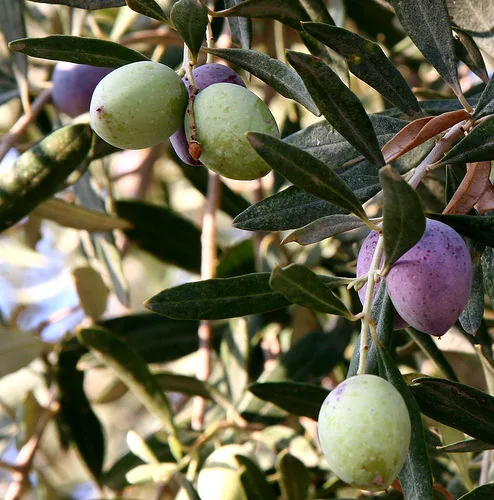
Olea europaea is a slow-growing Mediterranean evergreen adapted to hot, dry sites where summer drought excludes most fruiting trees. Cultivated for its oil and fruit over thousands of years, an individual can persist for centuries, which places it among the longer-lived cultivated trees. A planting decision here is effectively a multi-decade commitment to the site.
The tree's requirements are defined largely by what it does not want. It performs on full sun, sharp drainage, and lean soil and tolerates the poor, rocky, and calcareous ground that limits nutrient-demanding species. Excess water or rich, poorly drained soil suppresses vigor and predisposes the roots to rot, so restraint in irrigation and feeding is the governing principle.
One physiological point matters at planting. The fruit is inedibly bitter in the raw state owing to its phenolic content and requires curing before consumption. The species also carries a chilling requirement for reliable flowering, which restricts it to warm-temperate climates rather than the frost-free tropics.
Care
The short version: full sun, sharp drainage, and lean soil, with deep but infrequent irrigation once the tree is established. Withhold heavy feeding and standing water, and prune in late winter to maintain an open canopy.
Light
The olive is a high-light species and needs full sun through the day to fruit well, because flower and fruit set depend on the energy that full exposure supplies. It tolerates limited partial sun, but shade produces lanky growth and a thin crop, so the brightest available position is the correct one.
Water
Once established the olive is genuinely drought tolerant and is best irrigated deeply but infrequently, on a cycle of roughly 14 to 30 days, with the soil allowed to dry between applications. This regime mirrors its native rainfall pattern and keeps oxygen at the roots, since waterlogged, poorly drained soil drives the root rot that ends an otherwise centuries-long life.
Soil
Drainage governs soil selection more than fertility. The olive thrives in well-drained sandy loam and tolerates poor, rocky, and calcareous ground across a broad pH of 6.0 to 8.5, reflecting its origin on thin Mediterranean soils. Heavy soil that retains water around the roots is the one substrate it will not accept.
Temperature
The species withstands considerable heat, to about 100°F (38°C), and is well matched to the dry Mediterranean summer. Cold tolerance is the limiting factor, since wood is damaged below brief exposure to around 19°F (-7°C), which confines reliable culture to warm-temperate zones.
Humidity
Low atmospheric moisture suits the olive, which does best around 20% to 50% relative humidity. Damp, still air favors the fungal leaf spots to which it is prone, so canopy airflow contributes more to health than ambient humidity does.
Feeding
The olive is a light feeder adapted to lean ground. A single balanced, nitrogen-rich application in spring meets its seasonal demand, and excess nitrogen is counterproductive because it diverts the plant into soft vegetative growth at the expense of flowering and fruit.
Pruning
Prune in late winter to early spring, thinning to a loose open-vase form so light and air penetrate the interior. Removing suckers, dead wood, and crossing branches improves fruiting and lowers the canopy humidity that the fungal leaf spots require to establish.
Repotting
Container specimens need repotting every 2 to 3 years to renew root space and medium. Roots circling the pot or emerging from the drainage holes, water passing straight through, and stalled new growth are the diagnostic signs that the root system has filled its container.
Size & spacing
Unrestricted, the olive attains 20 to 50 feet (6 to 15 m) in height with a broad spreading crown, so plan for roughly 15 to 30 feet (4.5 to 9 m) of clearance. Its slow growth and long lifespan reward siting the tree with its mature dimensions in mind.
When to plant
The olive follows a slow Mediterranean cycle. Establish young trees in spring once frost has passed and the soil has warmed, expect bloom in late spring, and harvest the fruit through fall, from September into November.
Northern hemisphere
Southern hemisphere
Typical months for a temperate climate: start earlier in warm zones, later where spring frosts linger.
- Plant: spring after the last frost once soil has warmed
- Harvest: blooms late spring; fruit harvested fall (September to November)
Hardiness
USDA hardiness zones: 8–11
Temperature: down to -12°C
Troubleshooting
Most olive disorders originate in excess moisture and in wounds that admit pathogens, whether the result is a bacterial gall or a fungal leaf spot. Detecting the early signs and pruning during a dry period usually arrests the problem. Match the symptom below and intervene before the pathogen moves through the canopy.
Sudden one-sided wilting and branch dieback
One-sided collapse of a limb signals verticillium wilt, a soilborne fungus that invades the vascular system and occludes the water-conducting tissue, which is why a cut branch shows discoloration streaking the wood inside. Because the infection lives in the soil and cannot be eradicated from an infected tree, the response is to remove dead wood, restrict irrigation so the roots are not stressed further, and refuse to replant olives on any site where the pathogen has been recorded.
Fix:
- Remove and destroy dead wood
- Avoid overwatering
- Do not replant olives where the disease is known
Rough woody galls developing along twigs and branches
The tumor-like swellings indicate olive knot, a bacterial disease that colonizes fresh wounds, entering at pruning cuts, frost cracks, and leaf scars, which is why outbreaks intensify after wet weather that carries the bacteria across the canopy. Excise infected wood in dry conditions and well below each gall, since the pathogen extends beyond the visible tissue. Disinfect tools between cuts to avoid moving it, and a copper application after pruning or frost protects the newly opened wounds.
Fix:
- Prune out infected wood in dry weather well below the galls
- Disinfect tools between cuts
- Apply a copper bactericide after pruning or frost injury
Punctured fruit with larvae mining the flesh
Oviposition stings paired with cream-colored larvae in the flesh confirm the olive fruit fly, whose maggots develop inside the fruit and render it unusable. Cutting a suspect olive exposes the larvae or their exit holes, and baited traps track adult pressure as harvest approaches. Prompt picking and sanitation of dropped fruit break the life cycle by denying the next generation a host, with approved bait sprays or kaolin clay reserved for heavy infestations.
Fix:
- Harvest promptly
- Sanitize fallen fruit
- Use approved bait sprays or kaolin clay where infestation is heavy
Peacock-eye lesions preceding yellowing and defoliation
Sooty circular lesions ringed by a yellow halo identify olive peacock spot, a fungus that establishes in the lower, humid canopy during cool wet periods and triggers premature defoliation. Opening the canopy by pruning lowers the humidity the spores need, and removing fallen leaves eliminates the overwintering inoculum that would restart infection. A copper fungicide applied in fall, ahead of the rains, suppresses the pathogen before conditions favor it.
Fix:
- Improve air circulation through pruning
- Apply a copper fungicide in fall before rains
- Rake and remove fallen infected leaves
Toxicity
For households with animals, the olive tree is non-toxic and safe around pets, livestock, and people, and the fruit is edible once cured. The single meaningful hazard is mechanical rather than toxicological: the hard pit can choke a pet or obstruct the gut if swallowed whole, so fallen fruit should be collected.
Safe for
People · Cats · Dogs · Horses · Rabbits · Livestock · Birds
Cats None
The foliage carries no compounds toxic to cats, so the tree itself is safe. The sole hazard is mechanical: a swallowed pit can lodge in the gastrointestinal tract, so collecting fallen fruit removes the risk.
Dogs None
Dogs face no risk of poisoning from an olive, since the plant holds no toxins. The concern is a gulped pit, which can obstruct or choke, and the high salt load of cured olives, both of which are best avoided.
Horses Safe
Olive foliage is non-toxic to grazing horses. The only consideration is windfall fruit, since an ingested pit presents a choking and obstruction hazard rather than a poisoning one.
Rabbits Safe
The plant contains nothing toxic to rabbits. A whole pit is far too large and hard for them to process, so dropped fruit is best kept clear of the hutch and run.
Livestock Safe
Goats, sheep, and cattle can browse around olives with no toxicological risk. The hard stones are the single concern, since a swallowed pit can lodge or choke.
Birds Safe
Olives hold nothing toxic to birds, and wild species consume the fruit readily. The limiting factor is the dense pit, which can choke a smaller bird attempting to swallow it whole.
People Safe
Cured olives are a safe and common food, whereas raw fruit off the tree is far too bitter to eat. The hard pit should not be bitten, and small children should be kept from swallowing one.
The hard fruit pit is a choking and gastrointestinal obstruction hazard if swallowed, and cured table olives are very high in salt, so neither should be offered to pets.
Varieties
Olive cultivars divide chiefly into oil types and table types, with a small group selected to produce little or no fruit. The names below are the ones most frequently encountered.
Arbequina
A small, self-fertile Spanish cultivar with above-average cold tolerance that performs well in both oil production and container culture.
Mission
A cold-hardy California cultivar valued as a dual-purpose type suited to table use and oil pressing alike.
Manzanillo
A widely planted rounded table olive regarded above all as the standard for canning.
Frantoio
The classic Italian oil cultivar responsible for a great deal of high-quality fruity olive oil.
Swan Hill
A near-fruitless, low-pollen cultivar selected for sites where fruit drop and allergens would otherwise be problematic.
Companions
How to propagate
Olives are propagated mainly by cuttings or grafting so the progeny reproduces the parent cultivar, since seed is slow and genetically variable and rarely comes true to type.
Stem cuttingsModerate
Late spring to summer · 2 to 3 months to root
Cuttings are the standard method for reproducing a named olive because the resulting plant is genetically identical to the parent. Semi-hardwood cuttings taken from late spring through summer and rooted under mist with bottom heat form roots in roughly 2 to 3 months.
GraftingDemanding
Spring · One growing season
Grafting places a selected cultivar onto a vigorous seedling or clonal rootstock, combining the scion's fruit quality with the rootstock's resilience. Performed in spring, a successful union callouses and establishes over a single growing season.
SeedDemanding
Fall · Several years to fruiting
Seed propagation is slow and genetically variable, so the seedlings do not reproduce the parent cultivar and are used chiefly to raise rootstock. Sown in fall, a seed-grown tree takes several years to reach fruiting age.
Myths
Olives can be picked and eaten straight off the tree.
Raw olive fruit is intensely bitter because of a phenolic compound called oleuropein concentrated in the flesh. The fruit becomes palatable only after it is cured in brine, lye, or salt, a process that leaches the compound out.
Olive trees never need cold weather.
The tree is indeed cold-sensitive, yet it still requires a period of winter chill to flower and set fruit reliably. Where winters stay too warm, the tree remains healthy but produces little fruit, since the chilling requirement for floral induction goes unmet.