Shrub · Oleaceae
Border Forsythia
Forsythia × intermedia
Plant it for the first burst of yellow that opens long before anything else wakes up in spring.
Full sun
Every 7–14 days
USDA 5–8
8–10 ft · 2.4–3 m
Overview
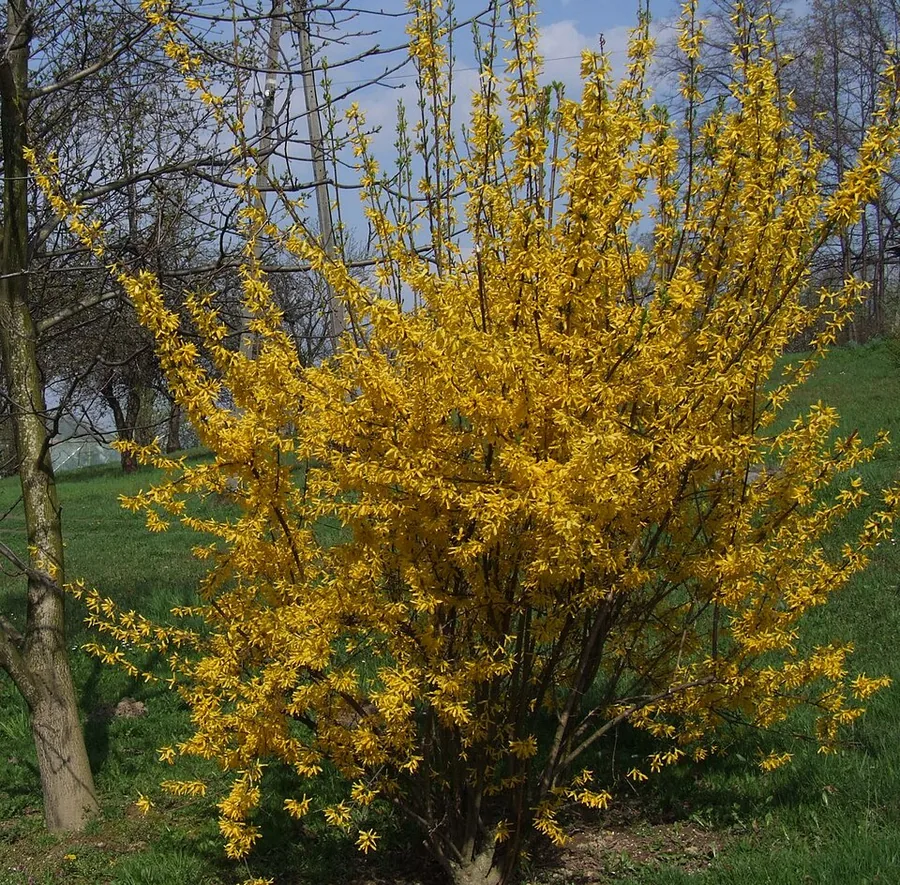
Forsythia signals the close of winter. Its bare stems break into bright yellow bells in early spring, several weeks ahead of leaf emergence and ahead of most other woody plants in the garden. A member of the olive family, Oleaceae, it grows quickly into a large, arching mound, a habit that has made it a mainstay of shrub borders and bank plantings for generations.
Cultural demands are modest. The shrub performs across clay, sand, poor ground, and urban soils, holds up through hardiness zones 5 through 8, and tolerates moderate drought once the root system is established. Its one non-negotiable requirement is light: bloom is a direct function of sun exposure, so a shaded plant yields foliage in place of the flowers that justify growing it.
Mature dimensions deserve attention at planting. The shrub reaches 8 to 10 feet (2.4 to 3 m) in height and spreads still wider, and the low branches root on soil contact, so unmanaged plants develop into thickets. Allow space for the arching form and prune once each year immediately after bloom to keep the framework open and well structured.
Care
The short version: full sun governs flowering, almost any well-drained soil will serve, even moisture supports establishment, and a single pruning each year directly after the flowers fade maintains the framework.
Light
Provide full sun to maximize flowering, since bud set scales directly with light. The shrub will persist in partial shade, but every reduction in light costs flowers, and a shaded plant grows leafy and color-poor.
Water
Irrigate regularly through the first year so the root system establishes, after which the plant largely sustains itself. An established shrub withstands short dry intervals and needs only medium, even moisture, on the order of one soaking every 7 to 14 days in dry weather. Avoid saturated ground, the precondition for root rot.
Soil
Forsythia is unusually accommodating on soil, succeeding in clay, loam, sand, and even degraded urban substrates. The two requirements that matter are sharp drainage and a reaction within the 6.0 to 8.0 pH band.
Temperature
The shrub is cold-hardy across roughly -20°F to 95°F (-29°C to 35°C). The wood itself survives hard winters, but the flower buds are the vulnerable tissue and sustain injury once temperatures fall below about -5°F.
Humidity
Ambient outdoor air is sufficient, so no humidity target applies. Good airflow is the more relevant variable, because crowded, slow-drying foliage is the condition under which leaf spot establishes.
Feeding
Forsythia is a light feeder. A balanced shrub fertilizer or compost in early spring supplies all it requires, and excess nitrogen shifts the plant toward vegetative growth at the expense of flower production.
Pruning
Prune once annually, immediately after the flowers fade. Thin the oldest stems at the base, and cut the entire shrub close to the ground every 3 to 4 years to rejuvenate it. Pruning past mid-July removes next spring's buds, since the flowers are borne on old wood.
Repotting
As a landscape shrub, forsythia rarely occupies a container, so repotting seldom arises. Where one is container-grown, repot only when the roots circle and mat, water passes through with little absorption, or new growth stalls.
Size & spacing
Account for substantial size at maturity. A grown forsythia stands 8 to 10 feet (2.4 to 3 m) tall and spreads wider still, near 10 to 12 feet (3 to 3.7 m), so allot enough room for the arching habit to develop without encroaching on neighbors.
When to plant
Forsythia follows the early-spring calendar closely. Establish new plants in spring or fall once the ground is workable and hard frost has passed, expect the yellow bells to open in March and April before the foliage, and confine the single annual pruning to the period immediately after flowering.
Northern hemisphere
Southern hemisphere
Typical months for a temperate climate: start earlier in warm zones, later where spring frosts linger.
- Plant: Spring or fall, after the ground is workable and the threat of hard frost has passed.
- Harvest: Early spring (March to April), before the leaves emerge.
Hardiness
USDA hardiness zones: 5–8
Temperature: down to -29°C
Troubleshooting
Forsythia is durable, so problems are infrequent, and most trace to an unsuitable site or pruning at the wrong stage. The entries below cover the disorders that actually occur. Identify the cause behind the symptom and treat that, not the visible sign alone.
Root decline in waterlogged soil
Decline and wilting in saturated ground are the classic presentation of Phytophthora root rot, a water mold that thrives in oxygen-poor soil and leaves the roots dark and mushy. Small swellings or knots along the roots instead indicate root-knot nematode, and chronic overwatering in compacted soil aggravates both by depriving roots of air. Lift a declining specimen to read the root system directly, then correct the drainage and reduce irrigation to restore the air-water balance roots require. A severely affected plant warrants removal and replanting on a raised, free-draining site.
Fix:
- Improve drainage and reduce watering
- Remove severely affected plants
- Replant in a raised, well-drained site
Sparse bloom on old wood
A poor spring display traces most often to mistimed pruning. Forsythia initiates its flower buds on the previous season's growth, so cuts made after mid-July remove the very wood that carries next spring's flowers. Insufficient light is the second factor, since the shrub needs full sun to set a heavy bud crop, and in severe winters the buds sustain cold injury once temperatures fall below about -5°F (-21°C). Prune only after flowering, place the plant in full sun, and in cold zones select a bud-hardy cultivar.
Fix:
- Prune only immediately after flowering, never in summer or late winter
- Move or limb up nearby plants to give the shrub full sun
- In cold regions choose hardier cultivars such as Northern Sun or Meadowlark
Foliar spotting with stem dieback
Discrete lesions on the foliage indicate fungal leaf spot, whereas sunken, killed shoot tips point to stem dieback or canker, a problem that drought stress tends to precipitate. Examine the crown as well, because rough woody swellings at the base are the signature of crown gall. Excise dead and cankered wood back to sound tissue and disinfect the blades between cuts to avoid moving pathogens along the plant, then thin the canopy so air circulates and foliage dries faster. Watering at the base rather than overhead keeps the leaf surface dry, which denies the fungal spores the free moisture they need to infect.
Fix:
- Remove and discard affected leaves and prune out dead or cankered wood to healthy tissue
- Disinfect pruners between cuts
- Improve air circulation by thinning the shrub
- Water at the base to keep foliage dry
Toxicity
For households with pets or children the verdict is clear: forsythia is non-toxic across the board. The ASPCA lists it as safe for dogs, cats, and horses, and it carries no poisonous compounds. The flowers are bitter, which limits browsing without any further measure.
Safe for
People · Cats · Dogs · Horses · Rabbits · Livestock · Birds
Cats None
Non-toxic to cats. A sampled leaf or flower produces no poisoning, and the bitter compounds in the bloom deter most cats before meaningful ingestion occurs.
Dogs None
Harmless to dogs whether brushed against or chewed. The only plausible response to a large quantity of any plant tissue is transient, self-limiting gastric upset.
Horses None
Classified as non-toxic to horses, so foliage that is browsed presents no poisoning risk to the animal.
Rabbits Safe
The shrub contains no compounds toxic to rabbits, so an accessible stem poses no hazard. Bitterness in the flowers tends to limit sustained browsing in any case.
Livestock Safe
Cattle, goats, and sheep may occupy a pasture margin alongside forsythia without any poisoning concern.
Birds Safe
Birds that perch on or peck at the shrub encounter no toxic hazard in the leaves, flowers, or stems.
People Safe
Safe for sites where children play and safe to prune ungloved, as no part of the shrub is poisonous. Routine handwashing after handling any garden plant remains sound practice.
No special handling required; the flowers are bitter, which discourages nibbling. Wash hands after pruning as a general practice.
Varieties
Most garden forsythia is this hybrid, but the named cultivars differ measurably in size, bud hardiness, and floral density. Several merit recognition by name.
Lynwood (Lynwood Gold)
An upright cultivar that has become a reference standard, carrying bright yellow flowers distributed evenly along the full length of the stems.
Spectabilis
The heaviest-flowering selection of the group, cloaking its branches in dense, deep yellow bloom.
Beatrix Farrand
A notably vigorous selection producing large flowers in a deep canary yellow.
Northern Sun
A bud-hardy cultivar rated to roughly zone 4, attaining about 10 feet in height while retaining viable flower buds through severe winters.
Gold Tide
A low, spreading dwarf form suited to groundcover use and to stabilizing a bank or slope.
Companions
Forsythia pairs well with early bloomers that pick up where its yellow leaves off, and poorly with anything trying to grow in the shade beneath its dense canopy.
Plant near
Daffodils: Yellow daffodils bloom at the same time and echo the forsythia's early-spring color at ground level.
Lilac: Lilac flowers shortly after forsythia, extending the shrub-border bloom season; both share full-sun, well-drained conditions.
Keep apart
Turfgrass directly beneath the canopy: The dense arching canopy and surface roots shade and compete with lawn grass, which struggles under the shrub.
How to propagate
Few shrubs propagate as readily. Forsythia roots from cuttings and self-layers wherever a branch rests on soil, so a single plant is quickly multiplied into many.
Stem cuttingsEasy
Late spring to summer · 4 to 8 weeks to root
Forsythia roots readily from cuttings because its tissue forms adventitious roots with ease. Collect softwood cuttings in late spring or early summer, or semi-hardwood cuttings later in the season, and most will form roots within 4 to 8 weeks.
LayeringEasy
Spring through summer · One growing season to root
The pendulous branches self-layer wherever they contact moist soil, forming roots at the point of contact. Peg a low branch to the ground at any point from spring through summer, allow a full growing season for rooting, then sever it from the parent and transplant the rooted division.
Myths
Forsythia should be cut back hard in late winter to make it bloom better.
Cutting in late winter or summer removes the flower buds, which are borne on the prior season's wood. Severe pruning at the wrong phenological stage thins or eliminates the spring display entirely. Confine pruning to the window just after flowering and the buds destined for the next season remain intact.
Forsythia berries and flowers are poisonous to pets and children.
The ASPCA classifies Forsythia, listed as Golden Bells, as non-toxic to dogs, cats, and horses, and it is regarded as safe around children as well. No toxic principles are present in the plant, and the bitterness of the flowers limits browsing without any intervention.