Shrub · Oleaceae
Privet
Ligustrum vulgare
A vigorous, shear-tolerant hedge in the olive family, prized for dense regrowth but flagged for escaping cultivation and poisoning grazing stock.
Full sun
Every 7–14 days
USDA 4–8
10–15 ft · 3–4.6 m
Overview
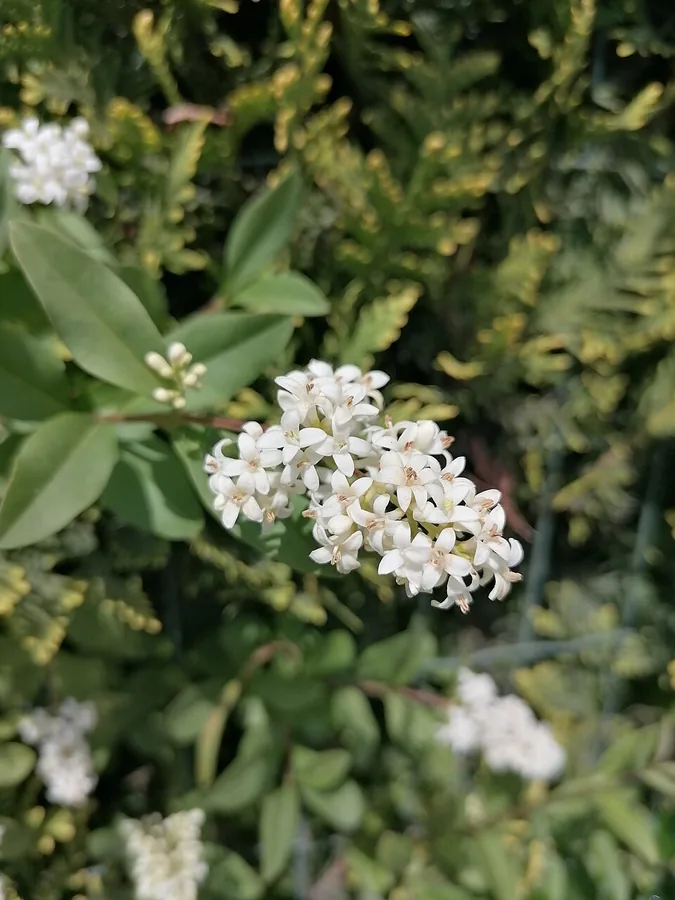
Privet is a fast, densely branching shrub in the olive family (Oleaceae), and its capacity to break new growth from old wood is what lets it recover from hard shearing that would ruin most hedges. It flushes early, holds its small oval leaves as a semi-evergreen well into the season, and produces panicles of white flowers in late spring followed by clusters of dark, seed-filled berries. Low cost and rapid establishment explain its long popularity as hedging.
That same growth rate drives its worst trait. Birds consume the fleshy berries and void the intact seed across woodland and field-edge habitat, where privet builds dense thickets that suppress native regeneration by shading the understory. Several species are listed or regulated as invasive, and common privet is rated a significant threat in some regions.
Every part is also poisonous. Foliage and, in higher concentration, the berries carry cardiac glycosides, saponins, and protoanemonin that are toxic to pets, livestock, and people, so placement should account for grazing access, shearing should precede fruit set, and prunings should be removed rather than left where animals feed.
Care
The short version: site privet in full sun to part shade in any well-drained soil, irrigate new shrubs until they root and then withhold most supplemental water, and shear to shape in late spring once flowering finishes.
Light
Privet develops its densest canopy in full sun, where high light supports maximum leaf density, but it performs adequately in partial sun and partial shade. Reduced light lowers photosynthetic output, thinning the growth and leaving gaps that are slow to fill.
Water
Irrigate new plantings until the root system establishes, after which the plant draws on moist to occasionally dry soil with minimal supplemental water. Allow the top half of the profile to dry between irrigations, on the order of every 7 to 14 days during establishment, which discourages the saturated conditions that favor root pathogens.
Soil
Privet adapts to clay, loam, or sand provided the soil drains, since standing water predisposes it to root rot. A soil pH of 6.0 to 7.5 matches its preference and describes most cultivated ground, so amendment is rarely warranted.
Temperature
Cold hardiness extends to roughly -29°F (-34°C) and heat tolerance to about 100°F (38°C), a wide thermal range that accounts for its success across many climates. This latitude in temperature is one reason the species establishes so readily outside cultivation.
Humidity
Ambient outdoor humidity meets its needs, so no target range applies. Air circulation is the operative factor, because still air within a crowded hedge raises leaf wetness duration and favors leaf spot and powdery mildew.
Feeding
In average soil privet seldom requires feeding, since it draws adequate nutrients from ordinary ground. Apply a balanced granular fertilizer in spring only where growth is weak, and avoid excess, because high nitrogen forces soft tissue that attracts sap-feeding pests.
Pruning
Privet withstands hard shearing because it regenerates freely from latent buds on old wood, the trait that makes it a premier hedge. Shape it in late spring after flowering, or shear repeatedly through the season, and cut before fruit set to suppress the seed that drives its spread.
Repotting
Privet is rarely containerized and seldom needs repotting. Where it is grown in a pot, move it up when roots circle the container or emerge from the drainage holes and water begins to run straight through, all signs the medium is exhausted.
Size & spacing
Unsheared, privet attains 10 to 15 feet (3 to 4.5 m) in height and 8 to 15 feet (2.4 to 4.5 m) in spread. For a continuous hedge, space plants inside that mature spread so the canopies knit together under repeated shearing.
When to plant
Privet imposes few timing constraints. Establish new plants in spring or fall while soil temperatures allow root growth, anticipate the white flowers around June, and shear after bloom, before fruit set, to limit the seed that drives its spread.
Northern hemisphere
Southern hemisphere
Typical months for a temperate climate: start earlier in warm zones, later where spring frosts linger.
- Plant: Spring or fall
- Harvest: White flowers in late spring to early summer (around June)
Hardiness
USDA hardiness zones: 4–8
Temperature: down to -34°C
Troubleshooting
Because privet tolerates heavy stress, most disorders are cosmetic rather than lethal. The common complaints are foliar feeding by sap-sucking and chewing insects and fungal leaf and twig diseases, while root rot in poorly drained soil is the one condition that reliably kills. Identify the agent below and intervene before it establishes.
Whole-plant wilt and chlorosis in saturated soil
General wilting and yellowing in an otherwise tough privet indicates root rot developing in soil that stays saturated. Excavation reveals dark, soft, decayed roots deprived of oxygen in waterlogged ground. Correct the drainage and cease overwatering, but a plant this far gone rarely recovers and is best removed and replaced on a better-drained site.
Fix:
- Improve drainage and stop overwatering
- Remove severely affected plants
- Replant in well-drained soil
Leaf spots, twig dieback, and sunken stem lesions
Dark leaf spots, blighted twigs, and sunken cankers indicate anthracnose or twig blight, whereas a white superficial coating is powdery mildew. Excise and destroy infected wood, then thin the canopy to lower humidity within it. Direct water to the base and remove fallen leaves, since both reduce the leaf wetness and inoculum the fungi require.
Fix:
- Prune out and destroy infected twigs and branches
- Improve air circulation by thinning the canopy
- Avoid overhead watering and clean up fallen leaves
White waxy insects and a sticky film on the foliage
Cottony white insects and a tacky coating indicate whiteflies or white peach scale drawing sap from the leaves. Dislodge whiteflies with a forceful water jet, then apply horticultural oil or insecticidal soap to the leaf undersides where the insects feed. Repeat until the honeydew and the black sooty mold growing on it subside.
Fix:
- Spray foliage with a strong jet of water to dislodge whiteflies
- Apply horticultural oil or insecticidal soap, coating undersides of leaves
- Repeat applications per label until populations decline
Notched leaf margins and diminished vigor
Scalloped notching on the leaf margins is characteristic feeding by a weevil, either the ligustrum or Japanese species, whose adults feed nocturnally while larvae consume roots below ground. Collect adults by shaking them onto a cloth at dawn, and apply a labeled insecticide only where damage is severe. A vigorous, well-irrigated plant compensates for the largely cosmetic foliar loss.
Fix:
- Handpick or shake adults onto a cloth in early morning
- Apply a labeled insecticide if damage is heavy
- Maintain plant vigor with proper watering
Toxicity
Regard the entire plant as poisonous. Leaves and dark berries contain cardiac glycosides, saponins, and protoanemonin, with the berries holding the highest toxin load. Ingestion produces vomiting and diarrhea, and larger doses add incoordination and cardiac effects, a syndrome that can prove fatal in horses and other livestock. Keep berries and prunings away from animals and young children.
Toxic to
Cats · Dogs · Horses · Rabbits · Livestock · Birds · People
Cats Mild
A cat ingesting leaves or berries typically shows hypersalivation, inappetence, and gastrointestinal upset with diarrhea. Signs generally remain mild, but because the dark berries concentrate the most toxin, exposure to fruit warrants the greatest caution.
Dogs Mild
Dogs commonly present with drooling, abdominal pain, and loose stools, sometimes appearing depressed afterward. Ingestion of dropped berries or fresh prunings is the usual exposure route.
Horses Severe
Horses are highly susceptible, with colic, abdominal pain, hypersalivation, and depression accompanied by ataxia. A large ingestion of leaves or berries can be fatal, so any suspected case should be handled as an emergency.
Rabbits Toxic
The glycosides toxic to other species render privet unsafe for rabbits, producing gastrointestinal upset and lethargy. Leaves and berries should never be offered, even in trace amounts.
Livestock Severe
Cattle, goats, and sheep develop serious gastrointestinal distress and colic from foliage and fruit, and larger intakes are lethal. Exclude privet from pasture and dispose of prunings away from grazing areas.
Birds Toxic
Birds swallow the berries whole and pass the seed intact, the very mechanism of dispersal, but foliage and fruit are not appropriate feed for pet birds. Keep caged birds away from any trimmings.
People Caution
No part of privet is edible. The berries pose the primary risk, with ingestion causing vomiting and diarrhea, and larger doses adding incoordination and cardiac effects. Store the fruit out of reach of small children.
Keep berries and prunings away from pets and grazing animals; clip flower panicles before berries form to limit fruit on the plant.
Helpline numbers

United States
ASPCA Animal Poison Control: (888) 426-4435 (fee applies)
Poison Control: (800) 222-1222



Canada
Poison Centres: 1-844-764-7669
Varieties
Privet refers to a group of closely allied Ligustrum species and hybrids spanning shrubs to small trees, most selected for rapid hedging or foliage color, and several notable for aggressive naturalization.
Ligustrum sinense (Chinese privet)
A semi-evergreen hedging species that has become highly invasive across the eastern and southern US, generating dense thickets from bird-dispersed seed.
Ligustrum japonicum (Japanese / wax-leaf privet)
A warm-climate selection with large, glossy, thick evergreen leaves that has likewise naturalized across parts of the southern US.
Ligustrum lucidum (glossy privet)
A tree-sized glossy species listed as a noxious weed in California and widely naturalized through the South.
Ligustrum × vicaryi (golden privet)
Grown for bright golden-yellow foliage whose color intensity depends on full sun exposure.
How to propagate
Privet propagates by several routes, from cuttings, seed, and self-layering branches, and that reproductive versatility is the mechanism behind its rapid colonization once it escapes.
Stem cuttingsEasy
Softwood cuttings in late spring/early summer or hardwood cuttings in late fall to winter · 4 to 8 weeks to root
Privet roots from cuttings with minimal intervention. Softwood cuttings taken in late spring or early summer, and hardwood cuttings from late fall into winter, form roots within 4 to 8 weeks. This rooting facility is a physiological basis for the plant's aggressive establishment.
SeedEasy
From ripe black berries in fall · Germinates readily; seed is abundantly bird-dispersed
The ripe black berries produced in fall contain seed that germinates readily. Privet self-sows prolifically, and bird dispersal of that seed is the principal driver of its invasiveness. Removing flower panicles before fruit set is the most reliable method to limit volunteer seedlings.
LayeringEasy
Spring through summer · Several weeks to months
Low branches in contact with soil root by natural layering, requiring several weeks to a few months to anchor. The plant also produces suckers, so a single specimen expands its footprint vegetatively without seed.
Myths
Privet is a harmless ornamental hedge suitable for any site.
Privet does not stay within the planting. Birds disperse the seed into woods and field edges, where it forms dense thickets that displace native vegetation, and several species carry noxious-weed listings or regulation. Verify local regulations before planting, and favor a native hedge alternative.
Privet berries must be safe because birds eat them.
Avian tolerance is not a general safety indicator. Birds digest the pulp and void the seed widely, yet the berries and leaves are toxic to pets and livestock, carrying cardiac glycosides, saponins, and protoanemonin that the birds metabolize without harm.