Shrub · Oleaceae
Common Jasmine
Jasminum officinale
Give it sun, warmth, and a sturdy support, and common jasmine fills the summer air with scent.
Full sun
Every 5–10 days
USDA 7–10
20–40 ft · 6.1–12.2 m
Overview
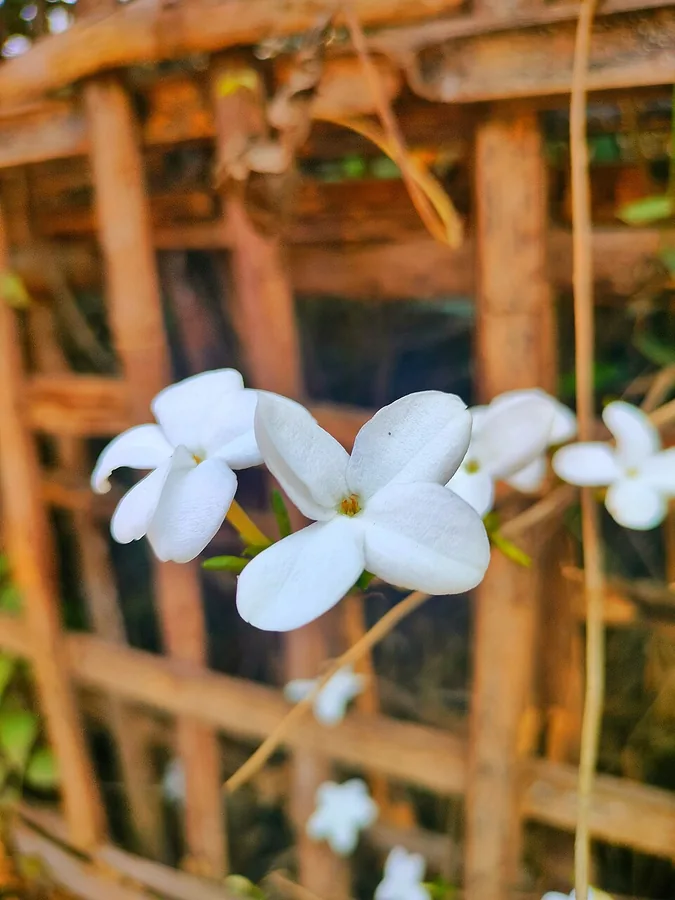
Common jasmine is a fast, twining shrub valued for the sweet white flowers it produces from summer into fall. A member of the olive family, it climbs vigorously once established and clears head height easily where winters stay mild. Trained against a wall or trellis, it converts a plain support into a sheet of fragrant bloom.
This is the true jasmine, the species prized by perfumers and tea makers, and it should never be confused with the toxic plants that trade on the name. In the open garden it performs across zones 7 to 10, and in colder regions it makes a dependable container plant moved indoors for winter. In either setting it demands bright light and something to climb.
What it needs is patience more than fuss. Steady moisture through the growing season, pruning at the correct moment, and feeding across spring and summer earn you months of evening fragrance. Deny it support or light and the result is a mass of leaves with few flowers, because both energy and bud-bearing structure depend on those conditions.
Care
The short version: full sun to part shade with something to climb, soil kept moist through the growing season, a monthly feed in spring and summer, and pruning done right after the flowers fade.
Light
Common jasmine flowers most heavily in full sun, while accepting partial shade and managing on bright indirect light indoors. Bloom scales with the amount of direct light it receives, so reserve the sunniest position you have for it.
Water
Hold the soil moist through the growing season, watering every 5 to 10 days as the surface dries. Established plants endure brief drought, but consistent moisture produces the strongest flowering. Cut back through the winter rest from October to March, when growth pauses and the plant needs far less.
Soil
Set it in moist, fertile, well-drained loam with generous organic matter worked through. It is relaxed about acidity, accepting a pH anywhere from 6.0 to 7.5.
Temperature
Its range is wide, enduring a hard 5°F (-15°C) at the low end and tolerating up to 100°F (38°C) in summer heat. That cold hardiness is precisely what allows it to grow outdoors through zones 7 to 10.
Humidity
Outdoors it makes no demands, but indoors it expects high humidity, ideally 50% or more. Dry household air is the very condition that lets spider mites build up, so a humid position keeps the plant in better health.
Feeding
Feed monthly through spring and summer with a balanced liquid fertilizer. Move to a phosphorus-heavy formula when you want more flowers, since phosphorus supports bloom, and stop feeding once growth slows for winter.
Pruning
Prune right after flowering and never before, because jasmine blooms on old wood and early cuts carry the buds away with them. It takes hard pruning in stride, so cut back firmly to manage its size and shape. Indoor plants need that hard pruning together with a trellis to climb.
Repotting
Container plants want repotting every 1 to 2 years in spring. Watch for roots circling the pot or pushing through the drainage holes, water running straight through, and slowing growth, each a sign the plant has outgrown its pot.
Size & spacing
Given room and time, it climbs 20 to 40 feet (6 to 12 m) tall and spreads 7 to 15 feet (2.1 to 4.6 m) wide. Allow for a strong support and ample space, because this is a vigorous climber rather than a compact shrub.
When to plant
Common jasmine works to the warm half of the year. Plant young specimens out in spring once the last frost has passed, allow them to climb and bulk up through the warm months, and the fragrant flowers follow from summer into fall.
Northern hemisphere
Southern hemisphere
Typical months for a temperate climate: start earlier in warm zones, later where spring frosts linger.
- Plant: spring, after the last frost
- Harvest: summer into fall
Hardiness
USDA hardiness zones: 7–10
Temperature: down to -18°C
Troubleshooting
Nearly all jasmine problems come down to one of two things: a pest taking hold or a plant that refuses to flower. Each reveals itself plainly once you know the signs, and each responds to treatment. Match what you observe below, then act before the plant loses ground.
Tacky shoot tips, twisted new leaves, and soft insects working the stems
Those symptoms point to aphids or mealybugs draining sap from the softest growth, and the sticky honeydew they excrete is what feeds the sooty mold that follows. A firm jet of water dislodges the bulk of a light population, after which insecticidal soap or horticultural oil smothers the rest by coating their bodies. Mealybugs tuck into the leaf joints where sprays miss them, so reach those with a cotton swab of rubbing alcohol and treat again each week until the cycle breaks.
Fix:
- Spray off light infestations with a strong stream of water
- Apply insecticidal soap or horticultural oil to coat the pests
- Dab mealybugs with a cotton swab dipped in rubbing alcohol
- Repeat treatment weekly until controlled
Stippled yellow foliage paired with fine webs or waxy crusts
Warm, dry indoor conditions favor spider mites because they reproduce fastest in low humidity, while scale and whitefly announce themselves as fixed waxy bumps or drifting clouds of small fliers. Lifting the humidity and rinsing the leaves removes mites and the dust they thrive in, and horticultural oil or insecticidal soap finishes them when worked into the leaf undersides where they feed. Scale yields to an alcohol-dipped swab, and a few follow-up rounds clear any survivors.
Fix:
- Raise humidity and rinse foliage to discourage spider mites
- Apply horticultural oil or insecticidal soap, coating leaf undersides
- Scrape or wipe off scale with alcohol-dipped swabs
- Repeat applications as directed until pests are gone
Plenty of leaf, almost no bloom
Vigorous foliage with no flowers almost always traces back to too little light, mistimed pruning, or excess nitrogen. Because jasmine sets its buds on old wood, any cut made before bloom removes the exact growth that would have carried the flowers. Relocating it to a brighter, warmer position drives flowering, holding the shears until after bloom protects the bud-bearing wood, and a phosphorus-heavy feed shifts the plant from leaf production back toward flowers.
Fix:
- Move the plant to a brighter, warmer location with plenty of direct light
- Prune only after flowering to preserve old growth that carries blooms
- Switch to a fertilizer higher in phosphorus and lower in nitrogen
Toxicity
The verdict here is reassuring: true jasmine is safe. The ASPCA classifies Jasminum species as non-toxic to cats, dogs, and horses, so it can go where pets and children spend time. The single genuine caution is identity, because toxic look-alikes such as Carolina jessamine borrow the jasmine name, so verify the botanical name before you buy.
Safe for
People · Cats · Dogs · Horses · Rabbits · Livestock · Birds
Cats None
The ASPCA places true jasmine on its safe list, so a cat that chews a leaf or paws at the flowers takes no toxic harm.
Dogs None
No part of true jasmine is poisonous to dogs, so brushing through the stems or chewing a stray vine causes them no trouble.
Horses None
This plant does horses no harm. The ASPCA clears true jasmine for them along with cats and dogs.
Rabbits Safe
True jasmine carries no toxic risk for a rabbit that nibbles the foliage, though any rich green is best offered in moderation.
Livestock Safe
Grazers such as goats, sheep, and cattle face no poisoning from true jasmine should they reach the vine.
Birds Safe
Birds run no chemical risk from the plant, whether they roost among the climbing stems or peck at the blooms.
People Safe
Nothing in this plant is toxic to people. Its fragrant flowers are used to scent tea, so a household with children has no cause for worry.
Safe around pets and children. Be sure the plant is a true Jasminum and not a toxic look-alike such as Carolina jessamine (Gelsemium sempervirens), which is highly poisonous.
Varieties
Common jasmine is offered in a handful of named forms, and several of its relatives reach the market under the jasmine name as well. These are the ones worth telling apart.
'Affine' (also sold as 'Grandiflorum')
This selection bears larger flowers, frequently pink-flushed while still in bud, and releases a notably stronger scent.
'Fiona Sunrise' ('Frojas')
Its golden-chartreuse foliage frames the fragrant white flowers, reading brighter in the garden than the plain species.
'Inverleith'
Strong red flushing runs through both the buds and the open flowers, giving it more color than the white-flowered forms.
Jasminum sambac (Arabian jasmine)
A tender relative with rounded leaves, this is the species that supplies the flowers for jasmine tea, but it lacks cold hardiness.
Jasminum nudiflorum (winter jasmine)
Yellow flowers open along bare green stems in late winter, but the species offers no fragrance.
Jasminum polyanthum (pink jasmine)
A popular indoor jasmine whose pink buds open into very fragrant white flowers.
How to propagate
Common jasmine multiplies readily, whether you root a summer cutting or peg a low stem to the soil and let it root where it lies.
Stem cuttingsModerate
Summer, from semi-ripe current-season growth · 4-8 weeks to root
Take semi-ripe cuttings from the current season's growth in summer, dip the cut ends in rooting hormone, and hold them in warm, humid conditions that prevent the cutting from drying before it can root. New roots usually form in about 4 to 8 weeks, though the process rewards a careful hand.
LayeringEasy
Spring to summer · A few months to one season
Layering is the simplest method. Pin a low, pliable stem against the soil in spring or summer so it roots while the parent keeps feeding it, then sever it once it has rooted firmly, generally within a few months to a full season.
Myths
Any plant called jasmine is the same safe, fragrant true jasmine.
The name jasmine belongs properly to Jasminum species alone, yet several toxic plants borrow it. Carolina jessamine (Gelsemium sempervirens) is poisonous throughout, and star or Confederate jasmine (Trachelospermum) and night-blooming jasmine (Cestrum) are entirely separate plants. Check the botanical name before you trust that a jasmine is harmless.
Jasmine flowers are poisonous and should be kept away from pets.
That worry stems from mistaking it for its toxic look-alikes. True jasmine, including Jasminum officinale, sits on the ASPCA's non-toxic list for cats, dogs, and horses, which makes it a sound choice around animals.