Shrub · Oleaceae
Common Lilac
Syringa vulgaris
Site it in full sun with open air around the canopy, and the common lilac returns decades of heavy spring fragrance.
Full sun
Every 7–14 days
USDA 3–7
8–16 ft · 2.4–4.9 m
Overview
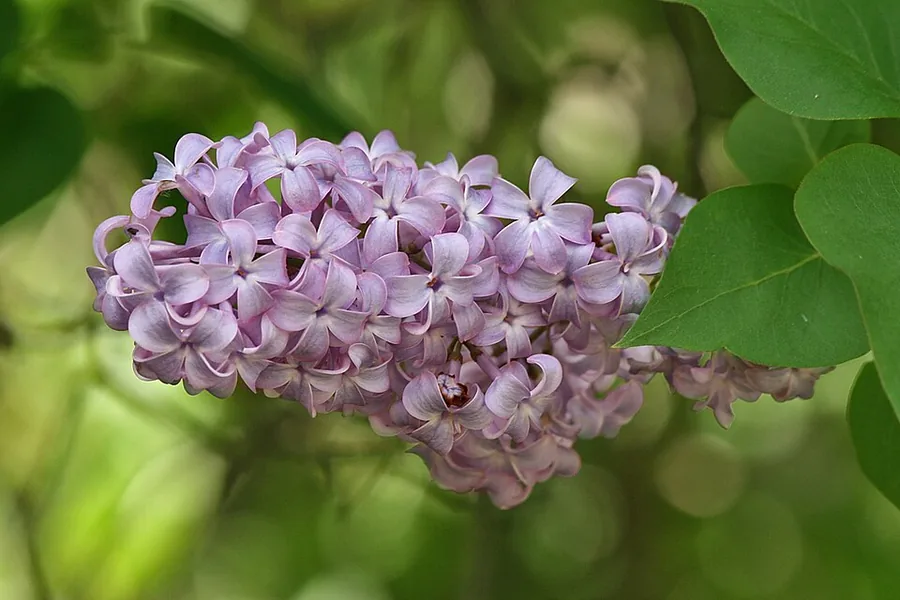
Common lilac is a hardy deciduous shrub in the olive family, grown above all for the fragrant panicles it produces in mid to late spring. Unpruned, it develops into a tall, multi-stemmed specimen of 8 to 16 feet (2.4 to 4.9 m) with a broad, suckering base. Its longevity is considerable, which explains why lilacs planted at old farmsteads frequently persist long after the buildings around them have gone.
The cultural requirements are modest but specific. Full sun drives flowering, a soil reaction on the neutral to slightly alkaline side suits its physiology, and open air movement around the foliage limits disease. The point that governs everything else is that flowers form on old wood: the current season's bloom was initiated on the previous year's growth, so the timing of pruning determines the following year's floral display.
Flower color spans classic lilac purple, deep violet, wine-red, and pure white according to cultivar. Given adequate sun and spacing the shrub is largely self-sufficient, and only powdery mildew and the occasional borer rise to the level of genuine problems.
Care
The short version: full sun, a fertile well-drained soil held near neutral to slightly alkaline, deep but infrequent irrigation, and pruning carried out as the flowers fade so the developing buds for next season are not removed.
Light
Flowering is maximized in full sun, defined as six or more hours of direct light daily. The shrub persists in partial shade, but at the cost of bloom, and reduced light also predisposes the foliage to the powdery mildew that disfigures it.
Water
Irrigate deeply and infrequently. An established lilac requires water only every 7 to 14 days during dry periods, reflecting its medium moisture demand and intolerance of saturated soil. Persistent wetness induces root rot and markedly depresses flowering.
Soil
Grow it in fertile, organically rich loam with free drainage. The species performs best at a soil reaction on the neutral to slightly alkaline side, a pH of 6.5 to 7.5, in contrast to the many shrubs that require acidic conditions.
Temperature
This is a decidedly cold-climate species, tolerant across -40°F to 95°F (-40°C to 35°C). The severe winter cold is not merely survivable but functionally necessary, since the plant requires a cold dormancy to flower reliably.
Humidity
Ambient outdoor air is adequate, so no humidity target applies. The controlling variable is air movement, because stagnant, humid air within a congested canopy is what permits powdery mildew to establish.
Feeding
As a light feeder that blooms in average soil, the lilac should be fertilized rarely and only in early spring where warranted. Apply a low-nitrogen balanced fertilizer and exclude lawn feed, since surplus nitrogen promotes foliage at the expense of flowers.
Pruning
Timing is decisive because the plant blooms on old wood. Prune and deadhead immediately after flowering so buds can set for the following year, and periodically rejuvenate an aging specimen by removing about a third of the oldest stems to the base.
Repotting
Lilac is adapted to open ground and is seldom containerized. A potted plant signals that it has exhausted its container when roots circle the pot and water drains too rapidly, but in a bed repotting is essentially never required.
Size & spacing
Allow generous room, as the shrub matures to 8 to 16 feet (2.4 to 4.9 m) in height and 6 to 12 feet (1.8 to 3.7 m) in spread. Adequate spacing sustains air movement and suppresses mildew.
When to plant
Lilac management follows a straightforward seasonal sequence. Establish new plants in spring or fall under cool conditions, anticipate bloom in mid to late spring, and confine pruning to the narrow interval immediately after those flowers fade.
Northern hemisphere
Southern hemisphere
Typical months for a temperate climate: start earlier in warm zones, later where spring frosts linger.
- Plant: Spring or fall
- Harvest: Mid to late spring (typically May)
Hardiness
USDA hardiness zones: 3–7
Temperature: down to -40°C
Troubleshooting
A lilac grown in full sun presents few problems, and the two that occur are readily diagnosed. Inspect the foliage in late summer and the lower trunk over the season, then correlate the symptoms with the entries below.
Frass and tunneling low on the trunk with dieback above
These wounds are the work of the lilac borer, the larval stage of a clearwing moth that mines the stems and trunk near the soil line. Diagnosis rests on roughly quarter-inch exit holes, expelled frass, and the extruded pupal skins that concentrate low on the plant. Because the larvae favor stressed wood, the durable control is vigor: excise infested stems to the base, keep the shrub well watered, and reserve a bark insecticide for the spring egg hatch when reinfestation persists.
Fix:
- Prune out and destroy infested and weak stems back to the base
- Reduce plant stress with proper watering and care
- Apply a labeled bark insecticide (e.g., permethrin or bifenthrin) timed to egg hatch in spring
Grayish-white fungal film across the foliage in summer
The coating is powdery mildew, a fungus that colonizes leaf surfaces where humidity is high and air movement is poor, which is why shaded, crowded lilacs show it most. Because the infection is superficial and leaves keep functioning, it stays cosmetic on a healthy plant. Open the canopy to restore airflow, remove the worst-hit leaves, and hold any labeled fungicide in reserve for cases where appearance alone justifies it.
Fix:
- Improve air circulation by thinning and spacing plants
- Remove and dispose of severely affected leaves
- Apply a labeled fungicide only if appearance is a concern
Toxicity
For households with pets or children the verdict is favorable: common lilac is safe. Syringa vulgaris is not toxic to cats, dogs, horses, or people, and the greatest effect from a large ingestion of leaves is a mild, transient digestive upset. It should not be conflated with the unrelated and genuinely toxic Persian lilac, which is in fact Chinaberry.
Safe for
People · Cats · Dogs · Horses · Rabbits · Livestock · Birds
Cats None
No toxic principle in the foliage acts on cats, so contact or a small nibble produces no clinical effect. The species carries nothing that would harm them.
Dogs None
The plant holds no compound that poisons dogs, so chewing a fallen leaf or bloom is inconsequential. Ingesting a large volume of plant material may at most provoke transient gastrointestinal upset.
Horses None
Horses may graze near a lilac without toxic consequence. A large intake of foliage can bring on mild, self-limiting digestive upset and nothing of greater concern.
Rabbits Safe
The leaves and stems contain no principle that affects rabbits, so prunings placed near a hutch present no hazard.
Livestock Safe
Cattle, goats, and sheep can share ground with lilac shrubs safely, as the foliage carries no poisoning risk for grazing stock.
Birds Safe
Backyard and pet birds face no toxic exposure from a lilac, whether they perch among the branches or sample a flower.
People Safe
Lilac presents no poisoning hazard to children or adults, and the blooms are on occasion used to scent or flavor food.
No special handling required; keep clippings out of reach of grazing animals as a general precaution.
Varieties
The lilacs offered commercially are almost all named cultivars selected for flower color and form. A limited number recur in the trade, and those are the ones most worth knowing.
Sensation
The diagnostic trait is a crisp white margin outlining each purple floret, which lends the trusses their bicolored definition.
Ludwig Spaeth
This long-established cultivar is identified by single florets in a deep reddish purple that approaches a wine-dark tone.
Agincourt Beauty
It is recognized by very large single deep-violet florets massed into oversized trusses for exceptional display.
Angel White
Pure white florets paired with a low chill requirement allow it to flower reliably where milder winters suppress bloom in other lilacs.
How to propagate
Lilac propagates readily, and the suckering habit that some gardeners regard as a nuisance is precisely what makes vegetative increase so easy.
DivisionEasy
Early spring or fall · 1-2 seasons
The simplest route exploits the plant's natural suckering: lift the rooted basal shoots and detach them in early spring or fall. Because the divisions must regenerate a root system, allow each one a season or two to establish before appreciable growth follows.
Stem cuttingsModerate
Spring (softwood) · Several weeks to root
Softwood cuttings taken in spring will initiate roots over several weeks, though the success rate is inconsistent. Since a proportion invariably fails, strike more cuttings than the number of plants required.
LayeringEasy
Spring to summer · One growing season
In layering, a low branch is bent to the ground and pinned from spring through summer, where it forms adventitious roots over a single growing season. Once rooted, sever it from the parent and transplant the new plant.
GraftingDemanding
Dormant season · One growing season
Grafting is a dormant-season technique used chiefly in the nursery trade to propagate select cultivars, and the union requires a growing season to consolidate. Grafted specimens tend to emit understock suckers from below the graft, which should be rubbed out as they emerge.
Myths
Lilacs are toxic to dogs and horses.
The true lilac, Syringa vulgaris, is non-toxic and safe among pets and grazing animals. The error arises from the so-called 'Persian lilac,' a common name applied to Chinaberry (Melia azedarach), an unrelated species whose meliatoxins produce vomiting, weakness, and seizures. The ASPCA listing refers to that toxic species, not to the common lilac growing in the garden.