Ornamental · Poaceae
Oats
Avena sativa
A rapid, resilient cool-season cereal that serves at once as cover crop, forage grain, and the pet grass grown for cats.
Full sun
Every 3–7 days
60–120 days
USDA 2–9
Overview
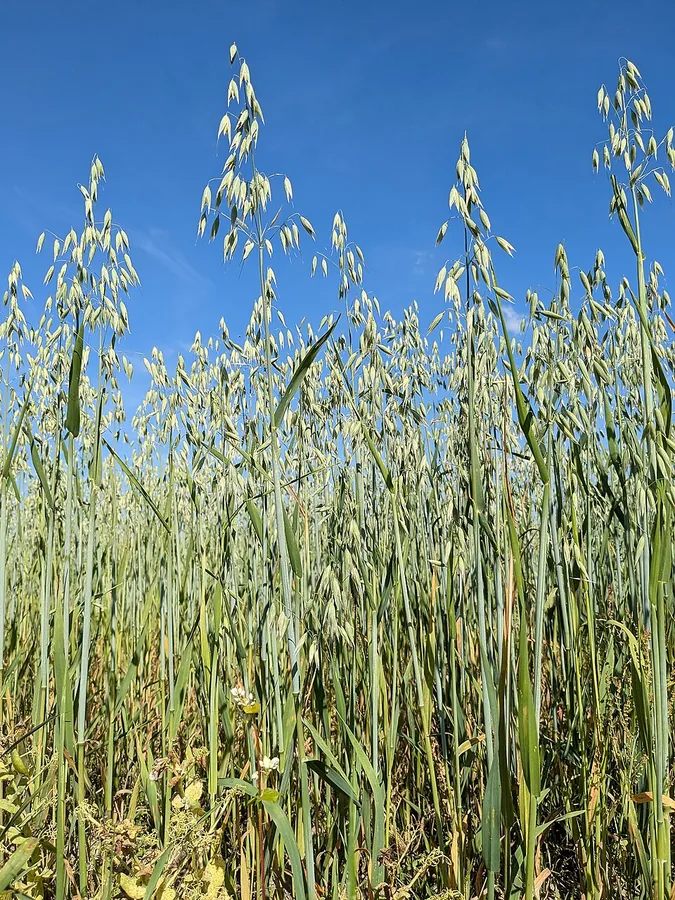
Oats rank among the most tractable grasses in cultivation, which explains the breadth of roles they fill. A single species, Avena sativa, functions as a cover crop, livestock forage, the grain in your breakfast bowl, and the cat grass raised for pets to nibble. Nothing but seeding method and management separates one use from another.
As a cool-season annual, oats perform best under cool, moist conditions and decline sharply in heat and drought. The plant establishes fast, produces early weed-suppressing cover, and scavenges loose soil nutrients before leaching removes them. Growers commonly interplant it with a slow legume such as peas or clover, where the oats function as a nurse crop, sheltering the seedlings and then dying back to release the stand to the legume.
Where winter cold reaches a lethal threshold, oats terminate themselves and spare the grower a killing operation. Where it does not, the stand overwinters and sets seed, so mowing or tilling before heading becomes necessary. Determining which side of that threshold a site falls on is the most consequential decision before sowing, because it governs the entire termination plan.
Care
The short version: oats perform best in full sun on cool, moist soil, with little or no supplemental feeding. Sow the seed directly into the ground, keep it from drying out, and guard against warm winters that allow the stand to reseed.
Light
Oats require full sun and yield best in open, unshaded ground, because full irradiance drives the dense tillering that carries the stand. They tolerate limited partial shade, but beyond that the stand thins and loses vigor.
Water
As a cool-season grass, oats favor cool and moist conditions and cope poorly with heat or drought. Maintain steady soil moisture, since drought stress suppresses both cover development and grain yield.
Soil
Oats are unusually adaptable among cereals. They prefer a well-drained loam yet tolerate poor, somewhat acidic, and even wet soils better than most grains, performing across a pH span of 4.5 to 8.0.
Temperature
This cool-weather plant grows across a broad thermal range, from about 21°F to 84°F (-6°C to 29°C). It germinates in chilly soil and accomplishes most of its growth before summer heat sets in, consistent with its cool-season habit.
Humidity
Ambient outdoor humidity meets the crop's needs, so no target figure applies. Airflow is the more relevant factor, because crowded, damp stands raise the incidence of rusts and other foliar diseases.
Feeding
Oats have low nutrient demand, and as a cover or nurse crop they often require no fertilizer at all, particularly in fall or legume-mix seedings. Restrict nitrogen, because excess produces lush growth that lodges.
Pruning
The crop needs no pruning in the conventional sense. In mild-winter regions, mow or till the stand before seed set to prevent weedy volunteers, whereas in cold climates it winterkills and requires no termination.
Repotting
none
Size & spacing
A mature stand reaches about 2 to 4 feet (60 to 122 cm) in height, with each plant occupying only 6 to 12 inches (15 to 30 cm) across. Seed at a high density, since oats are grown as a close stand rather than spaced like a garden vegetable.
When to plant
Oats key their development to cool weather and the frost calendar. Sow in late summer to early fall, about 40 to 60 days before the first killing frost so the cold can terminate the stand, or sow again in early spring. Heading follows in spring to summer, with grain ready to harvest by mid to late summer.
Northern hemisphere
Southern hemisphere
Typical months for a temperate climate: start earlier in warm zones, later where spring frosts linger.
- Sow: Not typical; direct sown outdoors
- Plant: Late summer to early fall (40 to 60 days before first killing frost, to winterkill) or early spring
- Harvest: Open drooping branched panicle of spikelets in spring to summer; grain harvest mid to late summer
Hardiness
USDA hardiness zones: 2–9
Temperature: down to -46°C
Troubleshooting
Oats present few problems, particularly under short-term cover cropping. Because the crop grows as a dense stand, the disorders that do arise register across the whole planting rather than on an individual plant. Diagnose against the entries below and intervene before the problem advances.
Grazing ruminants such as cattle, sheep, and goats fall ill on stressed forage
The plant is not intrinsically toxic; the hazard is a metabolic one. Under drought, frost, or heavy nitrogen fertilization, oat forage accumulates nitrate, and that nitrate is what sickens grazing ruminants such as cattle, sheep, and goats. Because the risk rides on stress and fertility, test suspect or heavily fed forage before grazing, keep animals off drought- or frost-stressed stands, and note that ensiling drives nitrate down. The standing plant and the harvested grain remain safe for pets and people.
Fix:
- Test stressed or heavily fertilized forage for nitrate before grazing or feeding
- Ensiling can reduce nitrate levels
- Avoid grazing drought- or frost-stressed stands
Oats overwinter and set seed instead of dying back
Termination here depends on cold, and a mild winter simply fails to deliver it, so the stand resumes growth, produces seedheads, and drops seed that volunteers the next season. Reliable winterkill occurs only in Zone 6 and colder and through much of Zone 7, where temperatures fall low enough to kill the tissue. In any warmer zone the frost cannot be trusted to end the crop, so the stand must be mowed or tilled before seed set.
Fix:
- Mow or till the stand before seed set
- Terminate by herbicide or mowing soon after the vegetative stage
- Do not rely on winterkill termination in mild-winter areas
Rust-colored pustules, sooty powder, or yellowed, dwarfed foliage
These symptoms track the standard cereal pathogens. Crown and stem rust erupt as orange-brown pustules, smut produces dark powdery spore masses, and barley yellow dwarf virus, transmitted by aphid feeding, yellows and reddens the foliage while suppressing growth. Because the pathogens persist on related hosts, rotation away from other cereals breaks the cycle, and clean or resistant seed plus aphid control limits the virus. Grown as a short-term cover crop, the stand rarely accumulates enough infection to matter.
Fix:
- Rotate away from cereals
- Use clean, treated, or resistant seed where available
- Control aphids that vector barley yellow dwarf
Tall stems bow down and sprawl flat over the soil
Collapsed stems signal lodging, a structural failure driven by soil that is too rich or has received too much nitrogen. The surplus nitrogen fuels lush, top-heavy shoots that outrun the strength of the stem, so a heavy rain or a gust brings the stand down. For that reason, withhold extra nitrogen when growing oats as a cover or nurse crop. Where grain is not the aim, a lodged stand carries no penalty and still suppresses weeds and lays down a useful mulch.
Fix:
- Avoid extra nitrogen fertilizer when grown as a cover or nurse crop
- Mow tall growth before it lodges if managing biomass
Toxicity
Oats sit at the safe end of the toxicity scale. The grain nourishes both people and animals, and the grass is cultivated deliberately as cat grass for pets to nibble, so no part poses a hazard to cats, dogs, horses, rabbits, birds, livestock, or children. The single qualification concerns grazing ruminants, in which drought- or frost-stressed forage can carry nitrate that warrants testing.
Safe for
People · Cats · Dogs · Horses · Rabbits · Livestock · Birds
Cats Safe
Oat grass is the reference cat grass, cultivated expressly for cats to nibble. Light chewing carries no toxicity and can assist a cat in passing a hairball.
Dogs Safe
Dogs graze the blades without adverse effect, and the pet grass marketed for cats serves them equally. Neither plain oats nor oat grass appears on any toxic-plant list.
Horses Safe
Oats have functioned as an equine feed grain for generations, and horses graze the grass without harm. No part of the plant is toxic to them.
Rabbits Safe
Oat hay and fresh oat grass suit rabbits well and figure as a normal element of their diet.
Livestock Safe
The plant itself is wholesome, non-toxic forage. The sole qualifier is nitrate, which accumulates in oats stressed by drought, frost, or heavy nitrogen, so test suspect forage before turning ruminants onto it.
Birds Safe
Oats function as a standard bird feed, and chickens and wild birds consume the grain and pick at the grass without restriction.
People Safe
The grain is a dietary staple, prepared as oatmeal, oat flour, and more. The plant is cultivated for human consumption.
Like other cereal grasses, drought- or frost-stressed oat forage can accumulate nitrates that may harm grazing ruminant livestock, but the plant is not poisonous to pets or people.
Varieties
Oat cultivars sort by growing season and end use, and the following types are the ones worth distinguishing.
Spring oats
The predominant type, sown in spring or late summer, which reaches heading without vernalization and winterkills once hard frost sets in.
Winter oats
Cold-hardier types adapted to mild-winter regions, where they persist through the cold season and head the following spring.
Forage / hay oat varieties
Selected for abundant leafy biomass, such as ForagePlus, and cut for hay, silage, or grazing in place of grain.
Hull-less (naked) oats
These thresh free of the hull to yield a bare groat valued in both feed and food channels.
Companions
Oats earn their keep beside slow-starting legumes, where they nurse the young plants along and then bow out as the season turns.
Plant near
Field peas: Oats serve as a nurse crop, providing quick weed-suppressing cover and support while the slower legume establishes.
Clover: Oats nurse establishing clover, suppressing weeds and scavenging nutrients while winterkilling to release the legume.
Hairy vetch: Oats added to slow-establishing vetch improve legume survival and provide cover that winterkills in many areas.
How to propagate
Oats reproduce by seed exclusively, direct sown into the position where the crop is to grow.
SeedEasy
Late summer to early fall or early spring · Germinates quickly (germinates at about 38 degrees F); usable cover in 6 to 10 weeks
Oats propagate by seed alone, direct sown outdoors in late summer to early fall or in early spring. Drill the seed at about 60 to 75 pounds an acre, or broadcast 80 to 100 pounds an acre, placed half an inch to an inch deep. Because germination proceeds in cool soil down to about 38°F (3°C), the stand establishes early and reaches usable cover in 6 to 10 weeks, which accounts for its standing as a quick, inexpensive, dependable crop to establish.
Myths
Oats grown as a cover crop form a botanically distinct plant from grain oats and from oat grass marketed as cat grass.
Botanically they are indistinguishable. Cover-crop oats, forage and hay oats, grain oats, and the grass grown for cats to nibble are all the same species, Avena sativa. Only the seeding method and subsequent management differ.
Oats invariably winterkill and self-terminate, so deliberate killing of the stand is never required.
Self-termination is contingent on temperature. Oats winterkill only where the cold reaches a lethal threshold, roughly Zone 6 and colder and much of Zone 7, down into the low 20s degrees F. In milder regions the stand survives and sets seed, which obligates a mechanical termination by mowing or tilling before heading.