Ornamental · Asteraceae
New England Aster
Symphyotrichum novae-angliae
Sited in full sun and pinched by midsummer, the New England aster carries the fall garden through the weeks when other perennials have finished.
Full sun
USDA 4–8
3–7 ft · 0.9–2.1 m
Overview
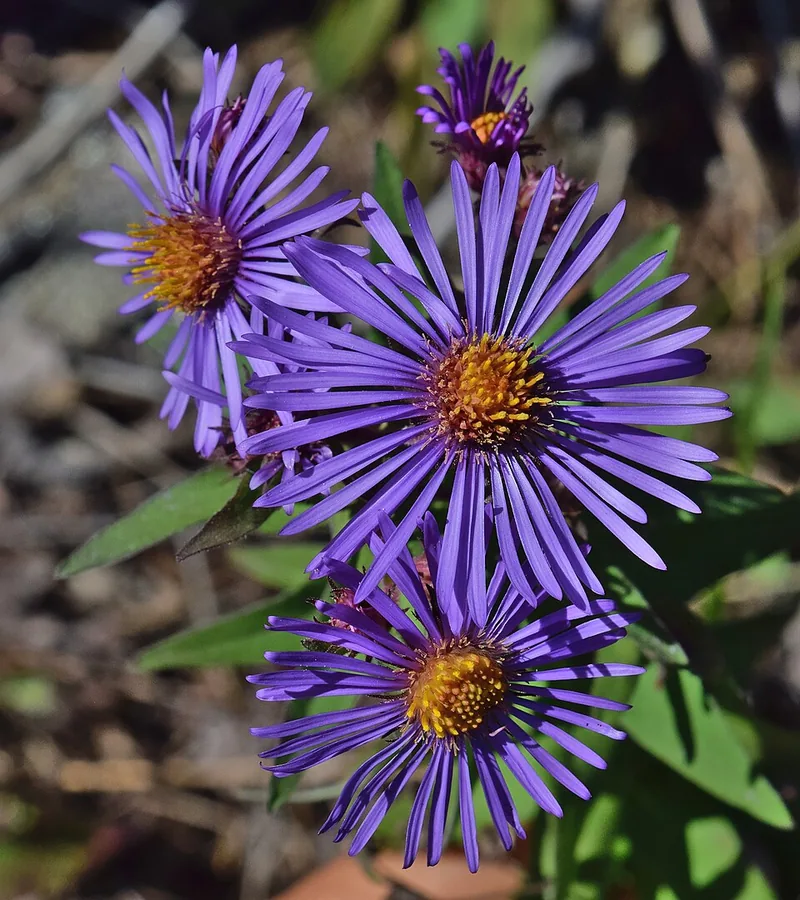
The New England aster is a native herbaceous perennial whose value lies in when it performs rather than how long. As the surrounding planting declines, it comes into bloom with purple, pink, and ruby ray flowers from late summer through fall. A member of the Asteraceae alongside sunflowers and true daisies, it colors roadsides and moist meadows violet across its native range each September.
Growth is fast and the mature scale is substantial, so placement matters. Stems reach 3 to 7 feet (90 to 210 cm) and the clump expands outward season by season, which argues for a back-of-border position in fertile, moisture-retentive ground. Hardiness extends to zone 4, and the species tolerates heavy clay that would defeat many perennials.
Its defining trait is phenological. Flowering coincides with the southward monarch migration and the pre-hibernation feeding of bumble bee queens, which makes it one of the most significant late-season nectar sources available in a temperate garden. Established once and pinched in summer, it returns with increasing vigor each year.
Care
The short version: full sun, fertile soil kept evenly moist over reliable drainage, and repeated pinching before mid-July to hold the tall stems self-supporting. Flowering falls in autumn and sustains pollinators once most other nectar has run out.
Light
Site it in full sun for maximum flower production and the strongest stems, since light drives both. Light afternoon shade is tolerated, but under heavier shade the plant etiolates, leaning as it stretches for light and flowering far less.
Water
Hold the soil evenly moist, particularly through dry spells, or the lowest leaves abscise and brown as the plant sheds them under stress. It favors rich, damp ground and accepts clay, which fits a rain garden, provided drainage stays sound so aster wilt does not gain a foothold.
Soil
Grow it in rich, fertile soil high in organic matter, from good loam through to heavy clay. The single intolerance is standing water, which suffocates the roots, so choose ground that drains freely even while it retains moisture.
Temperature
This is a cold-hardy perennial rated from -29°F to 95°F (-34°C to 35°C) and reliable across zones 4 through 8. It dies back to the crown each winter and regenerates from the rootstock in spring, so the winter dormancy is expected rather than a failure.
Humidity
Ambient outdoor humidity suits it, so no target figure applies. Air movement is the governing factor, because static, humid air trapped among crowded stems creates the leaf-surface conditions powdery mildew needs to establish.
Feeding
Its nutrient demand is low. A single light application of a balanced or compost-based fertilizer across the growing season meets it. Keep the nitrogen restrained, since surplus nitrogen forces soft, elongated stems that lodge.
Pruning
Pinch the stems repeatedly before mid-July to reduce height, induce branching, and remove the need for staking. Once frost blackens the top growth, cut the plant to ground level, as the crown carries it through winter.
Size & spacing
Mature stems stand 3 to 7 feet (90 to 210 cm) tall while each clump occupies 24 to 35 inches (60 to 90 cm) of width. Allow that full spread so air circulates through the stand and the leaf surfaces stay dry enough to deter mildew.
When to plant
The species is governed by a late-season schedule. Establish plants in spring after the last frost or in early autumn, pinch through early summer to build a stouter frame, and flowering follows from late August into October.
Northern hemisphere
Southern hemisphere
Typical months for a temperate climate: start earlier in warm zones, later where spring frosts linger.
- Sow: Late winter to early spring; seed germinates more reliably after cold stratification
- Plant: Spring after last frost, or fall
- Harvest: August to October
Hardiness
USDA hardiness zones: 4–8
Temperature: down to -34°C
Troubleshooting
Nearly every disorder in this aster reduces to two drivers: excess moisture in crowded, poorly ventilated conditions, and unsupported height. Both announce themselves early on the foliage and stems, which leaves time to intervene before a clump deteriorates. Match the presentation below and act while the response still changes the outcome.
Stems yellowing, wilting, and collapsing from the base upward
The pattern points to aster wilt, a Fusarium fungus that colonizes the vascular tissue and is most aggressive in wet, heavy clay that stays saturated. Since the pathogen blocks water movement from within the plant, no treatment reverses an established infection, so the affected plant must be lifted and destroyed. Correcting the drainage removes the waterlogging the fungus depends on, and siting new asters elsewhere avoids the inoculum left in the old ground.
Fix:
- Remove and destroy severely affected plants
- Improve soil drainage
- Avoid replanting asters in the same spot
A dusty white film advancing across the foliage
The coating is powdery mildew, a fungus that establishes where crowding and stagnant air raise humidity around the foliage, and it peaks in late summer as nights cool. Because the spores need still, humid conditions on the leaf surface, removing coated leaves and watering at the base rather than overhead denies them what they require. Widen the spacing and pinch the clump so air passes through, and the microclimate that favors the fungus never forms.
Fix:
- Improve spacing and air circulation
- Remove and discard affected foliage
- Avoid overhead watering
Tall stems leaning, splaying, or snapping
Rich soil and shade drive vegetative growth past 90 cm (35 inches), and stems this tall carry too much leaf and flower weight for their own strength, so they lean or split under rain. Pinching before mid-July removes the growing tips, which forces lower, branching growth and a shorter, stouter frame that supports itself. Where the tall form is wanted, staking early spreads the load, and a compact cultivar sidesteps the height entirely.
Fix:
- Stake or support taller plants
- Pinch back stems before mid-July to reduce height
Toxicity
The safety profile is straightforward for households with pets or children. The New England aster is not toxic to cats, dogs, horses, or people, and the ASPCA classifies asters as safe. A large mouthful may cause a mild, transient stomach upset from bulk, but no poisonous compound is involved.
Safe for
People · Cats · Dogs · Horses · Rabbits · Livestock · Birds
Cats None
Non-toxic to cats. A curious bite may provoke light drooling or a brief gastric upset, a mechanical response any fibrous plant can cause, since the aster itself carries no poisonous compound.
Dogs None
No toxic principle is present for dogs. Chewing a few flowers or leaves may bring on a short episode of mild digestive upset and nothing more serious.
Horses None
Horses may graze near it without hazard. The plant contains no compound capable of poisoning them, so an incidental mouthful carries no consequence.
Rabbits Safe
Rabbits browse the foliage without harm. Asters appear consistently on documented lists of plants that domestic and wild rabbits consume without ill effect.
Livestock Safe
Cattle, goats, and sheep graze it with no poisoning risk. The plant holds none of the compounds that would injure ruminant livestock.
Birds Safe
Birds face no toxic risk from the plant. Many exploit the seed heads through fall and winter, and the late flowering draws the insect prey they forage on.
People Safe
Not poisonous to people. It is cultivated strictly as a garden ornamental rather than a food crop, so there is no occasion to eat it, though handling presents no toxic risk.
Varieties
Most gardeners select a named cultivar chosen for improved flower color or a more restrained habit. The three below are the ones worth knowing.
Purple Dome
A compact, self-mounding selection that reaches roughly 2 feet of deep purple flower and remains upright without the pinching or staking taller forms demand.
September Ruby (Septemberrubin)
A taller-stemmed cultivar bearing large ruby-red ray flowers around bright yellow central disks.
Andenken an Alma Potschke
A vigorous, free-flowering plant densely set with bright rose-pink to salmon blooms.
How to propagate
New England aster propagates easily by two routes, division of an established clump or seed, each with its own timeline.
DivisionEasy
Spring or early fall, every 2 to 3 years · One growing season
Division is the most reliable method of propagation and doubles as routine maintenance. Lifting and splitting the clumps every 2 to 3 years in spring or early fall gives divisions that reestablish within a single growing season. The practice renews declining vigor, restrains the spread, and eliminates the bare, dead crown that develops as older clumps outgrow their center.
SeedEasy
Sow in late winter to spring; may self-seed in the garden · Blooms typically the second year from seed
Seed sown from late winter into spring succeeds, and a preceding cold period markedly raises germination by satisfying the seed's stratification requirement. Expect a lag, since seedlings generally reach flowering only in their second year. Self-sowing occurs readily in the garden, though seed-grown offspring segregate and may not match the parent.
Myths
New England aster is toxic to cats and dogs like many fall flowers.
The ASPCA classifies asters as non-toxic to cats, dogs, and horses. Ingesting a large mouthful may produce a mild, transient gastric upset from bulk alone, yet the plant contains no poisonous principle.
This aster blooms all summer long.
Flowering is held for the close of the season, running from roughly August into October. That deferred timing is precisely what gives the plant its ecological worth, supplying nectar to pollinators once most other sources have finished.