Houseplant · Crassulaceae
Mother of Thousands
Kalanchoe daigremontiana
An easy succulent that propagates itself along every leaf margin, and one to keep well away from pets.
Bright indirect
50–86°F · 10–30°C
USDA 9–11
12–35 in · 30–90 cm
Overview
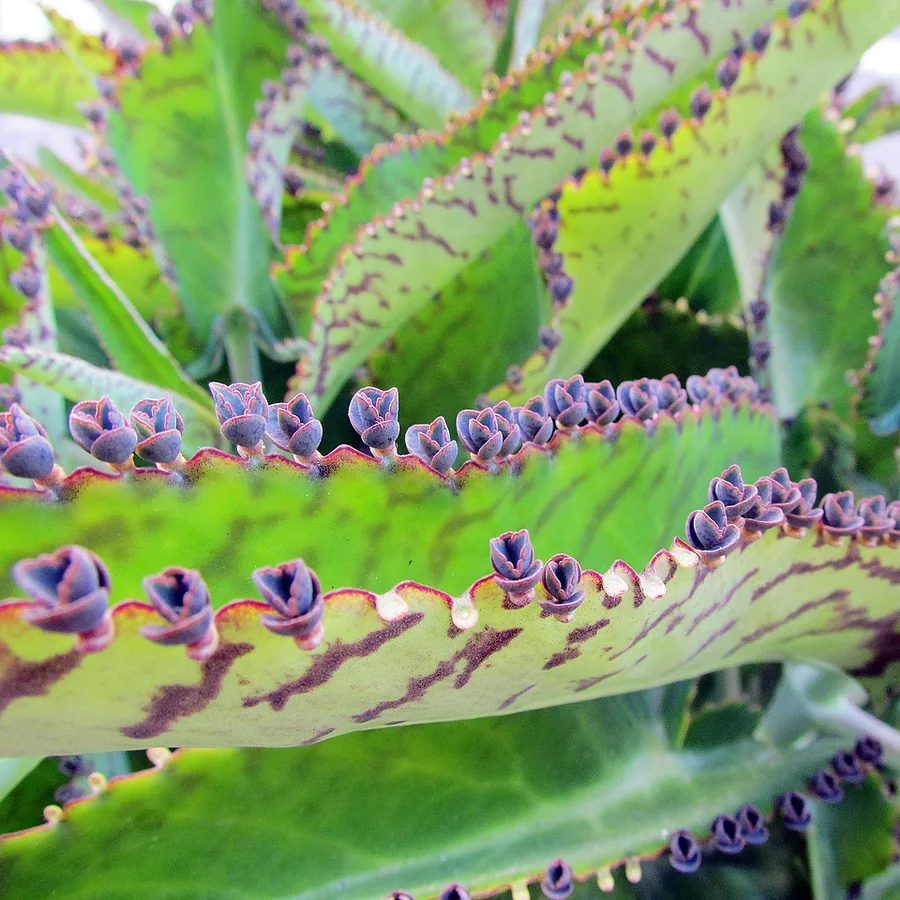
The name of mother of thousands describes its biology. Ranged along the scalloped margin of each leaf is a row of small, pre-rooted plantlets, a form of vegetative reproduction few houseplants match. Native to arid southwest Madagascar, it follows the succulent strategy of storing water in fleshy, blue-green leaves, which is why it demands so little at the tap.
In cultivation it is difficult to kill and quick to multiply. Provided a bright window and a free-draining pot, it develops into an upright plant of 12 to 35 inches (30 to 90 cm). The trait that makes it appealing is also its liability: the plantlets detach and root in any adjacent pot, so it spreads readily and has naturalized in warm regions where it was never intended to establish.
One property separates it from benign succulents such as jade. Every tissue contains bufadienolides, cardiac glycosides toxic to both animals and people. It remains a sound choice for a household without pets or small children, provided it is sited well beyond their reach.
Care
The short version: supply bright indirect light, a gritty fast-draining medium, and water only once the soil has dried completely. Feed sparingly through the growing season, hold it warm, and remove the plantlets before they colonize neighboring pots.
Light
Under bright indirect light it grows compact and holds good color. It tolerates some partial sun, but harsh afternoon exposure scorches the foliage, while inadequate light etiolates the stems and pales the leaves.
Water
Irrigate on the succulent model. Saturate the medium fully, then let it dry out completely before the next application, and reduce further during winter dormancy. Because standing moisture excludes oxygen at the roots, it is the direct route to the root rot this plant is prone to.
Soil
Grow it in a gritty cactus or succulent mix that sheds water within seconds. Conventional potting soil retains far too much moisture around the roots, so a container with a drainage hole is as important as the medium itself.
Temperature
Maintain it between 50°F to 86°F (10°C to 30°C), a range that most interiors meet year round. It has no frost tolerance, so return any summered specimen indoors well before cold sets in.
Humidity
Low humidity is its preference, so there is no target figure to meet and no reason to mist. The ordinary dry air of a heated room suits it better than any humid position.
Feeding
Fertilize modestly from spring through summer, about once a month, using a diluted balanced or cactus formulation. It performs on very little, so apply sparingly and suspend feeding through the winter rest.
Pruning
Pinch back elongated stems to restore form and remove spent flower stalks. The consequential task is stripping the tiny plantlets from the leaf margins before they detach, or self-sown offsets will appear in every neighboring pot.
Repotting
Step it up one pot size every 2 to 3 years, or when it becomes crowded. Roots emerging from the drainage holes, the plant lifting from its container, and water passing straight through all indicate the time has come.
Size & spacing
Indoors it attains 12 to 35 inches (30 to 90 cm) in height with a spread of 12 to 24 inches (30 to 60 cm). Allow some clearance so the shed plantlets do not root into whatever container stands alongside.
Troubleshooting
Almost every disorder in this species reduces to water or light. Excess of the first drowns the roots and rots them; a deficit of the second etiolates the shoot. Read the presentation below and correct the underlying cause, not merely the visible symptom.
Soft blackened stems and wilting over wet soil
Wilting above saturated soil is the signature of root rot, driven by overwatering in a mix that retains too much moisture and starves the roots of oxygen. Ease the plant from its pot and inspect for roots that are brown, soft, and foul-smelling. Excise all rotted tissue, repot into a dry gritty medium, and withhold water until the plant regains firmness.
Fix:
- Cut away all rotted tissue
- Repot into dry gritty succulent mix
- Withhold water until the plant recovers
White cottony masses and sticky residue on the foliage
The white cottony colonies lodged in the leaf axils are mealybugs, and the sticky residue is the excretion they leave as they feed. Touch each colony with a cotton swab charged with isopropyl alcohol, then apply insecticidal soap to reach the remainder. Examine any incoming plant and isolate it before it joins the collection, since that is how infestations arrive.
Fix:
- Wipe with isopropyl alcohol on a swab
- Treat with insecticidal soap
Dry brown scorch on the sun-facing leaves
Prolonged intense afternoon sun overwhelms the leaf tissue and scorches it, which is why the dry brown patches concentrate on the window-facing side. Relocate the plant to bright indirect light and away from the hot midday exposure. Where a brighter position is wanted, increase direct sun in stages so the foliage can acclimate rather than burn.
Fix:
- Move to bright indirect light
- Avoid the hot midday sun
Pale, elongated growth with widely spaced leaves
Under insufficient light the plant elongates in search of it and grows leggy, so stems pale and the internodes stretch far apart. Growth that leans toward the light source confirms the shortfall. Move it to a brighter position offering bright indirect light and rotate the pot at intervals so it develops symmetrically.
Fix:
- Move to a brighter spot with bright indirect light
- Rotate the pot periodically
Toxicity
Regard this plant as toxic to every animal in the household. All of its tissue holds bufadienolides, cardiac glycosides that induce salivation, vomiting, and diarrhea, and in any appreciable dose can disturb cardiac rhythm. No part is edible and the sap can irritate skin, so site it well beyond the reach of pets and small children.
Toxic to
Cats · Dogs · Horses · Rabbits · Livestock · Birds · People
Cats Toxic
A cat that ingests leaf tissue typically shows salivation and vomiting, followed by loose stools. The greater hazard lies in a larger dose, where the bufadienolides can disrupt cardiac rhythm.
Dogs Toxic
In dogs, pronounced salivation, vomiting, and diarrhea develop within a few hours of ingestion. Because a substantial dose carries the same arrhythmia risk, veterinary contact is warranted rather than a wait-and-see approach.
Horses Toxic
Horses are especially sensitive to the cardiac glycosides. Salivation and gastrointestinal upset present first, and a meaningful dose can derange the heartbeat to a life-threatening degree.
Rabbits Toxic
Exclude rabbits from any access. The same toxin disturbs the digestive tract and taxes the heart, and a small-bodied animal requires only a modest amount to be affected.
Livestock Toxic
Grazing cattle, goats, and sheep are at risk where the plant escapes into pasture. Digestive upset appears first, progressing to dangerous cardiac effects once a quantity is consumed.
Birds Toxic
Regard it as prohibited around birds. Given their small body mass, even a nibble of leaf can deliver a meaningful dose of the heart-acting glycosides.
People Caution
No part of the plant is intended for consumption, and the bufadienolides render even a taste unsafe. The sap can additionally provoke skin irritation, so handle it with gloves and keep it beyond the reach of small children.
Sap can cause contact dermatitis; wear gloves when handling the plant or removing plantlets.
Helpline numbers

United States
ASPCA Animal Poison Control: (888) 426-4435 (fee applies)
Poison Control: (800) 222-1222



Canada
Poison Centres: 1-844-764-7669
Varieties
One variety beyond the species merits attention, a hybrid that carried the parent's spreading habit to a further extreme.
Kalanchoe × houghtonii
A hybrid between K. daigremontiana and K. delagoensis, distinguished by narrower leaves, an even more aggressive spread than the parent, and a status as a global invader.
How to propagate
Increasing this plant is never the difficulty. The real task is restraining it, because it reproduces vegetatively with or without your intervention.
Offsets & pupsEasy
Spring · 2-4 weeks
The marginal plantlets abscise with functional roots already formed, so they establish wherever they land, typically within 2 to 4 weeks in spring. This is effortless precisely because the plant is built to reproduce vegetatively, which is also why it spreads so freely. Collect any surplus before they root.
Leaf cuttingsEasy
Spring to summer · 3-6 weeks
Placed flat on a gritty medium in spring or summer, a whole leaf differentiates plantlets and roots along its margins over the following 3 to 6 weeks. Hold the medium barely moist, because excess water rots the leaf before it can establish.
Myths
Mother of thousands is safe around pets because it is a common houseplant.
Prevalence in cultivation is no measure of safety. The ASPCA classifies it as toxic to cats and dogs owing to bufadienolides, cardiac glycosides that disturb the gut and can derange the heartbeat. Keep it out of reach of every animal in the house.
The plantlets are harmless and will not spread.
Each plantlet abscises already bearing functional roots and establishes wherever it settles. That mechanism accounts for the rapid spread and the way it naturalizes across warm regions, so collect the fallen ones rather than leaving them in place.