Shrub · Hydrangeaceae
Mock Orange
Philadelphus coronarius
Because it flowers on old wood in full sun, mock orange rewards correct timing with a flood of orange-blossom scent.
Full sun
Every 7–14 days
USDA 4–8
10–12 ft · 3–3.7 m
Overview
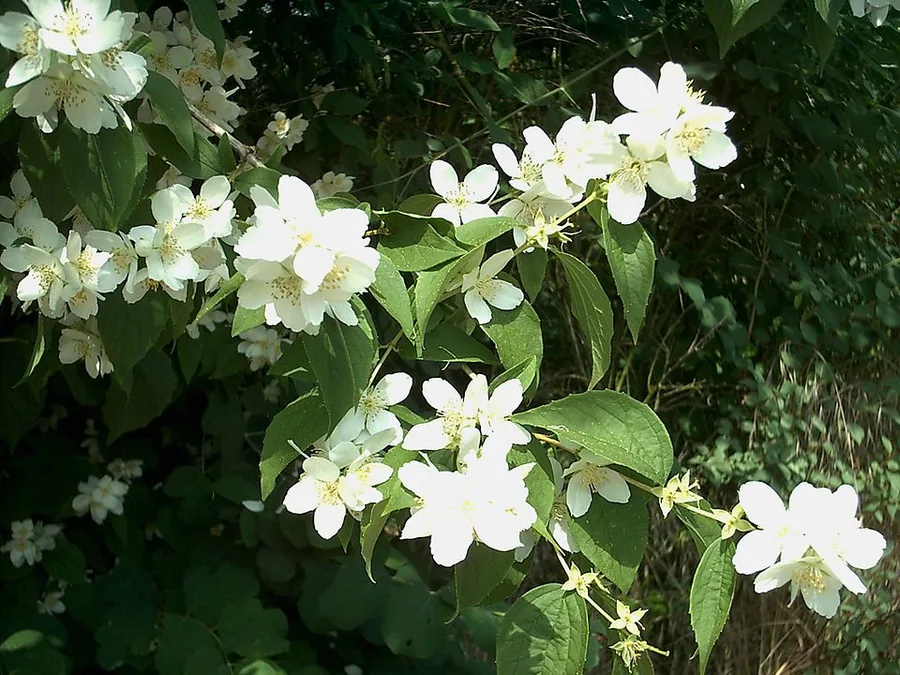
The defining trait of mock orange is its scent: the white, four-petaled flowers open in late spring and release a strong orange-blossom fragrance detectable at a distance. Botanically it is a deciduous shrub in the hydrangea family, native to southeastern Europe and Asia Minor, developing a large, multi-stemmed, arching form.
Its adaptability accounts for the reputation as an easy shrub. Cold hardiness reaches zone 4, and once the root system establishes, the plant tolerates drought and wind and accepts sandy, loam, or clay soils across a broad pH span, including alkaline ground. The single real requirement is light, because shade both reduces flowering and raises mildew pressure by keeping foliage damp.
The limiting factor over time is habit. Without intervention the shrub grows leggy and twiggy, concentrating bloom at the tops of long bare canes as older wood ages out. Annual removal of the oldest stems restores flowering wood lower on the plant, and that renewal is essentially the whole of its maintenance.
Care
The short version: full sun drives the heaviest bloom, moist well-drained soil supports establishment, and a single prune right after flowering preserves the old wood that carries next season's buds while renewing an aging shrub.
Light
Site it in full sun, because flower bud formation and fragrance intensity both scale with light. Partial shade is tolerated and the plant still grows, but the trade is vegetative growth over bloom, and the shaded, crowded interior stays damp enough to favor powdery mildew.
Water
Provide moist, well-drained conditions during establishment so the root system can expand, after which the plant becomes drought and wind tolerant and needs little supplemental water. Every 7 to 14 days suffices in dry spells. Waterlogged, poorly drained soil is the real hazard, since saturated roots invite rot.
Soil
The species is soil-indifferent, growing in sand, loam, or clay provided drainage is adequate. It performs across a pH of 4.0 to 7.0 and, unusually, tolerates the alkaline range, a trait that broadens its use where many shrubs decline.
Temperature
Cold hardiness spans roughly -29°F to 100°F (-34°C to 38°C), which is why it overwinters reliably in zone 4. The same broad tolerance lets it withstand summer heat without heat-related decline.
Humidity
Ambient outdoor humidity is immaterial to this shrub, so no target applies. Air movement is the operative factor, because still air around dense, twiggy growth keeps leaf surfaces wet long enough for powdery mildew to establish.
Feeding
Given its vigor, the plant has low nutrient demand. A balanced fertilizer or a light spring application of compost is sufficient, and excess nitrogen is counterproductive because it forces soft growth that aphids preferentially colonize.
Pruning
Prune only after bloom, because flowers form on old wood and a fall or winter cut removes the buds set for the coming spring. Cut immediately after flowering ends in early summer, and on aging, leggy specimens remove about a third of the oldest stems to the ground annually to force renewal from the base.
Repotting
As a landscape shrub rather than a container subject, repotting is not a normal operation. When relocation is unavoidable, lift and transplant young suckers in early spring or fall, timing the move to dormancy or the earliest growth to minimize transplant stress.
Size & spacing
Allow for mature dimensions of 10 to 12 feet (3 to 3.7 m) in height and 8 to 10 feet (2.4 to 3 m) in spread. Placing it with that arching mass in mind prevents later crowding against structures or paths and the mildew risk that follows restricted airflow.
When to plant
Establishment favors spring or fall planting, when cool, damp soil lets roots knit before heat or hard cold arrives. The fragrant white flowers open in late spring to early summer, roughly May into June, from buds set the previous season, which is why the display is short but dependable.
Northern hemisphere
Southern hemisphere
Typical months for a temperate climate: start earlier in warm zones, later where spring frosts linger.
- Plant: Spring or fall
- Harvest: White fragrant flowers in late spring to early summer (May to June)
Hardiness
USDA hardiness zones: 4–8
Temperature: down to -34°C
Troubleshooting
Mock orange presents few serious problems, and most that appear are cosmetic fungal or insect issues tied to shade and stagnant air. The consequential failure is poor flowering, which traces almost entirely to mistimed pruning that removes bud-bearing old wood. Identify the symptom below and correct the underlying condition rather than the surface sign.
Sparse bloom concentrated atop long, bare canes
The cause is nearly always the pruning window, because the shrub flowers on old wood and cutting in fall or winter excises the buds destined for spring. Excess shade and long-neglected, unrenewed growth compound the effect. Confine all pruning to the period just after flowering, remove a third of the oldest canes annually, and increase light exposure to restore bloom.
Fix:
- Prune only immediately after flowering, not in fall or winter
- Renewal prune by removing about one third of the oldest canes to the ground
- Move or site in fuller sun for best bloom
A white powdery film on the upper leaf surfaces
The film is powdery mildew, a fungus favored by shade, crowding, and the poor air circulation that keeps leaves damp. Opening the canopy with selective cuts and removing the worst foliage lowers the inoculum and dries the interior. Relocating to full sun, where leaves dry quickly, addresses the underlying condition rather than the symptom.
Fix:
- Prune to open up the canopy and improve air circulation
- Remove and dispose of badly affected foliage
- Site in full sun where foliage dries quickly
Discrete dark spots and blotches on the foliage
These are fungal leaf spots, seldom serious on this shrub because the plant's vigor outpaces the damage. The spores overwinter in fallen leaves, so raking and removing litter breaks the cycle, while thinning stems for airflow and keeping foliage dry limit reinfection. In most seasons the disorder remains purely cosmetic.
Fix:
- Rake and remove fallen, infected leaves
- Thin stems to improve airflow
- Avoid wetting foliage when watering
Distorted young shoots colonized by small insects
The clustered insects are typically aphids, whose feeding on tender tips distorts growth and deposits honeydew. A forceful water spray dislodges them mechanically, and insecticidal soap is warranted only when populations are heavy. Pale serpentine mines within the leaf tissue indicate leaf miners instead, which are managed by removing and destroying the affected leaves.
Fix:
- Dislodge aphids with a strong spray of water
- Use insecticidal soap if populations are heavy
- Remove and destroy mined leaves
Toxicity
The toxicology here is straightforward: Philadelphus mock orange is non-toxic, absent from toxic-plant references and documented as safe for pets. No compound in the leaves, stems, or flowers poisons a cat, dog, horse, rabbit, bird, or person. Any reaction is limited to mild gastrointestinal upset from mechanical irritation, as with ingesting any fibrous plant material.
Safe for
People · Cats · Dogs · Horses · Rabbits · Livestock · Birds
Cats None
Cats are unaffected by mock orange, which contains no compounds toxic to them. Ingestion of leaf or flower produces at most transient drooling or mild gastric upset from the plant fiber itself.
Dogs None
Dogs incur no toxic risk from this shrub, as neither foliage nor flowers hold harmful constituents. A consumed mouthful causes nothing beyond occasional mild gastrointestinal irritation.
Horses Safe
Horses can graze in proximity without hazard, since the plant carries no equine toxins. That safety makes it suitable along a paddock edge or pasture border.
Rabbits Safe
Rabbits are not endangered by mock orange, the leaves and stems being non-toxic. A rabbit sampling a low branch experiences no adverse effect.
Livestock Safe
Ruminant livestock, including cattle, goats, and sheep, can browse the shrub safely because it holds nothing that troubles their digestion. It presents no threat on grazed ground.
Birds Safe
Birds are entirely safe around mock orange and frequently shelter in its dense, twiggy structure. No component of the foliage or flowers is harmful to them.
People Safe
People, children included, face no toxicity from mock orange. It is not cultivated as food, but incidental tasting of leaf or petal produces no meaningful effect.
No special handling required; as with any plant, discourage pets and children from chewing foliage to avoid mild stomach upset.
Varieties
Commerce mostly offers the straight species, but several named selections are propagated for foliage color or for reliable bloom in colder zones.
'Aureus'
'Aureus' flushes bright golden-yellow on new growth, a pigment that fades toward green as summer heat accumulates.
'Variegatus'
'Variegatus' carries a clean, creamy-white margin on each green leaf, which reads well in the low light of a shaded position.
'Nanus'
'Nanus' is a compact dwarf selection that remains far below the towering stature of the species.
'Minnesota Snowflake'
'Minnesota Snowflake' is bred for cold hardiness and produces a heavy load of strongly fragrant double white flowers.
How to propagate
Mock orange propagates readily by three vegetative methods, each exploiting the shrub's easy rooting and suckering habit, with the choice governed by season and effort.
Stem cuttingsEasy
Softwood cuttings in late spring to early summer; hardwood cuttings from dormant stems in late fall to winter · 4 to 8 weeks for softwood cuttings to root
Cuttings are the most straightforward method because the wood roots readily. Softwood cuttings are taken in late spring to early summer and hardwood cuttings from dormant stems in late fall to winter, with softwood material rooting in 4 to 8 weeks.
DivisionEasy
Early spring or fall · One growing season
The shrub's suckering habit makes division simple, since it produces rooted suckers at the base that can be severed and lifted in early spring or fall. Each division reestablishes over a single growing season.
LayeringEasy
Spring to summer · One growing season or more
Layering exploits the plant's tendency to root along contact points and demands little labor. A low branch pinned to the soil from spring through summer forms roots where it meets the ground over a season or more.
Myths
Every shrub sold as mock orange is the same species.
The common name attaches to several unrelated plants, which is the source of the confusion. The true mock orange, Philadelphus coronarius, is a deciduous hydrangea-family shrub with four-petaled white flowers, whereas Pittosporum tobira is an evergreen bearing clustered five-petaled blooms and Murraya paniculata is a tropical evergreen that produces red fruit. They occupy entirely different genera and converge only in their orange-blossom fragrance.